
What It Really Takes to Grow Business Online in 2026
Growing your business online means building a system that consistently attracts the right customers, converts them efficiently, and keeps them coming back — not just getting more traffic.
Here's how successful businesses do it:
- Define your ideal customer — Know exactly who you're targeting before spending a dollar on marketing
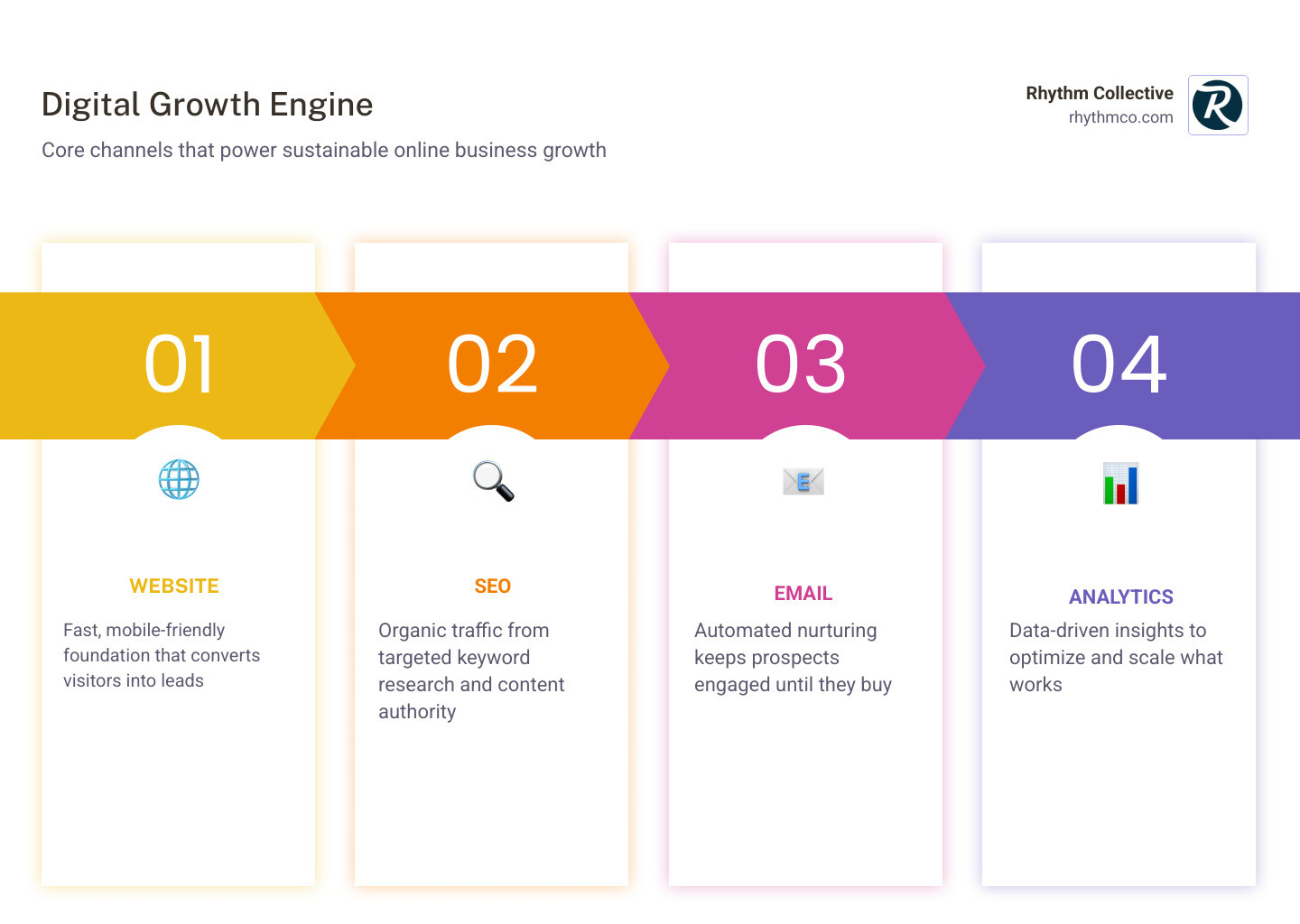
- Build a high-converting website — Fast, mobile-friendly, and designed to turn visitors into leads
- Drive targeted traffic — Through SEO, paid ads, and local search visibility
- Nurture leads with email and automation — Stay top of mind until prospects are ready to buy
- Track what matters — Use data to cut waste and double down on what works
- Adapt continuously — The digital landscape shifts fast; your strategy should too
The opportunity is real. The UK ecommerce market alone is projected to grow nearly 23% between 2026 and 2030, and 98% of consumers now use search engines to find local businesses. But more opportunity also means more competition — and businesses that grow online aren't just doing more marketing. They're doing smarter marketing.
The difference between businesses that scale and those that stall usually isn't budget. It's strategy.
I'm Trevor Jones, founder of Rhythm Collective and a marketing professional with over 13 years of experience helping service-based businesses grow business online — driving more than $140 million in tracked revenue across companies of all sizes. In the sections below, I'll walk you through exactly how to build a digital growth engine that delivers real, measurable results.
Basic grow business online vocab:
Laying the Foundation to Grow Business Online
Before we buy a single ad or write a line of code, we have to talk about your foundation. Many businesses in East Tennessee jump straight into tactics—posting on TikTok or running Facebook ads—without a plan. This is a recipe for a "leaky bucket" where you spend money to get people to a destination that doesn't resonate with them.
The most critical first step is developing a buyer persona. You need to know exactly who your ideal customer is. Are they a homeowner in Oak Ridge looking for emergency plumbing? A business owner in Maryville needing commercial insurance?
A buyer persona should answer:
- What is their age, income, and geographic region?
- What are their primary "pain points" (the problems they need you to solve)?
- Where do they "hang out" online (LinkedIn, Instagram, or Google Search)?
- What does a "win" look like for them?
By conducting deep market research, we can craft a digital marketing strategy that speaks directly to these people. We also recommend setting SMART goals (Specific, Measurable, Achievable, Relevant, and Time-bound). Instead of saying "I want more sales," try "I want to generate 20 qualified leads per month from the Sevierville area with a customer acquisition cost under $100."
Finally, define your unique value proposition. Why should someone choose you over a competitor in Knoxville? If you can't answer that in five seconds, your website visitors won't be able to either.
Building a High-Converting Website to Grow Business Online
Your website is your 24/7 salesperson. If it’s slow, confusing, or looks like it was built in 2005, it’s actively costing you money. Google uses mobile-first indexing, meaning it primarily looks at the mobile version of your site to determine your ranking.
Since over 60% of all web traffic now comes from mobile devices, your site must be flawless on a smartphone. But it’s not just about looking pretty. Speed is a requirement, not a feature. Research shows that every second of delay reduces conversions by 7%, and if a page takes longer than three seconds to load, over half of your visitors will bounce.
At Rhythm Collective, we provide expert website design services that focus on the user experience (UX). A high-converting site needs:
- Trust Signals: 95% of users read online reviews before a purchase. Include testimonials, case studies, and professional certifications.
- Clear CTAs (Calls to Action): Use buttons like "Get a Free Quote" or "Schedule Your Consultation" in contrasting colors.
- Simple Navigation: Users should be able to find what they need in three clicks or less.
- Visual Impact: High-quality graphic design and video help communicate your brand values instantly.
Driving Traffic Through Visibility Engines
Once your "digital storefront" is ready, you need to get people through the door. We call these "visibility engines." You have two primary options: Organic (SEO) and Paid (PPC).
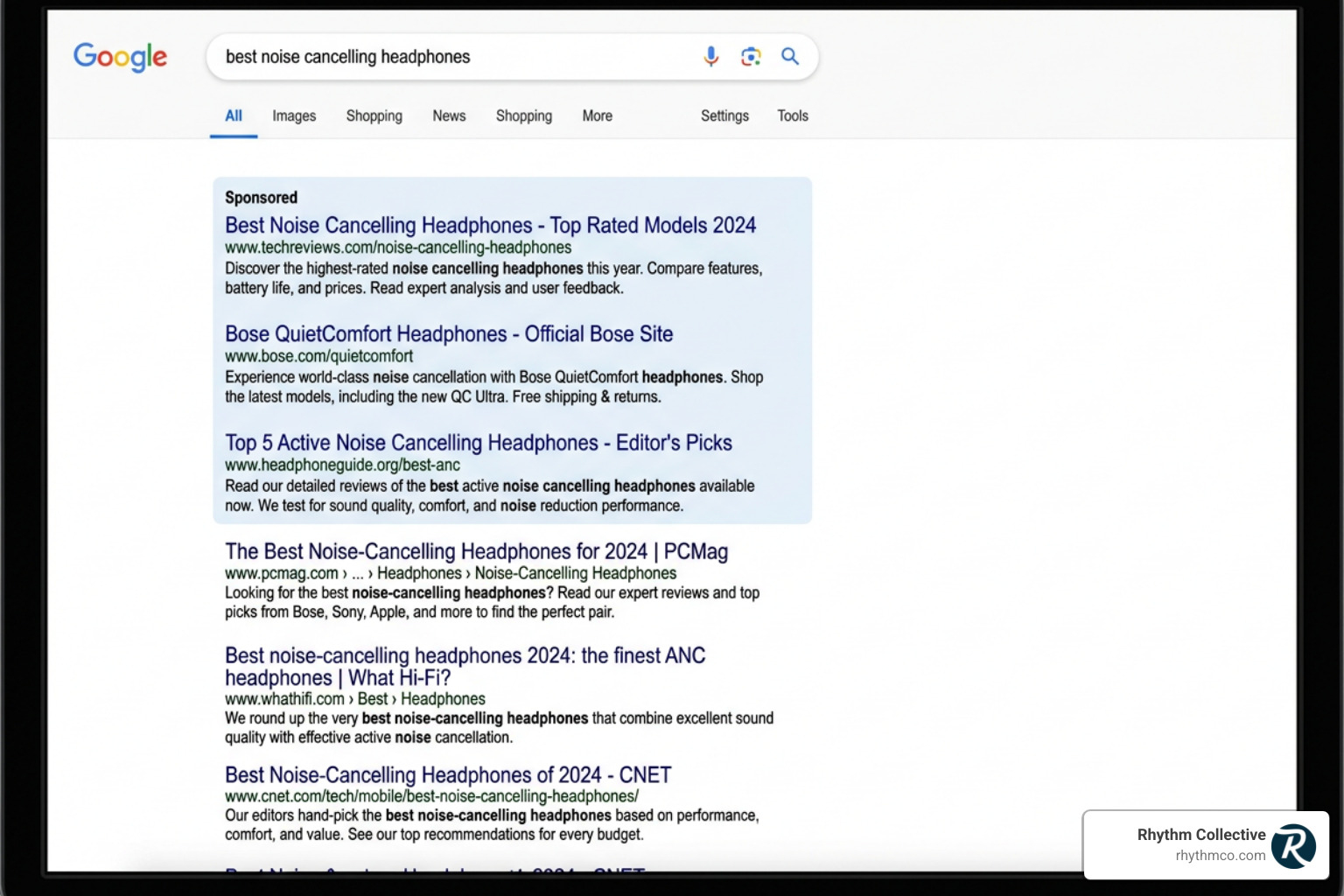
| Feature | Search Engine Optimization (SEO) | Pay-Per-Click (PPC) |
|---|---|---|
| Speed | Slow (4-12 months for results) | Immediate (Go live today) |
| Cost | "Free" (Requires time/effort) | Paid (You pay per click) |
| Longevity | High (Compounding returns) | Low (Traffic stops when you stop paying) |
| Trust | High (Organic results are trusted more) | Moderate (75% say ads help find info) |
For businesses in places like Lenoir City or Johnson City, local search visibility services are non-negotiable. Statistics show that 98% of Americans use internet search to find information about local businesses. This starts with your Google Business Profile. Ensure your address, phone number, and hours are 100% accurate, and actively encourage satisfied customers to leave reviews.
Implementing SEO to Grow Business Online
SEO is about playing the long game. It’s the process of making your site the most authoritative answer to a user’s question. This involves deep keyword research to find what people are actually typing into Google.
We focus on search engine marketing that targets search intent. For example, if someone searches for "best roofing materials," they are in the research phase. If they search for "roofing contractor Knoxville," they are ready to buy. You want to show up for both.
Key pillars of a strong SEO strategy include:
- On-Page SEO: Optimizing your metadata (title tags and meta descriptions) and using keywords in your headers.
- Technical SEO: Running a technical audit to find broken links, duplicate content, or indexability issues.
- Content Authority: Writing helpful blog posts that answer customer questions. This builds trust and shows Google you are an expert.
- Backlinks: Getting other reputable websites to link to yours, which acts as a "vote of confidence" in the eyes of search engines.
- Long-tail Keywords: Targeting specific phrases like "affordable web design in Maryville" rather than just "web design." These are easier to rank for and often convert better.
Nurturing Leads and Scaling with Automation
Driving traffic is only half the battle. What happens to the 97% of people who visit your site but aren't ready to buy right this second? If you don't have a way to stay in touch, you've lost them forever.
This is where social media marketing and email automation come in.
Email marketing remains one of the most powerful tools in our arsenal, delivering an average ROI of $42 for every $1 spent. By offering a "lead magnet"—like a free guide, a discount code, or a webinar—you can capture email addresses and move prospects into a drip campaign. These are automated sequences that educate the customer about your business over several weeks.
We also leverage AI tools to streamline these operations. According to a recent Google and Ipsos study, AI-fluent workers save 50 days of productivity per year. We use AI to help with:
- Drafting Content: Speeding up the creation of emails and social posts.
- Chatbots: Answering basic customer questions on your website 24/7.
- Predictive Analytics: Identifying which leads are most likely to convert.
Don't forget about customer retention. It costs 5 to 7 times more to acquire a new customer than to keep an existing one. Use your automated systems to send "thank you" notes, birthday discounts, or requests for reviews to keep your current clients happy.
Measuring Success and Avoiding Common Pitfalls
If you can't measure it, you can't manage it. One of the biggest mistakes we see when businesses try to grow business online is focusing on "vanity metrics"—things like Facebook likes or total page views that don't actually put money in the bank.
Instead, you should focus on:
- Conversion Rate: What percentage of visitors actually take an action (call, email, purchase)?
- Customer Acquisition Cost (CAC): How much does it cost you in marketing spend to get one new customer?
- Lifetime Value (LTV): How much revenue will a customer bring in over the entire time they work with you? (Ideally, your LTV should be at least 3x your CAC).
We use tools like Google Analytics (GA4) and Google Search Console to track the exact journey a customer takes. This data-driven approach allows us to see which channels are working and which are just wasting your budget.
Our website management services ensure that your tracking is set up correctly from day one. Common pitfalls to avoid include scaling your ad spend before you've proven your website actually converts, or ignoring your mobile users. A 150% increase in growth is possible when you combine the right strategy with accurate data.
Frequently Asked Questions about Online Growth
How long does it take to see results from online growth strategies?
It depends on the "engine" you're using. Paid advertising (PPC) can generate leads within 24 to 48 hours. However, SEO and content marketing are long-term investments that typically take 4 to 12 months to show significant traction. Consistency is the key to sustainable growth.
How can I compete with larger businesses on a small budget?
You don't have to outspend them; you have to out-maneuver them. Large corporations often have generic messaging. As a local business in East Tennessee, you can win by:
- Niche Targeting: Focus on a very specific service or neighborhood.
- Local SEO: Dominating the "near me" searches in your specific city.
- Personalized Service: Using your "Growth Story" and local roots to build a level of trust that a national chain can't match.
What are the most important metrics to track for success?
While every business is different, the "Big Three" are ROI (Return on Investment), Conversion Rate, and Traffic Sources. You need to know where your best customers are coming from so you can double down on those channels.
Conclusion
At Rhythm Collective, we believe that growing your business online shouldn't be a guessing game. Whether you are in Knoxville, Oak Ridge, or anywhere in East Tennessee, the goal remains the same: profitable revenue and long-term growth.
We don't just deliver leads; we build systems that turn those leads into loyal customers. From expert website management to high-impact search engine marketing, we have the tools and the experience to help you scale.
Ready to stop "trying" and start growing? Contact Rhythm Collective today to schedule a consultation. Let's build your digital growth engine together.