
Most service businesses know their photos are holding them back. The website still runs a stock photo of a smiling stranger in a hard hat. The Google Business Profile has six blurry phone shots from 2021. The ads use the same three images every month.
The problem is that nobody explains what a commercial photographer in Knoxville actually costs, what you get for the money, or what to shoot once you book one. This guide covers the pricing models, real ranges, a shot list built for service businesses, and how to run the shoot day so you leave with images you will use for years.
The short answer: Commercial photographers usually charge by the hour, half day, full day or image. National cost guides put hourly rates at $125–$500 and full days at $1,000–$3,500, with headshots around $100–$350 per person. For most local service businesses, one well-planned half or full day covers the website, Google Business Profile and ads for a year.
How Commercial Photographers Price Their Work
Commercial photography is not priced like a family portrait session. You are paying for time on set, editing, and the right to use the images in your marketing. Those three things can be bundled or billed separately.
The table below shows the common models. The ranges come from Fash’s 2026 commercial photography cost guide, which pulls national pricing data. Local quotes vary by photographer, so treat these as a starting point and compare two or three Knoxville bids on the same scope.
| Pricing model | Typical 2026 range | Best for |
|---|---|---|
| Hourly | $125–$500 per hour | Short jobs: a few headshots, one location |
| Half day (about 4 hours) | $500–$2,000 | Team photos plus one job site |
| Full day (about 8 hours) | $1,000–$3,500 | Full brand library: team, trucks, jobs, office |
| Per project | $500–$10,000+ | Defined scope with set deliverables |
| Per image (product) | $25–$250 per image | Products on white or styled scenes |
| Headshots | $100–$350 per person | Team pages, Google profile, LinkedIn |
A few line items often sit on top. The same guide lists travel beyond 25 miles at $200–$1,000+, advanced retouching at $25–$100+ per image, and drone sessions at $250–$500. Deposits of 25–50% are standard.
Marketplace apps advertise much lower entry prices. Snappr’s Knoxville commercial page starts bookings at $89. That can work for a quick product shot. It rarely includes planning, art direction or a shot list built around your marketing.
Experience Changes the Rate More Than Gear
ProShoot’s 2026 corporate photography guide puts budget photographers around $150 an hour and established professionals at $250–$400+. It also notes that editing takes about two to three hours for every hour on set. That editing time is a big part of what you are paying for.
What Usage Rights and Licensing Mean for You
This is the part most owners skip, and it causes problems later. In commercial work, the photographer usually owns the copyright. You pay for a license to use the images.
The U.S. Copyright Office explains in Circular 9 on works made for hire that a freelancer’s work only becomes "work made for hire" under narrow conditions. It needs a signed written agreement, and photographs on their own are not one of the eligible categories. In plain terms: unless your contract says otherwise, the photographer keeps ownership.
For big brands, licensing is where the real money is. A PetaPixel guide to commercial pricing says usage fees often exceed the day rate and scale with reach. A national billboard costs far more to license than a local website.
For a local service business, you rarely need that level of licensing. You do need clear answers to four questions before you sign:
- Where can we use the images? Website, Google Business Profile, social, paid ads, print, trucks and billboards should all be named.
- For how long? Ask for unlimited duration. A one-year license is a trap if your website will run for five.
- Is it exclusive? You do not want the same job-site shot showing up on a competitor’s site.
- Can we edit or crop? Ads need square, landscape and vertical crops. Make sure that is allowed.
When we plan shoots for clients, we put these terms in writing up front. It costs nothing extra to ask, and it saves an awkward call when you want the hero image on a billboard two years later.
The Shot List for Service Businesses
A shot list is the difference between 400 pretty photos and 60 you actually use. Build it around where the photos will go, not around what looks nice in the moment.
Google itself gives a useful starting point. Its tips for business-specific photos recommend at least three exterior, three interior, three "at work" and three team photos on a Business Profile. That maps well to what a contractor or home service company needs.
| Shot category | What to capture | Where it gets used |
|---|---|---|
| Team | Group photo, crew in uniform, owner portrait, office staff | About page, Google profile, recruiting ads |
| Headshots | Every customer-facing person, same background and lighting | Team page, estimates, email signatures |
| Trucks and equipment | Branded fleet lined up, single truck at a home, close-up of logo | Homepage hero, Google profile, social |
| Job sites | Crew working, hands on tools, safety gear, finished detail | Service pages, ads, Google "at work" photos |
| Before and after | Same angle, same framing, shot on day one and final day | Service pages, social, Google posts |
| Office or shop | Storefront from the street, reception, showroom, warehouse | Google exterior and interior photos, contact page |
| Customer moments | Handshake at the door, walkthrough with a homeowner (with consent) | Homepage, testimonials, ads |
| Detail shots | Materials, finishes, tools, product close-ups | Blog posts, web backgrounds, print |
Two tips that save reshoots:
- Shoot before-and-after pairs on purpose. Mark the tripod spot with tape. Shoot the "before" on day one and come back to the same mark when the job is done.
- Shoot wide and leave room. Website hero images need empty space for headlines. Ads need room to crop to square and vertical.
How to Prepare for Shoot Day
A good photographer can only shoot what is in front of them. Most of the quality comes from planning. Here is the checklist we use when we onboard a contractor for a shoot:
- Confirm the shot list a week out. Share it with the photographer and your crew lead. Rank shots by priority so the must-haves happen first.
- Pick locations with good light. Morning or late afternoon is easier outdoors. In East Tennessee summers, an early start also keeps crews from melting in the heat.
- Book a real job site. Ask a happy customer if you can photograph their project. Get written permission, especially if the house number or family appears.
- Clean the trucks and the shop. Wash the fleet the day before. Clear clutter, trash and competitor-branded gear from frame.
- Dress the team the same. Fresh branded shirts, hats in the same color, no torn or faded gear. Bring spares.
- Assign one point person. Someone from your team should move people, answer questions and keep the schedule.
- Plan for weather. Pick a backup date for exterior shots and an indoor shot list if it rains.
- Agree on delivery. Confirm the number of edited images, file sizes, turnaround time and the license terms before the camera comes out.
Where Your Photos Get Used and What Each Place Needs
The same photo has to work in several places. Each one has different specs.
| Placement | Key specs and rules | Source |
|---|---|---|
| Google Business Profile | JPG or PNG, 10 KB–5 MB, 720 x 720 px recommended, no heavy filters or AI edits | Google Business Profile Help |
| Google Ads image assets | Square 1:1 required, landscape 1.91:1 recommended; 1200 x 1200 and 1200 x 628 recommended; no text or logo overlays | Google Ads Help |
| Website | Wide hero images with space for text; compressed for fast loading | Your web designer |
| Social and print | Vertical crops for stories and reels; high-resolution files for trucks and signs | Your designer and printer |
Two details matter here. Google’s Business Profile guidance says photos should "represent reality," with no significant alterations or AI. And Google Ads disapproves images with added text, logos or overlays. Clean, real photos are what both platforms want.
Google does not list photos as a direct ranking factor. Its local ranking help page says local results are based mainly on relevance, distance and prominence. But photos help people choose you once they find you, which is the point of the profile. That is why our local SEO and Google Business Profile team treats fresh job-site photos as a regular part of profile upkeep.
Why Real Photos Beat Stock
Stock photos are cheap and fast. They also tell customers nothing about your company.
Nielsen Norman Group’s eyetracking research on photos as web content found that users ignore generic stock images of people and treat them as "filler." They pay close attention to photos that carry real information, such as actual employees. On one team page, users spent about 10% more time on real staff portraits than on the bios, even though the bios took up far more space.
For a service business, that is the whole argument. A homeowner wants to see who will show up at their door. Your real crew, your real trucks and your real finished work answer that question. A model in a spotless hard hat does not.
There is a practical side too. Stock images you license can also appear on your competitors’ sites. Your own job-site photos cannot.
When It Makes Sense to Bring In Help
You do not always need a pro. A recent phone does fine for weekly Google profile updates and quick social posts. Train one crew member to shoot job progress in good light, and do it every week.
Hire a commercial photographer when the photos will carry your brand: your website, your ads, your trucks and your team page. Those images get seen thousands of times. That is also when planning matters most, because a shoot without a shot list tied to your marketing usually produces nice photos you never use.
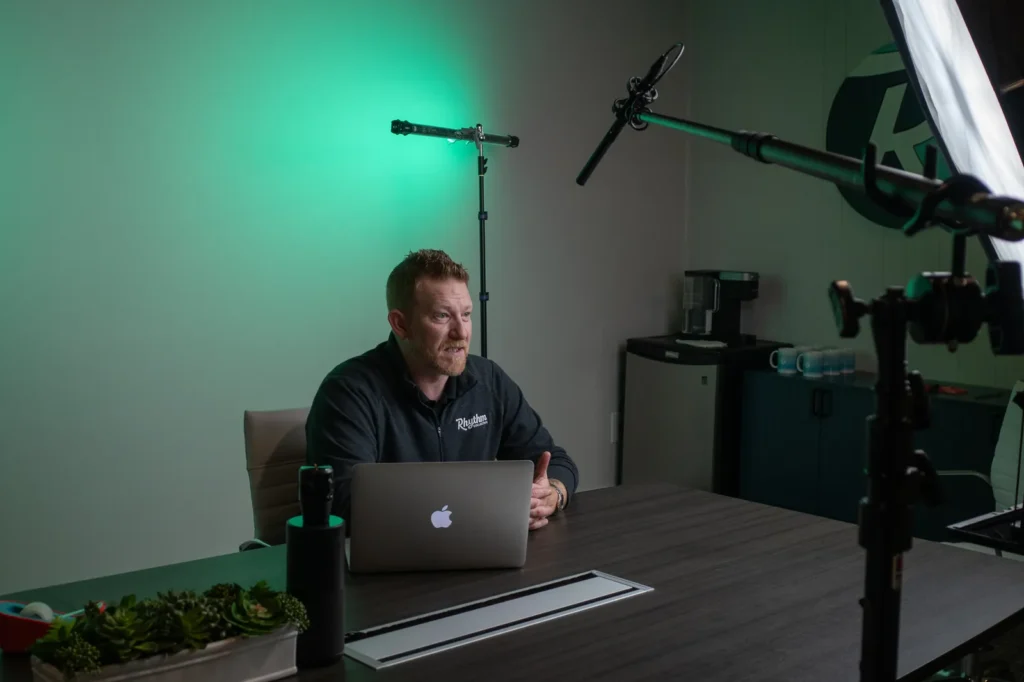
If you want one team to plan the shoot and put the images to work, our Knoxville photography team shoots in our studio or on location across East Tennessee, including drone. It is part of our broader creative services, so the same people who shoot your photos also place them on your website, Google profile and ads. That is how we handled one client’s brand, website, photos and ads under one roof. Book a free consultation or call (865) 564-9499, and we will send a shot list and quote. For a deeper look at studio work, see how having a photography studio makes a difference.
Frequently Asked Questions
How much does a commercial photographer cost in Knoxville?
National 2026 guides put commercial photographers at $125–$500 per hour, $500–$2,000 for a half day and $1,000–$3,500 for a full day. Local quotes vary, so compare bids on the same shot list. Ask what is included: editing, number of images, travel and usage rights.
What is the difference between commercial and portrait photography?
Commercial photography is made to market a business, product or service. Pricing usually includes a license for how the images will be used. Portrait photography is for personal use and is typically priced per session or package.
Do I own the photos after a commercial shoot?
Usually not by default. Under U.S. copyright rules, the photographer keeps ownership unless a signed written agreement transfers it or the work qualifies as work made for hire. Most local businesses get a license, so make sure it covers every channel and has no end date.
How many photos should I get from a business photo shoot?
It depends on the shot list. Build it from your needs: Google recommends at least three photos each for exterior, interior, at work and team. Add website heroes, service-page images and ad crops. A planned half day often delivers enough for a full year of updates.
What should I wear for business headshots?
Wear solid colors in your brand palette and avoid busy patterns or logos from other companies. Keep the whole team consistent, such as all in branded polos. Bring a spare shirt in case of stains.
Can I use stock photos on my Google Business Profile?
Google asks that profile photos reflect reality, without heavy edits or AI. Stock images do not show your actual business, so they help customers very little. Use real photos of your team, trucks, work and location.
Sources
- How much does commercial photography cost? (Fash)
- Corporate Photography Cost Guide 2026 (ProShoot)
- A Beginner’s Guide to Pricing Commercial Photography (PetaPixel)
- Knoxville Commercial Photographers (Snappr)
- Circular 9: Works Made for Hire (U.S. Copyright Office)
- Tips for business-specific photos on your Business Profile (Google Business Profile Help)
- Business Profile photo and video guidelines (Google Business Profile Help)
- Tips to improve your local ranking on Google (Google Business Profile Help)
- About image assets (Google Ads Help)
- Photos as Web Content (Nielsen Norman Group)