Why Your Google Ranking Determines Your Business Growth
Improve Google ranking strategies have never been more critical for business success. If you’re looking to climb higher in search results, here’s what you need to focus on:
Quick Answer: The 5 Core Pillars to Improve Your Google Ranking
- Create High-Quality, E-E-A-T-Focused Content – Demonstrate expertise, experience, authority, and trust in every piece you publish
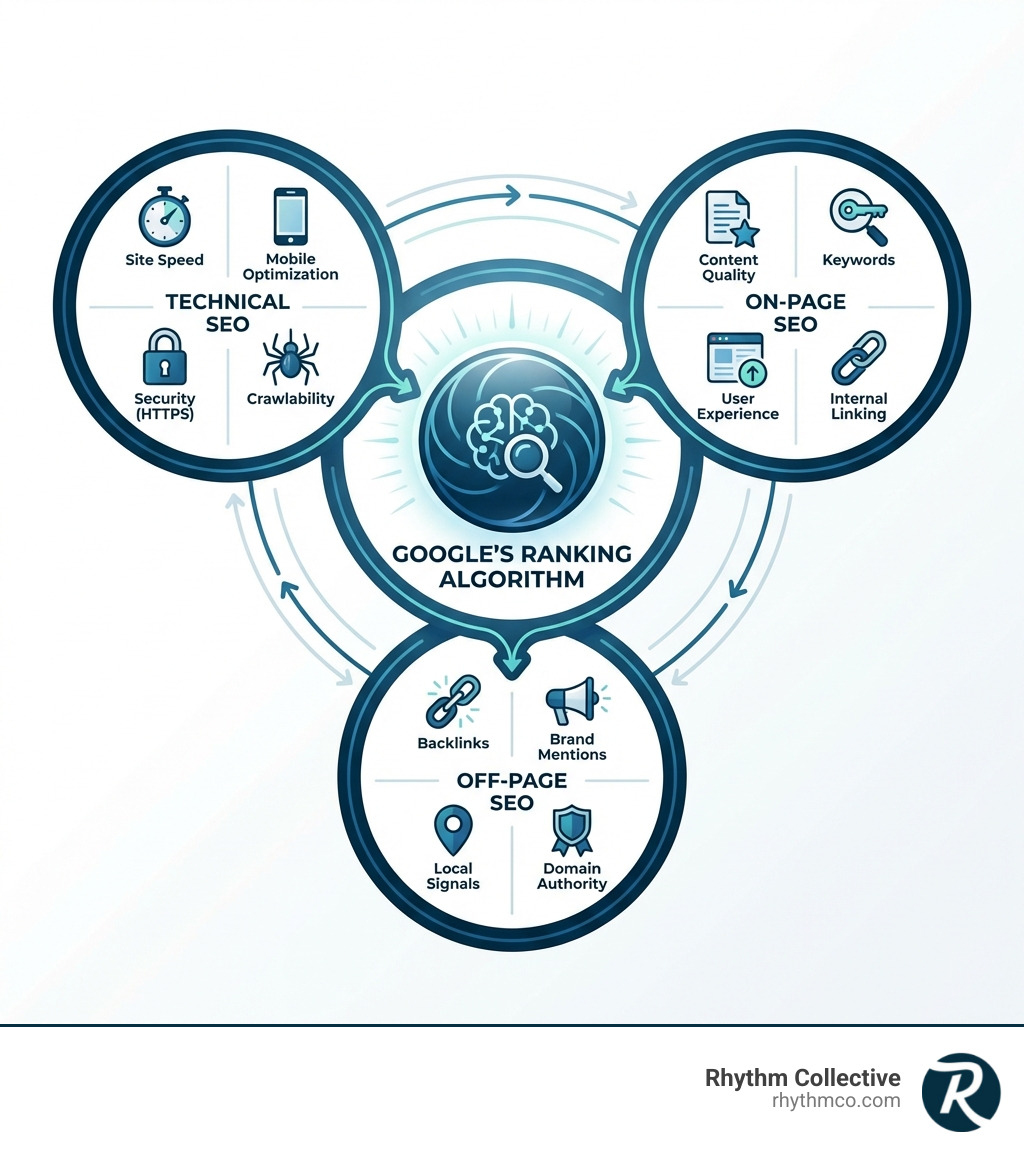
- Master Technical SEO Foundations – Ensure fast page speed, mobile-first design, and secure HTTPS protocols
- Build Authoritative Backlinks – Earn links from reputable sites in your industry to signal credibility
- Optimize for User Experience – Reduce bounce rates and increase dwell time with clear navigation and engaging content
- Target the Right Keywords – Match search intent with strategic keyword placement in titles, headers, and content
The stakes are high: Google drives about 63% of all web referrals, with the top three organic results getting 68.7% of all clicks. If you’re not on page one, you’re invisible. Fortunately, Google’s algorithm isn’t a mystery. It’s built on relevance, authority, and user experience. The goal is to connect users with the best answers. By understanding what Google considers “best,” you can reverse-engineer your way to the top.
In 2025, the game has evolved. Google’s AI now assembles answers, evaluates content at the passage level, and prioritizes sites with real expertise and brand authority. This isn’t about gaming the system; it’s about aligning your website with user needs. Do that consistently, and rankings become a natural outcome.
Mastering the Foundations: Content, Keywords, and User Experience
At the heart of a successful Google ranking strategy lies the ability to create content that genuinely serves your audience. Google’s algorithm prioritizes websites that offer high-quality, relevant content and a seamless user experience. These are the foundational elements we focus on to help your website thrive.
Crafting High-Quality, People-First Content (E-E-A-T)
In the search landscape, content is king. Google’s goal is to provide helpful, original, and reliable information, which it measures using E-E-A-T: Expertise, Experience, Authoritativeness, and Trustworthiness. These signals are crucial, especially for sensitive “Your Money or Your Life” (YMYL) topics.
To improve Google ranking, your content must:
- Demonstrate Experience: Show first-hand knowledge through case studies or practical examples.
- Showcase Expertise: Prove your knowledge with author credentials and accurate, in-depth information.
- Build Authoritativeness: Become a go-to source through consistent, high-quality content and mentions from other reputable sites.
- Instill Trustworthiness: Ensure user safety with HTTPS, clear contact info, and evidence-backed claims.
Google’s Search Quality Guidelines emphasize that content without value is spam. Our approach is to create value for users, not just produce content. We ensure our content leads with answers, is easy to scan, and provides immediate value. You can review Google’s official Google’s Search Quality Rater Guidelines and More on E-E-A-T from Google.
Opening up Search Intent with Strategic Keyword Optimization
High-quality content needs to be findable. This requires strategic keyword optimization and understanding search intent—the user’s goal behind a search query. The main types are:
- Informational: The user wants to learn something (e.g., “how to change a tire”).
- Transactional: The user wants to buy something (e.g., “buy new tires”).
- Navigational: The user is looking for a specific site (e.g., “Monro tires”).
To improve Google ranking, we use tools like Google Keyword Planner, SEMrush, and Ahrefs to find keywords that align with these intents, including valuable long-tail and question-based keywords. We then place them naturally in:
- Title Tags: The headline in search results (50-60 characters).
- Meta Descriptions: The summary under the title (150-160 characters) that entices clicks.
- Header Tags (H1, H2, etc.): To organize content logically.
- URL: Keep it clear, concise, and keyword-rich.
- Image Alt Text: To describe images for accessibility and SEO.
- Body Content: Use keywords and variations naturally, avoiding “keyword stuffing,” which Google penalizes.
Matching content to user queries helps Google understand your page’s relevance, setting the stage for higher rankings.
Enhancing User Experience (UX) and Engagement Signals
Google heavily weighs user experience (UX) because a happy user finds what they need easily. How users interact with your site sends crucial signals about its quality.

Key engagement signals that influence rankings include:
- Dwell Time: How long a user stays on your page. Longer times suggest engaging content. Visuals can increase time on site by up to 47%.
- Bounce Rate: The percentage of users who leave after viewing only one page.
- Click-Through Rate (CTR): The percentage of users who click your search result.
To improve UX and these signals, we focus on:
- Readability: Use short sentences, subheadings, and bullet points.
- Site Navigation: An intuitive structure helps users find information quickly.
- Visuals: High-quality images and videos keep users engaged.
- Fast Loading: Ensure content loads quickly to prevent users from leaving.
Google rewards websites that people enjoy with better rankings. This is why we prioritize user-centric design. Learn more about how we build powerful business tools from websites that captivate your audience and satisfy Google’s algorithms at More on how we build powerful business tools from websites.
Building a Rock-Solid Technical SEO Framework
Even the most brilliant content won’t get seen if Google’s crawlers can’t access or understand your website. Technical SEO is the backbone of your online presence, ensuring your site is healthy, fast, and secure. This foundation is non-negotiable if you want to improve Google ranking effectively.
Prioritizing Site Speed and Mobile-First Indexing
Speed is critical. More than half of visitors will leave a page if it takes longer than three seconds to load. As load time goes from one to three seconds, the bounce probability increases by 32%. Google’s Core Web Vitals measure this user experience:
- Largest Contentful Paint (LCP): Main content load speed (aim for < 2.5s).
- First Input Delay (FID): Site interactivity speed (aim for < 4s).
- Cumulative Layout Shift (CLS): Visual stability during loading (aim for < 0.1).
We optimize speed by compressing images, minimizing scripts, and enabling caching. You can test your site with Google PageSpeed Insights.
Equally important is mobile-friendliness. Since 2019, Google has used mobile-first indexing, prioritizing the mobile version of your site for ranking. With over 60% of web traffic coming from mobile devices, this is non-negotiable. We ensure your site is responsive, adjusting to any screen size, and test it with Google’s mobile-friendly tool. Learn more about how we can transform your site’s foundation at Boost Your Online Presence with Expert Website Design.
Optimizing Website Structure and Security (HTTPS)
A well-organized website guides search engine crawlers, improving crawlability and making it easier for Google to rank your content. We ensure a clear site hierarchy, use descriptive URLs, and submit a sitemap to Google Search Console to help crawlers steer your site efficiently.
Beyond structure, security is paramount. Google confirmed HTTPS as a ranking signal in 2014, and 75% of first-page results now have an SSL certificate. HTTPS encrypts data between your site and visitors, building user trust and sending a positive signal to Google. Moving from HTTP to HTTPS is a fundamental step to improve Google ranking. For more information on securing your site, check out What is an SSL certificate?. You can find more guidance in Google’s official Search Engine Optimization (SEO) Starter Guide and explore our solutions at More on our Web Design services.
How to Improve Google Ranking with Authority and Local Signals
Google’s ranking is like a popularity contest with specific rules. The more trusted “votes” your website gets (backlinks), and the more relevant you are to local searches, the higher your chances of winning. Building authority and leveraging local signals are crucial for businesses, especially those in the Knoxville, TN, and East Tennessee areas.
The Power of Backlinks and Building Website Authority
Backlinks—incoming links from other websites—are a top SEO ranking factor. Google sees them as a “vote of confidence.” The more high-quality, relevant backlinks you have, the more authoritative your site appears. However, quality trumps quantity. A link from a relevant industry authority is far more valuable than one from a spammy site.
Our link-building strategies focus on:
- Quality and Relevance: Prioritizing links from reputable, topically related sites.
- Natural Anchor Text: Using descriptive, varied clickable text.
- Valuable Content: Creating content that others want to link to, including guest blogging and broken link building.
Building a strong backlink profile takes time but is essential to improve Google ranking and establish authority. You can check your site’s authority with tools like Check your domain authority and evaluate your backlink profile using a SE Ranking backlink checker.
Dominating Local Search with Google Business Profile
For businesses in Knoxville, TN, and East Tennessee, local SEO is paramount. When customers search for nearby businesses, Google provides local results based on:
- Relevance: How well your profile matches the search.
- Distance: How far you are from the searcher.
- Prominence: How well-known your business is, based on links, articles, and reviews.
Your Google Business Profile (GBP) is the most powerful tool for local SEO. To dominate local search and improve Google ranking, we optimize your GBP by:
- Ensuring Complete and Accurate Info: Keeping your name, address, phone number (NAP), and hours updated.
- Verifying Your Business: A crucial step to appear on Google.
- Managing Customer Reviews: Encouraging and responding to reviews boosts prominence and trust.
- Adding Photos and Videos: To make your profile more engaging.
- Using Google Posts: To share updates, offers, and events.
Google doesn’t accept payment for better local rankings; it’s all about providing the best information. By optimizing your Manage your business on Google profile and following Tips to improve your local ranking, we help local businesses stand out. See how our Local Search Visibility services can put you on the map.
Advanced Strategies for the AI-Driven Search Era
The digital landscape is constantly shifting. To truly improve Google ranking in 2025 and beyond, we must look beyond traditional SEO and adopt advanced strategies that cater to AI-driven search engines.
How to Improve Google Ranking with Topic Clusters and Internal Linking
As Google’s AI gets smarter, it understands topics, not just keywords. This makes topic clusters and internal linking invaluable. A topic cluster is a group of interlinked pages built around a single subject. The model includes:
- Pillar Pages: A broad overview of a topic (e.g., “Digital Marketing Guide”).
- Spoke Content: Detailed articles on specific subtopics (e.g., “SEO for Small Businesses”).
- Internal Linking: All spoke content links back to the pillar, and the pillar links out to the spokes.
This hub-and-spoke model establishes topical authority, distributes link equity, improves user experience, and improves crawlability. By covering topics in-depth, we can significantly improve Google ranking for a wide range of related keywords.
Optimizing for Entities, Video, and AI Search
The future of search is AI-driven. Google’s algorithm now values how well content covers entities—real-world objects or concepts like “Knoxville” or “SEO.” AI systems like Google’s AI Overviews use these entities to assemble comprehensive answers. To optimize for this, we ensure content is well-structured and thoroughly covers all facets of a topic.
Video is also a powerful tool, as Google often ranks pages with engaging embedded videos higher. To optimize videos, we recommend:
- Descriptive Titles & Descriptions: Use relevant keywords.
- Transcripts/Captions: Provide text versions for accessibility and SEO.
- Schema Markup: Use video schema to help Google understand the content.
AI search assembles answers from passages across the web, not just whole pages. This makes clarity, structure, and entity coverage more critical than ever. Learn more about how Google’s AI ranks results at How Google ranks results. If using AI-generated text, remember to humanize AI-generated text for engagement. Our Search Engine Marketing services are designed to steer these advanced dynamics.
How to Improve Google Ranking by Refreshing, Testing, and Integrating AI
SEO is a marathon, not a sprint. To continually improve Google ranking, we focus on ongoing content refreshing, A/B testing, and smart AI integration.
Refreshing Old Content: Content decays over time. Refreshing old posts with updated stats, new insights, and improved readability is vital, as Google values fresh, accurate information. We often target pages with high impressions but low clicks for a refresh.
A/B Testing: By testing variations of page elements like titles, headlines, or CTAs, we can identify what resonates with your audience and drives better engagement signals (CTR, dwell time), leading to significant ranking gains.
Integrating AI Tools: AI empowers SEO professionals by assisting with content ideation, keyword research, and data analysis. While AI can automate tasks, human oversight is crucial for strategy, interpretation, and creating content that demonstrates genuine E-E-A-T. The best SEO plans use both AI and human skills.
Here’s a quick comparison:
| Feature | AI Content Generation | Human Editing & Strategy |
|---|---|---|
| Speed | Very fast, can produce large volumes quickly | Slower, requires thought and creativity |
| Originality | Can be formulaic, risks plagiarism/redundancy | High potential for unique insights and perspectives |
| Accuracy | Prone to “hallucinations” or outdated information | Relies on research, critical thinking, and fact-checking |
| E-E-A-T | Lacks genuine experience, expertise, authority, trust | Can demonstrate genuine E-E-A-T through unique voice/data |
| Strategic Thinking | Follows patterns, struggles with nuanced strategy | Essential for understanding intent, market, and business goals |
Tracking Success and Avoiding Pitfalls
To truly improve Google ranking and ensure your efforts are paying off, it’s essential to track your performance. Equally important is understanding what not to do, especially the risks of black hat SEO.
Measuring SEO Performance and ROI
Tracking SEO performance and ROI is crucial for understanding what’s working. We use powerful tools to monitor key metrics:
- Google Search Console (GSC): This free tool tracks your site’s presence in Google Search, monitoring impressions, clicks, CTR, keyword rankings, and crawl errors. You can Set up Google Search Console to start.
- Google Analytics 4 (GA4): Provides insights into user behavior, including organic traffic, bounce rate, dwell time, and conversions (like form submissions or purchases).
- Keyword Tracking Tools: (e.g., SEMrush, Ahrefs) help monitor keyword positions.
- Conversion Tracking: We also track call conversions, a key ROI indicator for local businesses in Knoxville, TN.
By analyzing these metrics, we refine our strategies and demonstrate the tangible ROI from your SEO efforts.
The Dangers of Black Hat SEO
While the desire for quick rankings is tempting, black hat SEO—unethical practices that violate Google’s guidelines—is a dangerous game. Common black hat techniques include keyword stuffing, buying links, cloaking (showing different content to users and search engines), and using hidden text.
The risks are severe. Google’s algorithms are designed to detect these tactics. If caught, your site could face manual or algorithmic penalties, or even be de-indexed (completely removed from search results). This can be devastating for a business, leading to a massive loss of traffic, revenue, and trust. At Rhythm Collective, we exclusively practice white hat SEO, focusing on sustainable, ethical strategies that build long-term value. Explore our Advertising & Marketing Solutions for more on our ethical approach.
Frequently Asked Questions about Improving Google Rankings
What are the most important Google ranking factors?
The top factors to improve Google ranking are high-quality, relevant content that satisfies user intent (guided by E-E-A-T), a strong backlink profile from authoritative sites, and a positive user experience, which includes mobile-friendliness and fast page speed. Google’s algorithm is a complex blend of relevance, authority, and user experience, constantly evolving to deliver the best results.
How long does it take to see results from SEO?
SEO is a long-term strategy, not a quick fix. While minor changes can show results in weeks, significant improvements in ranking for competitive keywords often take 4 to 12 months of consistent effort in content creation, technical optimization, and authority building. The timeline can vary based on your industry, competition, and the current health of your website.
What is the difference between traditional SEO and AI-driven search?
Traditional SEO focuses on optimizing for a list of ranked blue links. AI-driven search (like Google’s AI Overviews) assembles answers from multiple sources, prioritizing structured, authoritative content and brand mentions, not just page rank. This makes content clarity, entities, and topical depth more critical than ever. In the AI era, it’s less about just ranking a page and more about ensuring your content is understood and used by AI systems to answer user queries, even if your page isn’t the top “blue link.”
Conclusion
Mastering Google’s algorithm to improve Google ranking isn’t about luck; it’s about a strategic, holistic approach that prioritizes your users and builds genuine authority. From crafting high-quality, E-E-A-T-focused content and optimizing for search intent, to ensuring your website is technically sound and secure, every element plays a crucial role. Building a strong backlink profile and dominating local search with an optimized Google Business Profile are vital for establishing your presence. Furthermore, embracing advanced strategies like topic clusters, optimizing for entities and video, and intelligently integrating AI tools will position you for success in the evolving search landscape. Finally, vigilant performance tracking and a steadfast commitment to ethical white hat SEO are non-negotiable for sustainable growth.
As a Knoxville-based agency, Rhythm Collective has generated over $140 million for clients by implementing these proven strategies, focusing on profitable revenue and long-term growth. We understand the nuances of the market in East Tennessee and are dedicated to helping businesses like yours succeed online.
Ready to boost your Google ranking and drive profitable growth? Contact our digital marketing agency in Knoxville to get started.