Why ROI Focused SEO is the Key to Measurable Growth
ROI focused SEO is the practice of measuring and optimizing your search engine optimization efforts to generate measurable revenue returns, not just traffic or rankings. Here’s what you need to know:
Quick Answer: How to Make SEO ROI-Focused
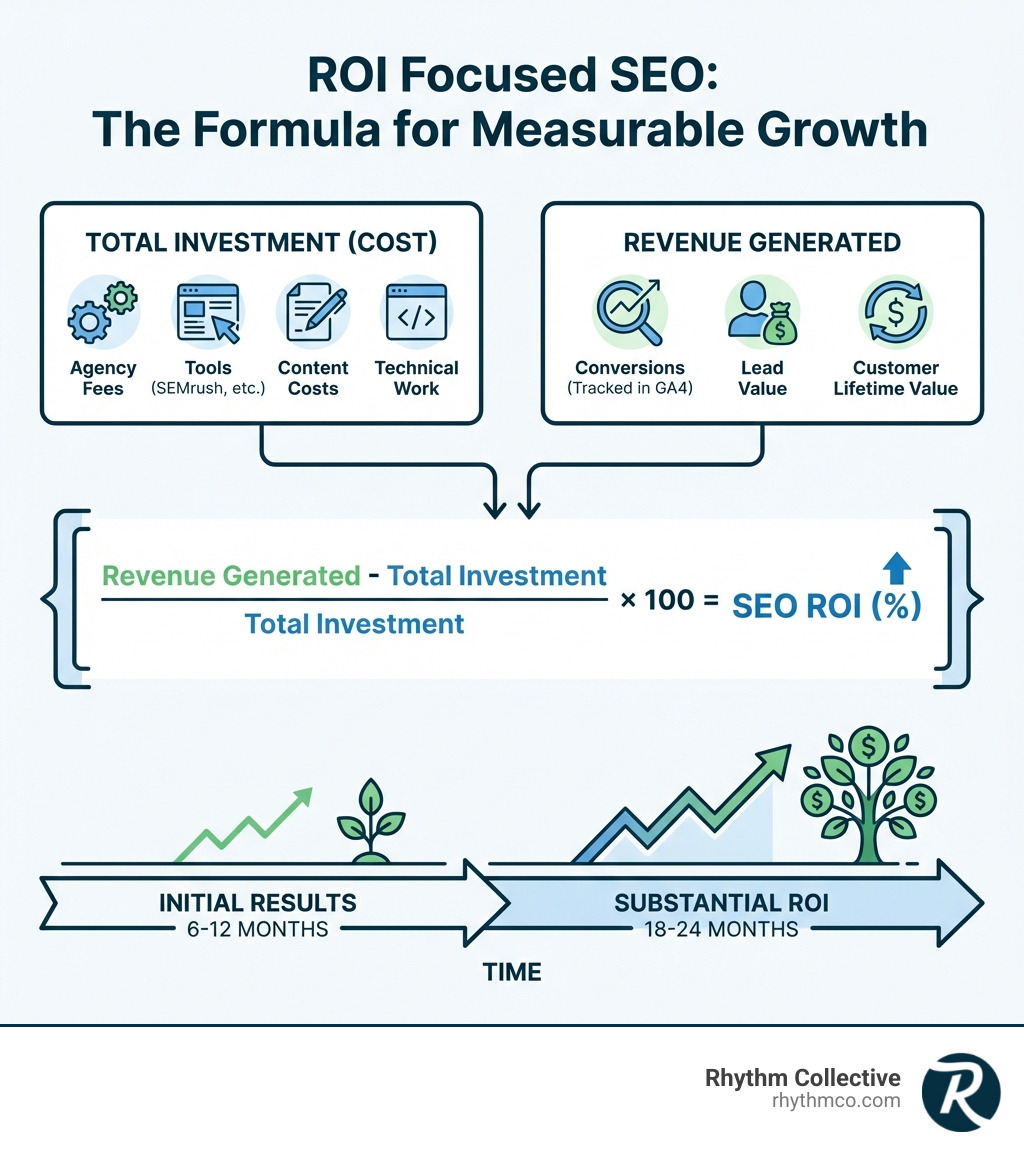
- Calculate Total Investment – Include agency fees, tools, content, technical work, and labor costs
- Track Revenue Generated – Use GA4 to measure conversions, leads, and sales from organic search
- Apply the Formula – ROI = (Revenue from SEO – Cost of SEO) / Cost of SEO × 100
- Measure What Matters – Focus on conversion rates, lead quality, and customer lifetime value
- Think Long-Term – Expect 6-12 months for initial results, with compounding returns over 18-24 months
You’re sitting in a budget meeting, and someone asks the question that makes every marketer’s stomach drop: “What’s the actual return on our SEO investment?”
If you can’t answer that question with real numbers, you’re not alone. 49% of marketers credit organic search for delivering the highest returns compared to other marketing channels, yet many businesses still treat SEO like a mysterious black box where money goes in and… something happens.
Here’s the problem: SEO has often been sold on vanity metrics. More traffic. Higher rankings. Better visibility. These things matter, but they don’t pay the bills.
Organic search generates 40% of business revenue for most companies. That’s not a vanity metric—that’s your bottom line. But unlike paid advertising where you can track every dollar in and out, SEO’s value compounds over time, making it harder to measure but ultimately more profitable.
The difference between SEO that “seems to be working” and SEO that drives measurable profit comes down to one thing: knowing how to calculate, track, and optimize for real return on investment. Not just traffic growth. Not just keyword rankings. Real revenue.
This guide will show you exactly how to measure SEO ROI, what timeline to expect, and how to turn your organic search efforts into a predictable, profitable growth engine for your business.
What is SEO ROI and Why Does It Matter?
At its core, SEO ROI (Return on Investment) calculates the financial return generated from your search engine optimization efforts relative to their cost. Simply put, it’s about proving that the revenue organic search brings in is higher than the money you spend on it. A positive ROI means your SEO is a profit center, not just an expense.
Why does this matter? Because while the benefits of SEO can feel intuitive—who doesn’t want to rank higher on Google?—the business world demands quantifiable results. 75% of users never scroll past Google’s first page, so getting there is vital, but what happens next is what truly drives your business forward.
Measuring ROI focused SEO allows us to:
- Justify Budgets: Convince stakeholders that SEO is a worthy investment, deserving of continued resources.
- Make Informed Decisions: Allocate resources to the SEO tactics that yield the highest returns, optimizing your strategy for maximum profitability.
- Benchmark Performance: Understand how your SEO efforts stack up against competitors and industry standards.
- Drive Bottom-Line Growth: Shift the conversation from traffic numbers to actual revenue and profit generated.
Organic search is consistently a top traffic source for websites across all industries. By measuring its ROI, we ensure that this powerful channel is directly contributing to your business’s financial health and long-term success.
The Core Difference: SEO vs. Other Digital Marketing ROI
When we talk about marketing ROI, many immediately think of channels like PPC (Pay-Per-Click) advertising. With PPC, you pay per click, and when your budget runs out, your visibility disappears. It’s a quick, transactional model.
SEO is fundamentally different. It’s the only digital marketing channel that offers both compounding performance and decreasing marginal cost over time. Think of it like planting a tree rather than buying a bouquet: it takes time to grow, but once established, it provides fruit for years with minimal additional effort.
- Compounding Performance: The longer you invest in SEO, the more your efforts build upon each other. Improved rankings lead to more traffic, which can lead to more backlinks and brand mentions, further boosting authority. This creates a snowball effect where early gains multiply over time.
- Decreasing Marginal Cost: Unlike paid ads where every new click costs the same, once your content ranks organically, it continues to attract traffic without an additional per-click cost. The assets you build—optimized content, strong website authority, quality backlinks—keep delivering long after the initial investment.
- Asset Building vs. Temporary Results: SEO builds enduring digital assets. Your well-ranking web pages and authoritative domain become valuable properties that generate leads and sales continuously. When your PPC budget pauses, your traffic stops. When your ROI focused SEO efforts are robust, your organic content keeps working for you.
- Long-Term Sustainability: This compounding effect means SEO offers unparalleled long-term sustainability. It creates a stable foundation for your online presence, reducing your reliance on constant ad spending.
- Lower Customer Acquisition Costs (CAC): Over time, SEO can drastically reduce your customer acquisition costs. Organic search customers often have a higher lifetime value and convert at a better rate, making the initial investment highly cost-effective in the long run. In fact, organic search can cost 61% less per lead than paid advertising.
The Importance of Tying SEO to Business Goals
It’s easy to get caught up in the technical jargon of SEO—keywords, backlinks, algorithms. But at Rhythm Collective, we believe that ROI focused SEO must always be tied directly to your business’s overarching goals. We’re not just aiming for higher rankings; we’re aiming for higher revenue.
- Moving from Rankings to Revenue: While rankings are a means to an end, the true measure of SEO success lies in its ability to drive conversions and revenue. This means focusing on metrics like leads generated, sales closed, and customer lifetime value (LTV), rather than just how many keywords you rank for.
- Aligning with Sales Objectives: Your SEO strategy should be a partner to your sales team, not a separate entity. By understanding your sales funnel and customer journey, we can optimize content and targeting to attract users who are ready to convert.
- Lead Quality Over Quantity: Especially for B2B businesses in Knoxville, TN, or other parts of East Tennessee, lead quality is far more important than sheer traffic volume. An effective ROI focused SEO strategy prioritizes attracting the right decision-makers—those most likely to become valuable, long-term clients.
- Communicating Value to Stakeholders: When SEO results are framed in terms of business outcomes—increased revenue, reduced CAC, improved profit margins—it becomes much easier to communicate its value to executives and secure their continued buy-in. Proving a positive ROI is key to getting the support needed for sustained growth.
The Anatomy of a True ROI Focused SEO Calculation
Calculating SEO ROI isn’t always as straightforward as other marketing channels, but it’s entirely possible and incredibly valuable. It involves a clear understanding of your investment and a systematic approach to quantifying your returns.

The standard formula for calculating ROI focused SEO is:
SEO ROI = ((Revenue from SEO – Cost of SEO) / Cost of SEO) × 100
This formula yields a percentage, telling you how much profit you generated for every dollar invested. For example, if your SEO generated $50,000 in revenue and cost $10,000, your ROI would be 400%.
A challenge in measuring SEO ROI is attribution. The customer journey is rarely linear, with multiple touchpoints contributing to a conversion. Disconnected tech stacks, where your website analytics don’t “talk” to your CRM, can make this even harder. However, with modern tools and a diligent approach, we can overcome these complexities.
We can also forecast potential SEO ROI by analyzing historical data, traffic potential using keyword research tools, and average conversion rates. This helps set realistic expectations and informs strategic planning.
Step 1: Calculating the ‘Investment’ in SEO
To get an accurate ROI, we need to account for all the costs associated with your SEO efforts. This often goes beyond just an agency fee and includes:
- Agency Retainers or Freelancer Fees: The cost of partnering with an expert Digital Marketing Agency in Knoxville like Rhythm Collective or hiring independent SEO consultants. Companies in our region often invest anywhere from $2,500 to $7,500 per month on SEO.
- In-House Team Salaries: If you have dedicated staff working on SEO, their salaries and benefits are part of the investment.
- SEO Tools: Subscriptions to keyword research tools, rank trackers, site audit tools, and analytics platforms. Enterprise-level SEO toolsets can typically cost $2,000-$10,000 monthly.
- Content Creation Costs: This includes the expenses for writing blog posts, landing page copy, video scripts, and other content assets. Modern SEO demands comprehensive, authoritative content, which can cost 3-5 times more to produce than traditional blog posts.
- Link Building Expenses: The resources spent on acquiring high-quality backlinks, whether through outreach, guest posting, or digital PR.
- Technical Development Resources: Costs associated with implementing technical SEO recommendations, such as improving site speed, mobile-friendliness, Core Web Vitals optimization, structured data implementation, and website architecture improvements. These often require developer time and resources.
By carefully tracking these expenses, we establish the “Cost of SEO” in our ROI formula.
Step 2: Quantifying the ‘Return’ from SEO
Measuring the “Revenue from SEO” is where the rubber meets the road. This involves accurately tracking conversions and assigning monetary value to them.
- Tracking Conversions: The foundation of quantifying return is robust conversion tracking. We use tools like Google Analytics 4 (GA4) to monitor user behavior and identify key actions taken on your website.
- E-commerce Revenue: For online stores, this is relatively straightforward. GA4 can track direct sales revenue generated from organic search traffic. We filter reports to specifically show transactions attributed to “google/organic” sources.
- Lead Value Calculation: For businesses that generate leads (e.g., service providers, B2B companies), we need to assign a monetary value to each lead. This is often based on your average customer lifetime value (LTV) and your lead-to-customer conversion rate. For example, if a customer is worth $5,000 over their lifetime and 10% of your leads become customers, each lead is worth $500.
- Customer Lifetime Value (LTV): This is a critical metric. Studies show that customers acquired through organic search often have a higher LTV compared to other channels. Incorporating LTV into your ROI calculations provides a more accurate picture of SEO’s long-term value.
- Assisted Conversions: GA4 provides advanced attribution models that acknowledge that organic search often plays a role at multiple touchpoints in the customer journey, even if it’s not the final click. This helps us understand the full impact of SEO, including those “assisted conversions.”
For businesses in East Tennessee looking to increase their local presence, tracking conversions from local searches is equally vital. Learn more about our Local Search Visibility services to capture these high-intent local customers.
Key KPIs That Fuel Your ROI Focused SEO
While the ultimate goal is revenue, several key performance indicators (KPIs) serve as leading indicators of success and are crucial for optimizing your ROI focused SEO strategy:
- Organic Traffic Growth: An increase in qualified visitors from search engines indicates that your visibility efforts are working.
- Conversion Rate: The percentage of organic visitors who complete a desired action (e.g., purchase, form submission). This directly impacts your revenue.
- Keyword Rankings for High-Intent Terms: While not an ROI metric itself, ranking for keywords that signal commercial intent (e.g., “Knoxville SEO agency pricing”) brings highly qualified traffic.
- Organic Impressions: How often your website appears in search results. This measures brand awareness and visibility.
- Bounce Rate: The percentage of visitors who leave your site after viewing only one page. A high bounce rate from organic traffic might signal content-user intent misalignment.
- Pages Per Session: The average number of pages a user views during a session. More pages often indicate higher engagement.
- Lead Quality: For lead-gen businesses, tracking the quality of leads generated from organic search (e.g., MQLs, SQLs) is paramount.
- Cost Per Lead (CPL): How much it costs to acquire a lead through organic search. Comparing this to other channels highlights SEO’s efficiency.
Timelines, Benchmarks, and the Future of SEO ROI
One of the most common questions we hear is, “How long until we see results?” The answer, while sometimes frustratingly nuanced, highlights the unique strength of SEO.

How Long Until You See a Positive SEO ROI?
SEO is a long-term strategy. It’s not a sprint; it’s a marathon that pays dividends over time. While paid ads offer immediate clicks, SEO builds a sustainable pipeline.
- Typical Timeframe: Meaningful results typically begin within 4-6 months, sometimes extending to 6-12 months depending on factors like competition and your website’s current authority. Initial benefits, such as improved rankings and traffic, often start to materialize in this window.
- Initial Results vs. Significant ROI: The first few months might show incremental gains. However, the ROI of SEO grows significantly between months 6 and 18, where content velocity and backlink acquisition begin to compound. This is when you start to see substantial growth in organic revenue.
- Compounding Effect: As your website gains authority and your content ranks for more keywords, the returns accelerate. Experts like Google’s Maile Ohye have consistently stated that it takes 4-12 months to see SEO benefits.
- Why Patience is Crucial: Abandoning an SEO strategy too soon is a common mistake. The compounding nature means that consistent investment over 12-24 months often yields transformative results that far outweigh the initial slower period.
What is a ‘Good’ SEO ROI?
What constitutes a “good” SEO ROI isn’t a one-size-fits-all answer. It varies significantly by industry, business model, and the value of your average customer.
- Industry Benchmarks: In the e-commerce sector, a 12-month average SEO ROI can range from 2.8x to 4.2x, depending on the vertical. Specialty retail, for example, often sees higher returns due to niche focus.
- E-commerce vs. B2B:
- E-commerce: Might aim for $3–$10 in revenue per organic session, focusing on high-volume sales.
- B2B: Often prioritizes lead quality and pipeline growth. A single B2B client can be worth thousands, justifying a higher investment for fewer, but more qualified, leads. Mid-market B2B companies often see 300-500% ROI within 24 months.
- High-Value Leads vs. High-Volume Sales: For a service-based business in Knoxville, TN, one high-value client could justify a significant SEO investment, whereas a retail business needs many smaller transactions.
- General Goal: While specific numbers vary, a strong ROI focused SEO campaign generally aims for an ROI of 3:1 or higher (meaning $3 in revenue for every $1 invested), with 5:1 (400% ROI) often seen as an excellent benchmark, and some businesses achieving far greater.
- Best Practices for Measuring: Consistently track all costs and revenue, assign clear monetary values to conversions (especially leads), and re-evaluate your strategy regularly.
The Impact of AI Search on SEO ROI
The landscape of search is rapidly evolving, with the rise of AI-powered search experiences like Google’s AI Overviews and tools like ChatGPT and Perplexity. This shift introduces a new dimension to ROI focused SEO.
- Generative Engine Optimization (GEO): We are entering an era of Generative Engine Optimization (GEO). The new goal isn’t just to rank on Google’s first page, but to be the authoritative source that AI models use to generate answers.
- Optimizing for Natural Language Queries: AI excels at understanding conversational queries. Optimizing your content for natural language questions and comprehensive answers positions you as a valuable resource for AI.
- E-E-A-T Signals: AI models prioritize information from authoritative, experienced, expert, and trustworthy sources (E-E-A-T). Building strong E-E-A-T signals through high-quality content, backlinks, and brand mentions is more crucial than ever.
- Dual-Channel Visibility: The good news is that traditional SEO and AI SEO are converging. If your website ranks well in organic search, it’s more likely to be cited by AI. This means capturing visibility in both Google’s traditional search results and AI tools multiplies your ROI—one strategy fuels two powerful channels.
- Evolving Search Behaviors: As users increasingly interact with AI for information, businesses need to adapt. This means structuring content with clear headings, summaries, bullet points, and expert citations to make it easily digestible for both humans and AI.
Our Search Engine Marketing Services are continually evolving to ensure your business remains at the forefront of these changes, maximizing your visibility across all search platforms.
How to Improve a Low or Negative SEO ROI
Sometimes, despite best intentions, SEO efforts don’t yield the desired returns. A low or negative ROI focused SEO isn’t a sign to abandon ship, but rather a call for strategic optimization.
If your SEO isn’t performing as expected, it’s time to dig in. We can help you turn your SEO from a cost center into the profit center it’s meant to be. Our Website Management Services that Supercharge Your Online Presence are designed to ensure your website is always optimized for performance and conversions.
Auditing and Refining Your Strategy for ROI Focused SEO
A comprehensive audit is the first step to diagnose and fix underperforming SEO.
- Technical SEO Audit: We start by ensuring your website’s foundation is solid. This includes checking for crawlability, indexability, site speed, mobile-friendliness, HTTPS security, and proper structured data implementation. A slow or broken website can undermine all other SEO efforts.
- Content Gap Analysis: Are you creating content that truly meets user intent? We identify gaps in your content strategy, finding opportunities to create authoritative, comprehensive pieces that answer user questions and attract high-intent traffic. This also involves optimizing existing content for better conversions.
- Keyword Targeting Review: Re-evaluate your keyword strategy. Are you targeting keywords with enough commercial intent? Are there long-tail keywords or niche terms that could bring in highly qualified leads with less competition? For businesses in Knoxville, TN, this often involves local keyword research to capture nearby customers.
- Conversion Rate Optimization (CRO): Even if traffic is growing, if it’s not converting, your ROI will suffer. We analyze user journeys, calls-to-action, and landing page designs to optimize for maximum conversions.
- User Experience (UX) Improvements: A positive user experience is paramount for both rankings and conversions. Websites that are easy to steer, fast-loading, and visually appealing keep users engaged, reducing bounce rates and encouraging conversions.
Beyond Direct Revenue: The Hidden Value of SEO
While direct revenue is the primary focus of ROI focused SEO, it’s important not to overlook the significant non-financial benefits that contribute to overall business value. These often act as multipliers, enhancing the impact of your direct revenue gains.
- Improved Brand Visibility: Appearing consistently at the top of search results for relevant queries significantly increases your brand’s exposure and awareness. This passive visibility can lead to direct traffic and brand recognition over time.
- Increased Brand Credibility and Trust: Ranking highly on Google signals authority and trustworthiness to potential customers. When users see your brand consistently appearing for their queries, it builds confidence and positions you as an industry leader.
- Improved User Experience: The technical and content optimizations required for SEO success (fast loading times, mobile-friendliness, clear navigation, valuable content) inherently lead to a better user experience for all visitors, not just those from organic search.
- Valuable Market Insights from Search Data: The data gathered from SEO efforts—what keywords people search for, what questions they ask, what content they engage with—provides invaluable insights into your target audience’s needs, pain points, and preferences. This intelligence can inform product development, marketing campaigns, and business strategy.
- Supporting Other Marketing Channels: SEO can amplify the effectiveness of your other marketing efforts. Optimized landing pages improve PPC campaign performance, strong organic content provides material for social media and email marketing, and overall brand authority makes all your marketing more impactful.
Conclusion: Partnering for Profitable Growth
In today’s competitive digital landscape, a truly ROI focused SEO strategy is no longer a luxury—it’s a necessity. It’s about more than just getting found online; it’s about ensuring that every dollar invested in your search engine optimization efforts contributes directly to your business’s profitability and long-term growth.
We’ve explored how SEO, unlike other marketing channels, offers a compounding return with decreasing marginal costs, building valuable digital assets that continue to perform over time. We’ve demystified the calculation of SEO ROI, breaking down the essential components of investment and return, and highlighted the critical KPIs that drive real business value. From setting realistic timelines to understanding the evolving impact of AI search, we’ve outlined a comprehensive approach to mastering your SEO ROI.
At Rhythm Collective, a Creative Marketing Agency in Knoxville, TN, we specialize in delivering profitable revenue and long-term growth, not just leads. With over $140 million generated for our clients, we understand the intricate dance between strategy, execution, and measurable outcomes. Our approach is data-driven, strategic, and always focused on your bottom line.
Don’t let your SEO efforts remain a mystery. It’s time to demand measurable results and transform your organic search presence into your most powerful growth engine.
Start building a results-driven SEO strategy with our Digital Marketing Agency in Knoxville