
Beyond Vanity Metrics to Real Profitability
Marketing for profit is the strategic approach of planning, measuring, and optimizing marketing efforts based on bottom-line business performance rather than surface-level metrics like clicks or impressions.
Key components of profit-driven marketing:
- Focus on customer economics - Track metrics like Customer Acquisition Cost (CAC) and Lifetime Value (LTV)
- Measure cash flow impact - Monitor Payback Period and contribution margins
- Optimize for efficiency - Maintain an LTV:CAC ratio of 3:1 or better
- Align teams around profit - Connect marketing, finance, and product data
- Test and iterate - Use data to reallocate budget toward profitable channels
You've probably seen it happen. Billions of dollars disappear into marketing each year, and executives wonder if any of it came back as ROI. A campaign shows a 5x ROAS, but the company still loses money because it drove traffic to low-margin products with high return rates.
The truth is simple: traditional metrics like ROAS and CPA tell you about efficiency, not profitability. They measure how well you spend money, not whether you make money.
Economic headwinds have changed the game. With tariff volatility, inflation, and channel saturation compressing margins across retail and ecommerce, brands can't afford to chase top-line growth anymore. Every marketing dollar must contribute to the bottom line.
This shift isn't about cutting budgets. It's about reallocating spend toward what actually drives sustainable growth. When one ecommerce retailer aligned campaign strategy with product-level margins and customer profitability, they achieved a 24% lift in true ROI without spending more.
The companies that win today understand customer economics, protect cash flow, and measure what matters. They know that a good benchmark for LTV:CAC is 3:1 or better, and that a ratio below 1:1 means you're losing money on every customer you acquire.
Marketing isn't an expense. It's an investment that requires consistent execution and accurate measurement to deliver profitable, long-term results.
The Strategic Shift: From Performance Marketing to Profit-Driven Growth
For years, many of us have rallied around familiar performance marketing metrics: Return on Ad Spend (ROAS), Cost Per Acquisition (CPA), and Conversion Rate (CVR). These metrics ushered in an era of fast, measurable, and seemingly efficient marketing. But as the economic landscape evolves, we're realizing that these metrics, while useful for measuring efficiency, often fall short in measuring true profitability. They tell us how well we're spending our marketing dollars, but not necessarily if those dollars are genuinely contributing to the bottom line.
The core issue is that ROAS and CPA are incomplete metrics. A campaign with a stellar 5x ROAS might still be losing money if it's driving traffic to low-margin products with high return rates, or if the acquired customers never make a second purchase. Similarly, a low CPA might seem great on the surface, but if those "cheap" customers never become repeat buyers, their long-term value is questionable. As one expert insight put it, "ROAS is no longer a sufficient answer for justifying marketing spend."
The strategic shift involved in moving from traditional performance marketing to profit-driven marketing is profound. It's about changing our focus from optimizing for volume and efficiency to optimizing for value and sustainability. In today's economic climate, with inflation and channel saturation compressing margins, brands simply "can no longer afford to focus solely on top-line growth or metrics that only tell part of the story." Instead, we must prioritize "value over volume, sustainability over spend, and profit over performance theater."
Profit-driven marketing is a strategic shift to plan, measure, and optimize marketing efforts based on bottom-line business performance. This means asking critical questions like: "Are we really acquiring valuable customers—or just cheap ones?" and "Are our best-performing campaigns actually profitable?" This approach helps us ensure that our media strategy is helping the business grow in a truly sustainable way.
Here's a quick comparison of how we view metrics in both approaches:
| Traditional Metrics | Profit-Driven Metrics |
|---|---|
| ROAS (Return on Ad Spend) | LTV (Customer Lifetime Value) |
| CPA (Cost Per Acquisition) | CAC (Customer Acquisition Cost) |
| CVR (Conversion Rate) | Payback Period |
| Traffic | LTV:CAC Ratio |
| Impressions | Net Revenue Retention (NRR) |
| Clicks | Contribution Margin |
| Net Profit Per Cohort |
This table highlights the fundamental difference: traditional metrics focus on the initial interaction and conversion, while profit-driven metrics dig into the long-term financial health and value generated by those interactions.
The Metrics That Matter: A Guide to Profit-Driven KPIs
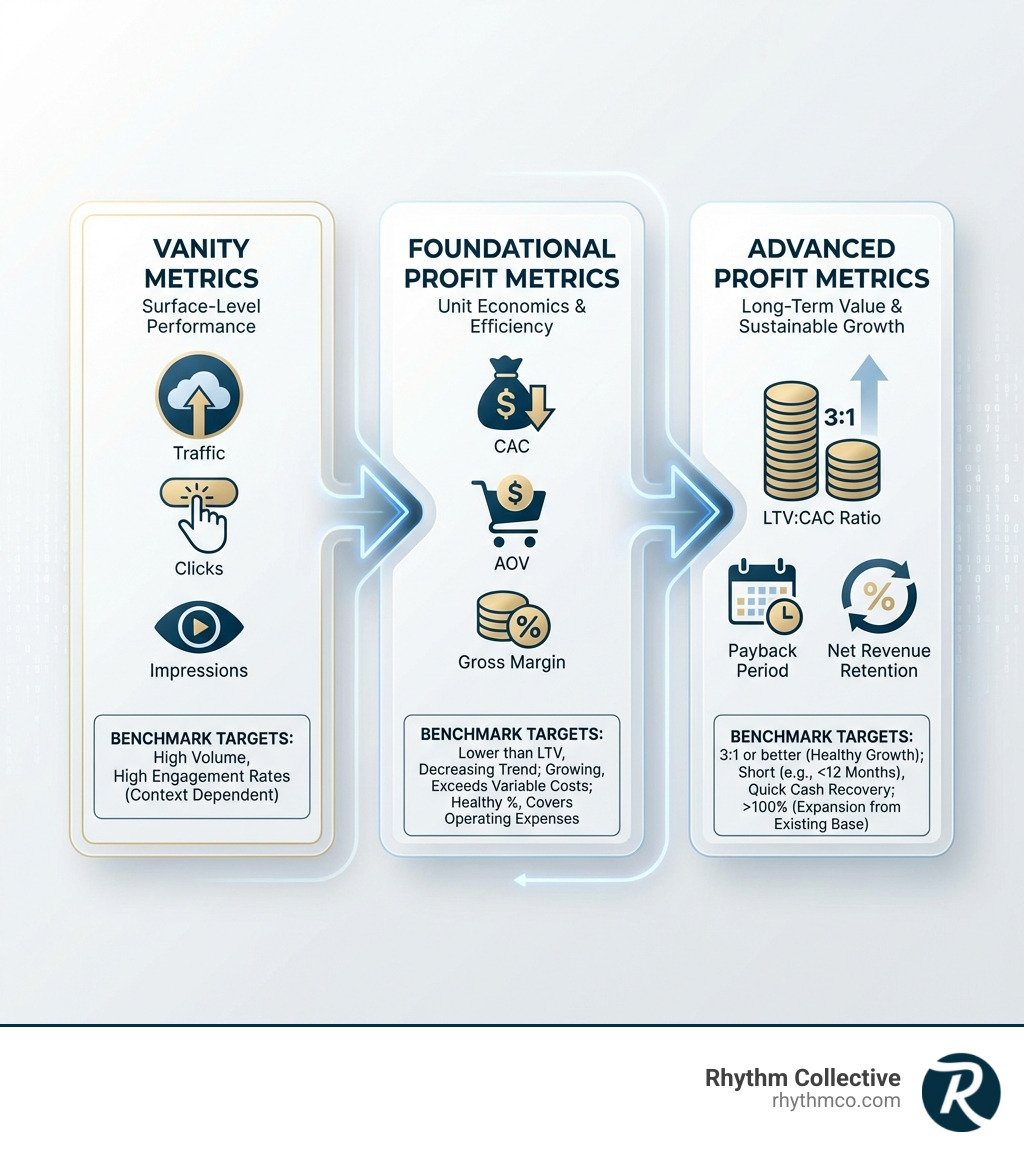
To truly accept marketing for profit, we need to move beyond vanity metrics and focus on indicators that directly impact customer economics and cash flow. This involves understanding a hierarchy of metrics, from foundational to advanced, that collectively paint a comprehensive picture of our marketing's financial contribution.

Calculating marketing ROI has long been desirable, but now it is critical. We need a "proven system for measuring marketing ROI" to ensure our efforts are not simply disappearing into thin air.
Foundational Metrics for Marketing for Profit
These are the building blocks, providing a basic understanding of costs and revenue at the individual transaction level.
- Customer Acquisition Cost (CAC): This metric tells us how much it costs to acquire a new customer. To calculate CAC, we sum all marketing and sales expenses over a period and divide by the number of new customers acquired in that same period. For example, if we spent $10,000 on marketing and acquired 100 new customers, our CAC is $100. Keeping CAC efficient and scalable is crucial for long-term profitability.
- Average Order Value (AOV): AOV is the average amount of money a customer spends per transaction. We calculate this by dividing total revenue by the number of orders. Increasing AOV through strategies like bundling, upsells, or promoting premium products directly boosts revenue per customer without increasing acquisition costs.
- Gross Margin: This is the revenue remaining after deducting the cost of goods sold (COGS). It tells us the profitability of each product or service before accounting for operating expenses. Understanding gross margin at a product level is vital, as not all products are equally profitable. A high ROAS campaign might be unprofitable if it's promoting a product with a very low gross margin.
Understanding these foundational metrics helps us identify immediate areas for optimization and ensures that each transaction is contributing positively to our financial health. For more detailed insights into attracting customers effectively, consider exploring our services in Search Engine Marketing.
Intermediate Metrics for Sustainable Growth
Once we have a handle on the foundational metrics, we can move to intermediate ones that provide a deeper understanding of customer value and marketing efficiency over time.
- Customer Lifetime Value (LTV): LTV is a prediction of the total revenue a business can expect to generate from a single customer account over the duration of their relationship. Calculating LTV often involves multiplying the average purchase value by the average purchase frequency rate, and then multiplying that by the average customer lifespan. For subscription businesses, it might be average monthly revenue per user multiplied by average customer lifespan. LTV is critical because it shifts our focus from one-time transactions to the long-term value of a customer.
- LTV:CAC Ratio: This ratio compares the lifetime value of a customer to the cost of acquiring them. It's a powerful indicator of marketing efficiency and business health. A "good benchmark for the LTV:CAC ratio is 3:1 or better." This means for every dollar we spend acquiring a customer, we expect to generate three dollars in return over their lifetime. A ratio of "4:1 or higher indicates a great business model," suggesting strong profitability. Conversely, "a ratio below 1:1 means you are losing money acquiring customers." If the ratio is 5:1 or higher, it might even suggest we're under-investing in marketing and could afford to acquire more customers.
- Payback Period: This metric tells us how long it takes for a customer cohort to repay its CAC via contribution margin. It's crucial for cash flow management. A shorter payback period means we recoup our investment faster, allowing us to reinvest sooner and scale more rapidly.
- Retention Rate: This measures the percentage of customers that a business retains over a given period. High retention rates directly contribute to higher LTV, as existing customers are often more profitable than new ones. Improving retention reduces our dependence on constant paid acquisition.
These intermediate metrics help us build a more sustainable growth model by focusing on customer loyalty and long-term value. To nurture these customer relationships, effective communication is key. Learn more about how we help businesses with Email Newsletter Marketing.
Advanced Metrics for Scaling Profitability
For those looking to scale with precision and maximize profitability, advanced metrics offer granular insights into customer segments and product performance.
- Net Revenue Retention (NRR): This metric measures the percentage of recurring revenue retained from existing customers over a specific period, including upgrades, downgrades, and churn. "NRR > 100% indicates growing revenue from the existing customer base, a strong health signal." It tells us if our existing customers are not just staying, but also increasing their spending with us.
- Contribution Margin: This is the revenue per unit minus the variable costs per unit. It tells us how much profit each individual sale contributes towards covering fixed costs and generating overall profit. Protecting this aggressively is vital, as it's what ultimately funds our growth.
- Net Profit Per Cohort Over Time: This advanced metric tracks the actual net profit generated by a specific group of customers acquired during a particular period (a "cohort") over their entire lifecycle. This helps us understand the long-term performance impact of different acquisition tactics or time periods, allowing for highly refined strategic decisions.
- Product-Level Margins: Diving deep into the profitability of individual products or services is crucial. We might find that some of our most popular items have razor-thin margins, while niche products are highly profitable. This insight allows us to reallocate marketing spend to promote the most profitable offerings, even if their initial ROAS or CPA isn't the highest. A campaign that looks good on paper might be losing money if it's pushing low-margin products.
By leveraging these advanced metrics, we can optimize our marketing efforts to not just acquire customers, but to acquire the right customers for maximum long-term profitability. If you're ready to dive deeper into optimizing your marketing strategy for profit, our Marketing Consulting Services can guide you.
The Core Principles of Marketing for Profit
Implementing a profit-driven marketing approach requires more than just understanding metrics; it demands a fundamental shift in how we plan, align teams, and execute our strategies. It's about ensuring consistency in doing "the right things consistently in the right way" to make a great deal more money.

Building Your Profit-Focused Marketing Plan
A clear marketing strategy, encompassing goals, target markets, and the marketing mix, is the bedrock of profitability. A well-designed marketing plan helps us raise awareness, attract customers, and boost sales.
- Setting SMART Goals: Our marketing plan should detail what we want to accomplish, setting clear, realistic, and measurable targets with deadlines. This means our goals should be Specific, Measurable, Achievable, Relevant, and Time-Bound (SMART). For example, instead of "get more traffic," a SMART goal might be "increase qualified leads from organic search by 30% in six months." These clear objectives give our marketing teams focus and our marketing dollars purpose.
- Target Market Segmentation: We must identify segments of customers who share common characteristics. This involves conducting thorough research to understand demographics, buying characteristics, motivations, and where our target customers get their information. By building buyer personas, we can tailor our marketing approach for each segment, ensuring our messages resonate with the right people in the right places.
- The Marketing Mix (4Ps): The foundational marketing mix—Product, Price, Place, and Promotion—remains crucial.
- Product: What are we selling? What are its benefits and unique selling points?
- Price: How much are customers willing to pay? How does our pricing compare to competitors and support our positioning?
- Place: Where will our product or service be sold? How do customers access it? This includes physical locations and online channels.
- Promotion: How will we inform consumers and increase brand awareness? This involves our marketing message and the channels we use to communicate it. The marketing mix is a significant tool in determining the right strategies for our business, evolving with digital media to remain useful.
- Budgeting Principles: A marketing plan must include a budget. For new businesses, this often requires a larger financial commitment. According to the U.S. Small Business Administration, small businesses (under 250 employees) typically spend 7% to 8% of their total revenue on marketing. Larger companies may invest 10% to 14%. Companies with online sales above 10% often allocate more, around 13% of revenue. We should account for individual line items, annual expense increases, one-time expenses (like rebranding, which can cost $50k-$150k every seven years), industry trends, new product launches, and seasonal spending. A practical guideline is to "invest 80% of advertising budget in proven promotions and 20% in testing new variations." This ensures both stability and innovation.
Developing a comprehensive marketing plan is an essential step in helping define our marketing strategy and drive business success. For a deeper dive into crafting your plan, check out the Marketing Plan Guide | SCORE. For help in managing these intricate plans, our Marketing Management services are designed to help businesses like yours.
Aligning Data, Teams, and Strategy
A challenge in measuring marketing ROI is the difficulty in determining all marketing expenses and an over-reliance on short-term numbers. To overcome this, we need to foster deep alignment across our organization.
- Breaking Down Data Silos: Profit-driven marketing demands that we combine inputs from marketing, finance, and product teams. This gives us visibility into margin, retention, and true customer value. Without this integrated view, we're making decisions in a vacuum.
- Finance and Marketing Alignment: Getting finance, analytics, and marketing aligned on new success metrics—like profit per order, payback periods, contribution margins, and retention rates—is paramount. This ensures everyone is working towards the same financial objectives.
- Stakeholder KPIs: Aligning stakeholder KPIs to focus on profitability means that individual and team goals are tied to bottom-line results. This encourages a collective responsibility for profit generation, rather than just hitting top-line targets.
- Piloting and Iterating: We don't have to overhaul everything at once. A practical roadmap involves piloting and iterating. We can test profit-based bidding strategies in one region or on a high-margin product category. This allows us to learn and refine our approach before a full rollout.
- Common Myths and Misconceptions:
- "Profit-driven marketing is only for big brands." Not true! Even smaller brands can achieve significant improvements through basic segmentation and analysis.
- "It's about cutting marketing spend." Far from it. It's about reallocating spend towards what actually drives the bottom line, focusing on profitable growth.
- "It's too complex to implement." It doesn't require enterprise-level infrastructure. Simple LTV:CAC modeling by key segments can deliver impact.
- "It takes too long to show results." Often, the opposite is true. Turning off campaigns that acquire low-margin, high-churn customers can create immediate gains, sometimes within weeks.
"70% of marketers say they face moderate to significant challenges when trying to measure campaign ROI." This statistic underscores the need for a more integrated, profit-focused approach.
Advanced Strategies for Marketing for Profit
To truly excel at marketing for profit, we must leverage cutting-edge tools and strategies that improve measurement and drive ROI.
- Leveraging AI and Analytics: The "AI era" is changing marketing, offering powerful ways to improve measurement and drive ROI. AI-powered measurement can lead to significant lifts in conversion value, as demonstrated by companies strengthening their data capabilities. Artificial intelligence is accelerating the production cycle, changing shopping in search, and enabling brands to market at the "speed of culture." We can use AI to peel back production bottlenecks, gain deeper consumer insights, and adapt to evolving consumer journeys. Tools like Google Analytics and Keyword Planner, alongside AI-driven solutions, help us stop guessing and start growing with data-backed decisions.
- Content Strategy's Role: A robust content strategy is vital in a profit-driven marketing approach. It connects our marketing objectives with audience needs by outlining how content will be created, distributed, and managed across customer touchpoints. Our content should be relevant, consistent, varied, and clear, answering audience questions and guiding them through the buyer's journey. This can include anything from videos and blogs to email newsletters and social media posts. By understanding our target audience and competitors, we can choose the most effective content formats to engage and convert.
- The 80/20 Rule for Testing: As mentioned earlier, "investing 80% of advertising budget in proven promotions and 20% in testing new variations is a highly effective guideline." This allows us to continuously optimize and find new profitable channels or messages. A/B testing headlines, visuals, and calls-to-action, guided by data, can lead to significant improvements in performance and ROI. This iterative approach ensures that our marketing spend is always moving towards greater profitability.
By integrating these advanced strategies, we ensure our marketing efforts are not just effective but also highly profitable, driving sustainable growth for our business. For a foundational online presence that supports these strategies, consider our expertise in Web Design.
A Note on Mission vs. Margin: For-Profit vs. Nonprofit Marketing
While our focus is primarily on marketing for profit, it's insightful to briefly consider how marketing strategies differ for nonprofit organizations. Both types of entities ultimately seek revenue, but their approaches to generating it, attracting stakeholders, providing satisfaction, and building relationships are fundamentally distinct.
- Revenue Generation (Sales vs. Donations): For-profit businesses make money because consumers purchase a product or service. The revenue is directly tied to a tangible exchange. Nonprofits, on the other hand, make money primarily through donations. As one source notes, "For-profits provide a tangible element that nonprofits cannot because when you support a nonprofit, your donation is going to help someone else. You don’t have anything physical to claim; it’s all about that warm, fuzzy feeling we get from helping someone in need."
- Attracting Customers (Product Benefits vs. Emotional Appeal): For-profit marketing typically educates consumers about product/service benefits and targets specific media to highlight how the offering solves a problem or improves life. Nonprofit marketing, however, appeals to emotions and builds awareness of an issue or cause. They market their mission instead of a product, focusing on storytelling to evoke positive emotions and connect with their audience.
- Providing Satisfaction (Purchase Experience vs. Feeling of Giving): For-profits use marketing to build hype and create an experience around a purchase, emphasizing the satisfaction derived from owning or using the product. Nonprofits focus on the satisfaction of giving back and helping others. The reward is the emotional fulfillment of contributing to a cause, not a physical item.
- Brand Relationships (Customer vs. Supporter): For-profits emphasize customer relationships to encourage repeat purchases and loyalty. Nonprofits, however, thrive on building deep connections to their cause and fostering a "longstanding support network." According to Meyer Partners, "nonprofit marketing is about building relationships to cultivate a longstanding support network." This often involves personalized communications and regularly updating supporters on the impact of their contributions.
- Measuring Success (Profit vs. Donor Retention): Nonprofits and for-profit businesses measure success differently. For-profits focus on sales, customers, and financial profitability metrics like ROI and LTV. Nonprofits, while needing funds, prioritize donor acquisition/retention, event attendance, and fundraising success. Marketing for nonprofits is about "educating supporters about your mission, upcoming events, and ways to get involved," raising awareness, and driving positive social change.
Understanding these distinctions is crucial for tailoring an effective marketing strategy, whether our goal is maximizing financial profit or advancing a mission for good.
Conclusion: Make Every Marketing Dollar Count
In today's dynamic economic landscape, the imperative to move beyond surface-level metrics and accept marketing for profit has never been clearer. We've seen how traditional performance indicators, while efficient, often fail to tell the full story of profitability, leading to wasted marketing spend. The strategic shift towards profit-driven marketing is about grounding our efforts in bottom-line business performance, prioritizing customer economics, cash flow, and sustainable growth.
By focusing on foundational metrics like CAC and AOV, intermediate metrics such as LTV:CAC ratio and Payback Period, and advanced metrics like NRR and Net Profit Per Cohort, we gain the insights needed to make every marketing dollar count. This approach demands a clear marketing strategy, the alignment of data across finance, marketing, and product teams, and the continuous leveraging of advanced tools like AI and analytics.
Marketing is not merely an expense; it is a critical investment. Like any investment, it requires consistent effort, intelligent planning, and rigorous measurement to deliver profitable, long-term results. For businesses in Knoxville, TN, and across East Tennessee, this means adopting a disciplined approach to ensure that our marketing efforts are not just generating leads, but driving profitable revenue and fostering long-term growth.
If you're ready to transform your marketing from a cost center into a profit engine, we're here to help. Partner with a digital marketing agency in Knoxville to build your profit-driven strategy and open up your business's full potential.