

What Is a Strategic Marketing Partner (And Why It Changes Everything)
A strategic marketing partner is a business or agency that works alongside you as a long-term collaborator — not just a vendor completing tasks, but a genuine partner invested in your growth, your revenue, and your success.
Here's a quick breakdown of what that actually means in practice:
| Vendor | Strategic Marketing Partner | |
|---|---|---|
| Focus | Completing tasks | Driving business outcomes |
| Relationship | Transactional | Long-term and collaborative |
| Goals | Their deliverables | Your revenue growth |
| Involvement | Project-based | Ongoing strategy and execution |
| Risk | Yours alone | Shared |
Most businesses hire agencies expecting transformation. What they get instead is a list of deliverables and a monthly invoice. The relationship stays transactional, the results stay mediocre, and the frustration builds.
The data tells a clear story: 96% of businesses expect revenue growth from partnerships, and companies that sell through strategic partners see win rates increase by 39% and deal sizes grow by 45%. Partnerships also account for 57% of new customer acquisitions. These aren't small gains — they're business-changing results.
But those numbers only show up when the partnership is real. When there's alignment, trust, shared goals, and genuine collaboration.
This guide will show you exactly how to find, evaluate, and build that kind of relationship.
I'm Trevor Jones, founder of Rhythm Collective, and over 13 years I've helped businesses generate more than $140 million in tracked revenue by focusing on one core principle: the right strategic marketing partner doesn't just run campaigns — they build the systems that create predictable, long-term growth. I'll walk you through everything I've learned so you can stop guessing and start building something that actually works.
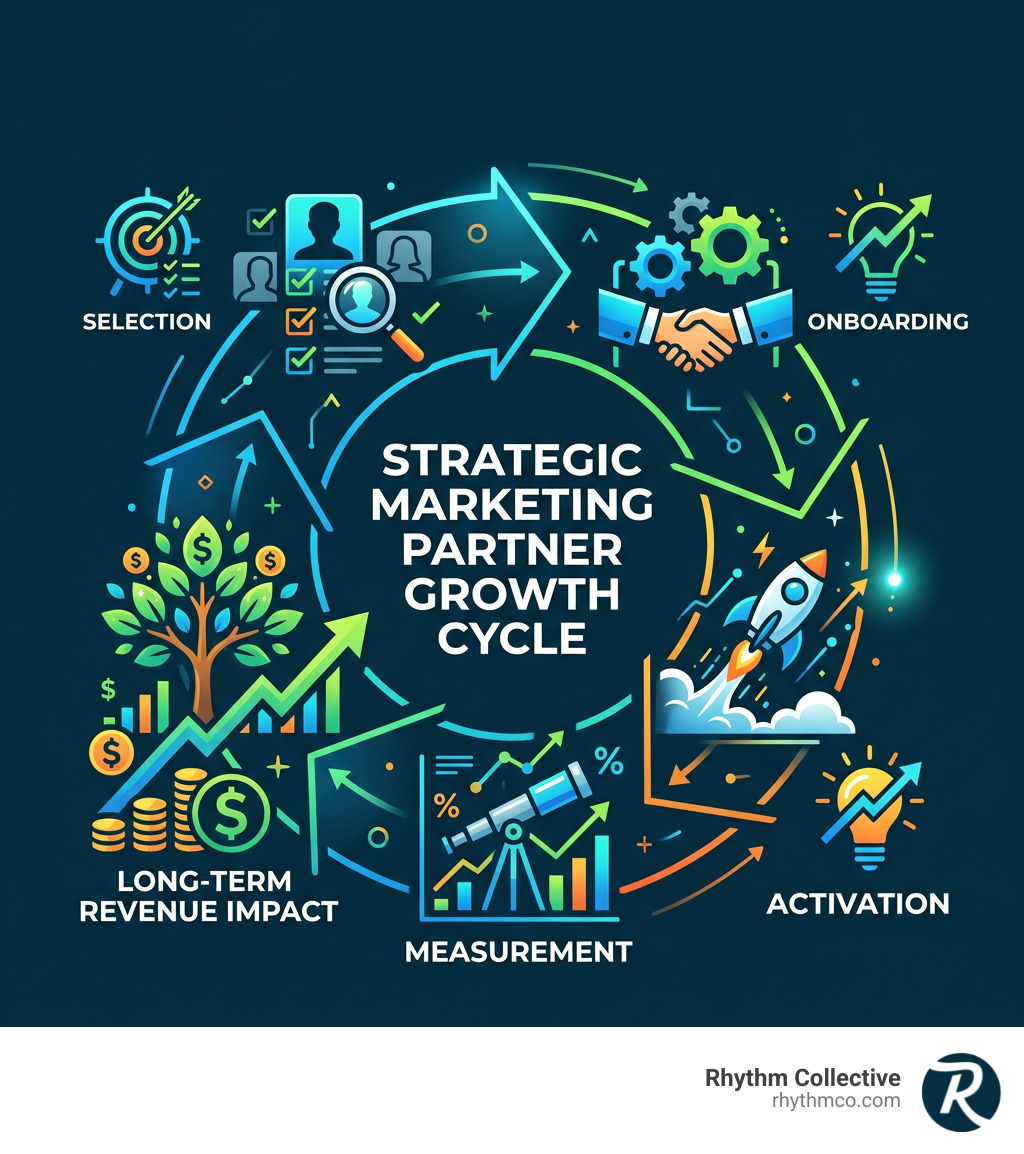
Common strategic marketing partner vocab:
Why Your Business Needs a Strategic Marketing Partner
In the business environment of East Tennessee—from the tech hubs in Knoxville to the manufacturing corridors in Kingsport—staying ahead requires more than just "doing marketing." It requires a revenue engine.
When we talk about a strategic marketing partner, we aren't just talking about someone to post on your Facebook page. We are talking about an entity that understands your P&L as well as you do. According to a survey by DemandGen, 96% of businesses expect an annual revenue increase directly linked to marketing initiatives within their partner networks.

The benefits of this high-level collaboration are numerous:
- Boosted Win Rates and Deal Sizes: Selling through a partner can boost win rates by 39% and increase deal sizes by 45%. Why? Because a partner provides the credibility and the integrated solution that a solo effort often lacks.
- Customer Acquisition: Partnerships are responsible for 57% of new customer acquisitions. In B2B, this often means moving from a product-focused model to an ecosystem-driven approach.
- Shared Resources: You don't have to own every tool or employ every specialist. A partner brings their own "stack" to the table, reducing your overhead while increasing your capability.
- Market Expansion: A local partner offers flexibility and "capillarity"—the ability to reach deep into specific vertical markets or geographic areas like the Tri-Cities or the Smoky Mountains.
For many B2B companies, marketing consulting services are the first step toward this model. Instead of guessing which tactics might work, you sit down with experts to align your tools and tactics to a core business strategy. This eliminates the "random acts of marketing" that drain budgets without producing results.
Diverse Models of Marketing Collaboration
Not all partnerships look the same. Depending on your goals—whether it’s brand awareness, lead gen, or customer loyalty—different models will serve you better.
Co-Marketing and Co-Branding
This is where two brands combine their "cool factor" and resources to create something unique. A classic example is BMW and Louis Vuitton. They didn't just slap logos on each other; they co-created luxury travel bags specifically tailored to fit the interior of the BMW i8. This showed a deep level of sustained collaboration rather than an isolated project.
In the tech world, look at Salesforce and Dropbox. By integrating Dropbox’s file-sharing directly into Salesforce, they enhanced the user experience for their shared customer base.
Affiliate and Ambassador Programs
These are often more transactional but can be highly effective for scale. You reward partners for bringing in traffic or sales. However, the real gold is in referral partnerships. According to Invespcro, customers who learn about your brand through referrals have a 37% higher retention rate and are four times more likely to recommend your brand to others.
Distribution and Channel Partnerships
For companies in manufacturing or SaaS, this is often the backbone of the business. You rely on a network of dealers or resellers to move your product. Google Cloud and Splunk do this brilliantly by integrating Splunk’s big data platform into Google’s infrastructure, creating industry-specific solutions like "Splunk for Retail."
Comparison of Partnership Models
| Model | Primary Goal | Level of Integration | Best For |
|---|---|---|---|
| Referral | Lead Generation | Low | Service-based businesses |
| Affiliate | Sales Volume | Low | E-commerce / SaaS |
| Co-Marketing | Brand Awareness | Medium | Complementary brands |
| Channel Partner | Market Reach | High | Manufacturing / Enterprise Software |
| Joint Venture | New Product Entry | Very High | Innovation / R&D |
How to Evaluate and Select a Strategic Marketing Partner
Choosing the wrong partner is more than just a waste of money; it can actually damage your brand reputation. You need a structured process for "quality recruiting."
1. Audience Alignment
Does their audience actually care about what you do? You should analyze audience data to pinpoint shared or complementary characteristics. If you are a B2B software firm in Maryville, partnering with a B2C retail brand in Gatlinburg might look fun, but if the audiences don't overlap, the ROI won't be there.
2. Brand Reputation and Credibility
Do your homework. In the UK, businesses use Companies House to check financial filings. In East Tennessee, you should look for established local presence and a track record of success. Check their "due diligence" list:
- Financial stability.
- Frequent leadership changes (a red flag).
- Client testimonials that focus on revenue, not just "vanity metrics" like likes or follows.
3. Cultural Fit
This is often overlooked but is the #1 reason partnerships fail. If your company moves fast and breaks things, but your partner requires three weeks of committee meetings to approve a tweet, you’re going to have a bad time. Look for a shared approach to problem-solving and communication.
4. Technical and Vertical Expertise
A generalist agency is rarely a true strategic marketing partner. You want someone who understands your specific industry—whether that's healthcare, manufacturing, or tourism. They should bring "verticality" to the table, meaning they already know the pain points of your specific customers.
Managing the Relationship: From Onboarding to Activation
Once you've signed the agreement, the real work begins. You can't just "set it and forget it."
Setting SMART Goals
Every successful partnership starts with a shared vision. You need to define goals that are:
- Specific
- Measurable
- Achievable
- Relevant
- Time-bound
For example, instead of saying "we want more leads," aim for "generating 100 qualified B2B leads per quarter through joint webinars."
Onboarding and Playbooks
To ensure uniform service standards, you need a playbook. This is a document that outlines:
- Brand guidelines (colors, fonts, tone of voice).
- Communication protocols (who talks to whom and how often).
- Escalation paths for when things go wrong.
Effective marketing management involves simplifying the onboarding process so partners can start producing value quickly. Think of it like a "franchise in a box" for your marketing activities.
Building Trust
Trust is the foundation. As seen with Disney and Pixar, rebuilding trust through clear agreements and open communication can turn a rocky start into one of the most successful collaborations in history. We recommend weekly syncs and quarterly business reviews (QBRs) to keep the relationship healthy.
Essential Tools for a Strategic Marketing Partner
You can't manage a complex network with just email. You need a "stack" that allows for transparency and collaboration.
- Communication: Microsoft Teams or Slack for daily chatter.
- Project Management: Trello, Notion, or Miro for brainstorming and task tracking.
- CRM and PRM: HubSpot is the gold standard for tracking lead generation and partner-sourced revenue.
- Creative Collaboration: Canva for quick design wins and Adobe Creative Cloud for heavy-duty design work.
Amplifying Results with a Strategic Marketing Partner
Once the foundation is set, use digital channels to pour gasoline on the fire.
- LinkedIn: With 80% of members holding decision-making roles, it's the place for B2B. Video content here generates 5x the engagement of static posts.
- Email Marketing: Personalization is key. Adobe research shows that personalized subject lines can increase open rates by 26%.
- Account-Based Marketing (ABM): This is where you and your partner target high-value accounts together. Businesses that align sales and marketing teams report up to 208% growth in marketing revenue.
- Joint Content: Whitepapers, webinars, and case studies co-authored by both partners carry double the authority.
Measuring Success: KPIs and Performance Reviews
If you can't measure it, you can't improve it. According to Gartner, by 2026, 65% of B2B sales organisations will shift from intuition-based to data-driven decision-making. Your partnership should be no different.
Key Metrics That Matter
- Partner-Sourced Revenue: How much money actually hit the bank account because of this partnership?
- Lead Quality: Are these leads actually converting, or are they just names on a list?
- Conversion Rates: The percentage of joint leads that move through the sales funnel.
- Pipeline Creation: The total value of new opportunities opened through partner activities.
- Brand Reach: Shared audience growth and engagement levels.
The Power of the Review
Don't wait for a crisis to talk about performance. Conduct regular reviews to recognize success and identify bottlenecks. This keeps both parties accountable and ensures the strategic marketing partner relationship continues to deliver ROI.
Frequently Asked Questions about Strategic Partnerships
What is the difference between a vendor and a strategic marketing partner?
A vendor is transactional—you pay them to do a specific thing (like "write five blogs"). A strategic marketing partner is collaborative. They help you decide why you are writing those blogs, how they fit into your revenue goals, and they share the risk if the strategy doesn't pan out. It’s the difference between buying a shovel and hiring someone to help you find the gold.
How do cultural differences impact international partnerships?
Even within the US, regional differences matter. But on an international scale, variations in values, decision-making etiquette, and communication styles can cause major misunderstandings. The key is adaptability and respecting local customs. For example, some cultures prioritize relationship-building (coffee and small talk) for months before a single contract is signed, while others want to get straight to the numbers.
How do you supervise partner activities without micromanaging?
The "Golden Rule" is to provide value-added services rather than just oversight. Instead of checking their every move, provide them with:
- Localized campaign templates.
- Automated reporting tools.
- Co-branding assets.
- Clear KPIs and the autonomy to reach them. When you give partners the tools to succeed, they won't need you to breathe down their necks.
Conclusion
In the end, business transformation doesn't happen in a vacuum. It happens when you stop looking for "help" and start looking for a strategic marketing partner. Whether you are a manufacturing firm in Johnson City or a tech startup in Knoxville, the path to profitable revenue is paved with collaboration.
At Rhythm Collective, we don't just "do marketing." We partner with you to build a revenue engine that has already generated over $140 million for our clients. We focus on long-term success, not just short-term leads.
Ready to stop hiring agencies and start finding a real partner? Let’s talk about how we can help you achieve the kind of growth that changes everything.
Explore more about working with a Digital Marketing Agency in Knoxville and see how a true partnership can transform your business.