Why Understanding Content and Digital Marketing Matters for Business Growth
Content and digital marketing are often used interchangeably, but they're not the same thing. Understanding the difference is critical for business leaders who want to drive measurable revenue growth rather than just generate leads.
Quick Answer: The Key Differences
Digital Marketing is the umbrella term for all online marketing efforts—including SEO, PPC ads, social media, email campaigns, and more. Its primary goal is to promote your brand and drive conversions across multiple digital channels.
Content Marketing is a subset of digital marketing. It's a strategic approach focused on creating and distributing valuable, relevant content to attract and engage a defined audience. The goal is to build trust, authority, and long-term relationships.
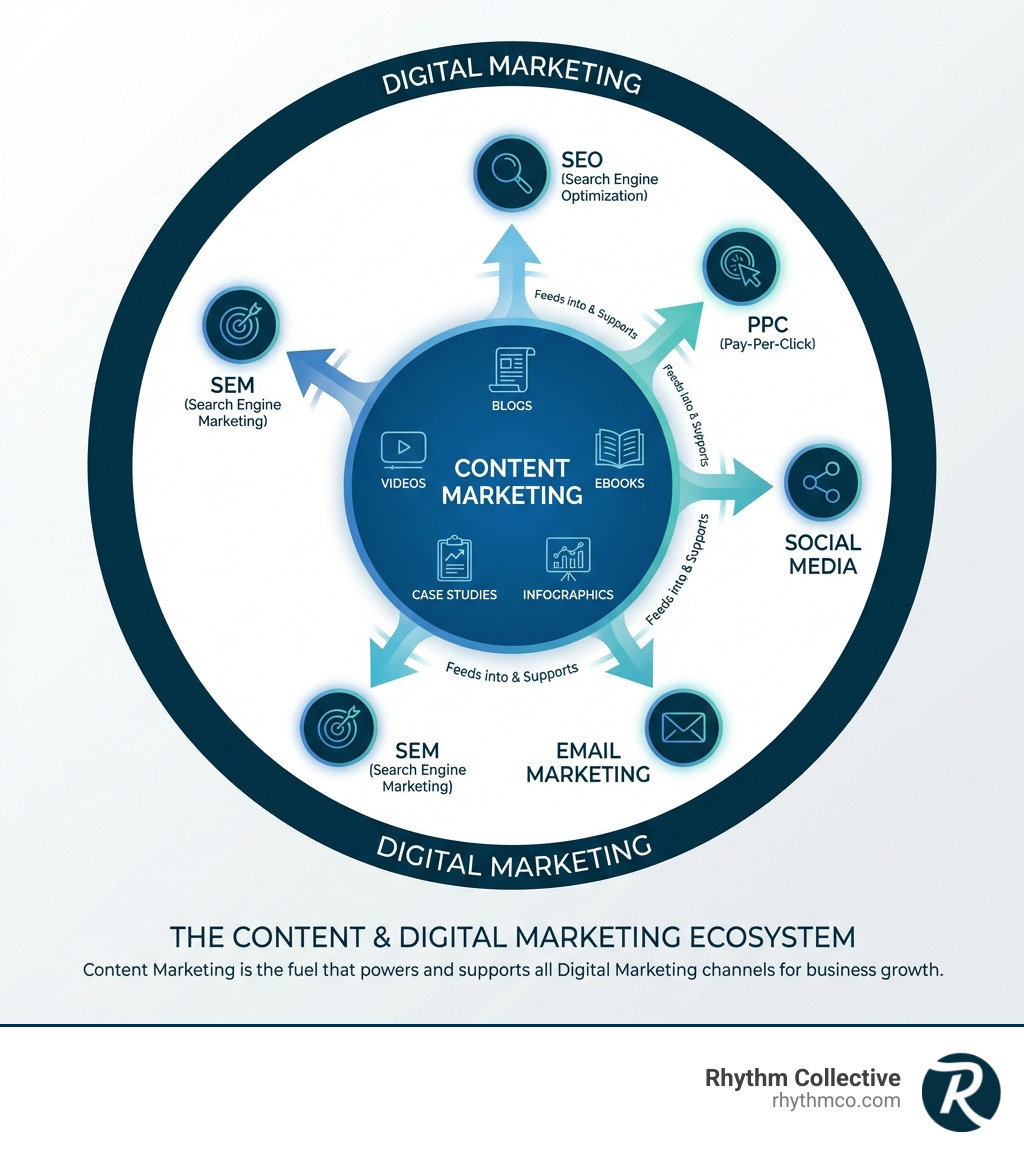
The Relationship: Content marketing provides the fuel (valuable content), while digital marketing channels provide the engine (distribution and amplification).
Here's the reality: you can't succeed with one without the other. As the research shows, 93% of online encounters begin with a search engine. That means your audience is already looking for answers. Content marketing helps you provide those answers, while digital marketing ensures your content actually reaches the right people at the right time.
Many businesses pour money into digital ads or social media campaigns without a solid content foundation. Others create amazing content that never gets seen because they haven't invested in distribution. Both approaches waste budget and miss opportunities for profitable growth.
The real power comes from integration—using content to fuel your digital channels and using digital channels to amplify your content. When you understand how these two pieces work together, you can build a marketing strategy that doesn't just generate traffic, but drives long-term revenue and market leadership.
Digital Marketing vs. Content Marketing: A Head-to-Head Comparison
It’s easy to get lost in the jargon, but at Rhythm Collective, we believe in making complex topics simple. Think of it this way: digital marketing is the entire car, and content marketing is the high-octane fuel that makes it go. Without the car, the fuel has nowhere to go. Without the fuel, the car just sits there looking pretty.
The fundamental difference lies in their scope, goals, and how they operate. While they both aim to grow your business, their primary methods diverge significantly.
| Aspect | Digital Marketing | Content Marketing |
|---|---|---|
| Primary Goal | Conversion, Lead Generation, Direct Sales | Engagement, Trust-Building, Authority, Education |
| Approach | Direct, Promotional, Action-Oriented | Indirect, Informative, Value-Driven, Relationship-Orienting |
| Scope | Broad umbrella, encompassing all online tactics | Specific subset, focused on creating and distributing valuable content |
| Timeframe | Short-term (e.g., PPC results) & Long-term (e.g., SEO) | Primarily Long-term (building brand equity, organic growth) |
| Key Metrics | Conversion Rate, Click-Through Rate, ROI, CPA | Engagement Rate, Time on Page, Shares, Brand Mentions, Organic Rankings |
| Tactics | SEO, PPC, Social Media Ads, Email Marketing, SEM, Display Ads | Blogs, Videos, Ebooks, Infographics, Case Studies, Whitepapers, Podcasts, Webinars |
What is Digital Marketing?
Digital marketing is the grand orchestra of all your online promotional efforts. It's the use of digital channels—search engines, websites, social media, email, and mobile apps—to promote a product or service. Its goal is typically more direct: to get people to do something, whether that's clicking an ad, signing up for a newsletter, or making a purchase. As Neil Patel points out, effective digital marketing gets your brand in front of online audiences and improves your online presence.
Why is this so important? Because, as we know, 87% of consumers begin their journeys on digital channels. If you’re not there, you’re missing out. Digital marketing helps us reach a wider audience, with over 6 billion social media users expected by 2028. It’s also incredibly measurable, allowing us to see real-time data on website traffic, engagement, and conversion rates, making it easier to adapt and optimize strategies. This agility is crucial in a landscape where trends and algorithms change faster than you can say "viral video."
At Rhythm Collective, our expertise in Digital Marketing Agency in Knoxville helps businesses in East Tennessee steer this dynamic environment, ensuring their online efforts translate into tangible growth.
What is Content Marketing?
If digital marketing is the car, content marketing is the captivating story playing on the radio during the drive. It’s a strategic approach focused on creating and distributing valuable, relevant, and consistent content to attract and retain a clearly defined audience—and, ultimately, to drive profitable customer action.
The essence of content marketing is to educate, entertain, or inspire, earning the confidence of potential customers rather than overtly selling to them. As the Content Marketing Institute highlights, 75% of respondents say content marketing is pivotal to building brand trust and awareness. It's about developing relationships with clients rather than disrupting them. This indirect, subtle approach builds authority over time. We've seen how a well-crafted blog post or an informative video can turn a curious browser into a loyal customer.
Want to see what we're talking about? Check out More info about our Blog. This is where we share our insights, tips, and expertise, demonstrating the power of valuable content.
The Power of Synergy: How to Integrate Content and Digital Marketing
Here’s where the magic happens: when content and digital marketing stop being separate entities and start working together like a well-oiled machine. Content is the fuel, and digital channels are the engine. You wouldn't put premium fuel in a car with no engine, would you? And you wouldn't expect an engine to run on empty.
The symbiotic relationship means that while not all digital marketing is content marketing, all content marketing is digital marketing. They share the same ultimate goals: generating leads and converting audiences into loyal customers. Especially in a post-COVID-19 world, where 65% of consumers intend to accept their new digital buying behaviors, this integration is non-negotiable. Our clients in Knoxville and East Tennessee understand that a truly successful strategy requires both.
Creating a cohesive strategy starts with understanding your audience and setting clear goals. We use a framework that guides prospects through a "Customer Value Journey," from initial awareness to becoming raving fans. This journey is powered by content at every stage and amplified by digital channels.

This integrated approach is what we help our clients achieve through our Marketing Consulting Services. It’s not just about running campaigns; it’s about crafting a unified experience that resonates.
Essential Components of an Integrated Strategy
For a strategy to truly sing, it needs a few key instruments playing in harmony:
- Buyer Personas: Before we create anything, we need to know who we're talking to. Developing detailed buyer personas helps us understand our audience's demographics, interests, pain points, and buying habits. This ensures our content is relevant and our digital distribution is targeted.
- Content Calendar: Consistency is key. A well-planned content calendar ensures a steady flow of valuable content across various platforms, mapped to different stages of the customer journey. This helps us avoid the dreaded "content drought" and keeps our audience engaged.
- SEO Keyword Strategy: We don't just write; we write smartly. A strong SEO keyword strategy ensures our content is optimized to rank in search engines, helping people find our answers when they search. Tools like Ahrefs are indispensable for keyword research and competitive analysis.
- Distribution Plan: Great content is wasted if no one sees it. Our distribution plan outlines how we'll use digital channels—social media, email, paid ads—to amplify our content and reach the right audience. Think of it as getting your masterpiece into the right gallery.
- Analytics and Reporting: We're obsessed with data. Implementing proper tracking from day one with tools like Google Analytics 4 and HubSpot’s Reporting Software allows us to measure what's working, what needs improvement, and how our efforts connect to revenue. This data-driven approach means we're constantly refining and optimizing for profitable growth.
All these components come together to create a powerful online presence, much like our Web Design Services ensure your website is not just pretty, but a high-performing hub for your integrated marketing efforts.
Using Content to Power Digital Channels
Content isn't just a standalone piece; it's the fuel for every digital channel. Here’s how it powers various digital marketing efforts:
- SEO (Search Engine Optimization): This is where content shines brightest. High-quality blog posts, articles, and evergreen guides optimized with relevant keywords are the backbone of a strong SEO strategy. They help your website rank higher in search results, capturing the 93% of online encounters that begin with a search engine. Felix Johnson, Senior SEO and Content Strategist at Adilo, demonstrated this by focusing heavily on content marketing and SEO, resulting in over 95% of new signups from Google Search. Our Search Engine Marketing services leverage this synergy to ensure your business gets found.
- Social Media: Engaging content like infographics, short videos, and shareable articles are perfect for social media platforms. They capture attention, drive engagement, and encourage sharing. Videos, for instance, are highly engaging, with almost 70% of people watching them on their smartphones.
- PPC (Pay-Per-Click) Advertising: While PPC is a paid digital marketing tactic, the landing page content it directs users to is crucial. A compelling, relevant landing page that addresses the user's search intent (fueled by strong content principles) makes all the difference between a click and a conversion.
- Email Marketing: Newsletters, guides, and exclusive content delivered via email nurture leads and build customer loyalty. Email marketing is incredibly effective, boasting an average ROI of $36 to $42 for every dollar spent. It allows us to deliver personalized, valuable content directly to an engaged audience, keeping them informed and connected.
A Closer Look at the Strategies and Benefits

Understanding the distinct advantages of both content and digital marketing helps us strategically deploy them for maximum impact. Each brings unique strengths to the table, and when combined, they create a formidable marketing force that drives business growth for our clients in East Tennessee.
Key Benefits and Types of Content Marketing
Content marketing is the long game. It's about building an asset that continuously works for your business.
Benefits:
- Builds Trust and Credibility: By consistently providing valuable information, you establish your brand as an authority and a trusted resource. As the Content Marketing Institute found, 75% of respondents consider content marketing pivotal for building brand trust and awareness.
- Improves SEO: High-quality, keyword-rich content is loved by search engines. It boosts your search engine exposure, leading to higher organic rankings and more free traffic over time.
- Generates Leads: Educational content like ebooks or webinars can be offered in exchange for contact information, effectively generating qualified leads.
- Educates the Audience: It allows you to address customer pain points, answer their questions, and guide them through their buying journey, ultimately earning their confidence.
Types of Content Marketing:
- Blogs: Regular articles on your website demonstrate expertise, drive organic traffic, and convert visitors into leads. They are typically 1200-1500 words long and are excellent for SEO.
- Videos: Highly engaging and easy to consume, videos (like explainers, tutorials, or behind-the-scenes glimpses) are powerful for capturing attention and conveying complex information. We often recommend video for its versatility, and our Video Production Services help businesses create compelling visual stories.
- Ebooks and Guides: These longer-form pieces dig deep into a topic, positioning your brand as a thought leader. They are excellent lead magnets.
- Case Studies: Real-world examples of how your product or service solved a customer's problem build immense credibility and social proof.
- Infographics: Visual representations of data or complex information are highly shareable and great for conveying key messages quickly across social media.
Key Benefits and Types of Digital Marketing
Digital marketing is about precision, reach, and speed. It gets your message out there and brings immediate, measurable results.
Benefits:
- Wider Audience Reach: Digital channels allow you to connect with a global (or hyper-local, for our Knoxville clients) audience far beyond traditional methods. By 2028, there will be over 6 billion social media users worldwide – that's a massive pool of potential customers!
- Measurable Results: One of digital marketing's greatest strengths is its trackability. We can see the exact number of people who viewed a page, clicked an ad, or converted, allowing for data-driven decisions and rapid optimization.
- Cost-Effective: Compared to traditional advertising, many digital marketing tactics offer a higher ROI. Email marketing, for example, boasts an average return of $36 to $42 for every dollar spent.
- Precise Targeting: Digital platforms allow us to target very specific demographics, interests, and behaviors, ensuring our messages reach the prospects most likely to be interested.
- Agility and Flexibility: If a campaign isn't performing, we can quickly adjust or pause it, saving budget and optimizing for better results. This adaptability is key for short-term goals. PPC and paid social campaigns can show results within 24-48 hours, while email marketing yields results within days.
Types of Digital Marketing:
- Social Media Marketing Services: Promoting your brand and content on platforms like Facebook, Instagram, and LinkedIn to build awareness, drive traffic, and generate leads.
- Email Newsletter Marketing: Sending targeted messages to subscribers to nurture leads, announce promotions, or build loyalty. Remember the impressive ROI here!
- PPC (Pay-Per-Click): Running paid advertisements on search engines (like Google Ads) or social media platforms, where you pay only when someone clicks on your ad. This is excellent for driving immediate, targeted traffic.
- Local Search Visibility (Local SEO): Optimizing your online presence to attract customers from nearby locations. For Keeps Bookstore, for instance, optimized its Google My Business profile for local SEO to appear in "Atlanta bookstore" queries. This is especially vital for businesses in Knoxville, TN, and surrounding East Tennessee areas.
- SEM (Search Engine Marketing): The broader practice of increasing website visibility in search engine results pages through both paid advertising (PPC) and organic ranking (SEO).
Building a Career in Marketing
The dynamic world of content and digital marketing offers a wealth of career opportunities for those eager to adapt and learn. As the digital landscape continues to evolve, so does the demand for skilled professionals who can steer its complexities. Whether you're a recent graduate or looking to pivot your career, there's a place for you in this exciting field.
Career Paths in Digital and Content Marketing
The integration of content and digital strategies means that roles often blend, but here are some common career paths:
- Content Strategist: These professionals are the architects of a brand's content. They plan, develop, and manage the creation of engaging content across various formats, ensuring it aligns with business goals and resonates with target audiences.
- SEO Specialist: Focused on optimizing websites and content to rank higher in search engine results. They conduct keyword research, technical SEO audits, and competitor analysis to drive organic traffic.
- Digital Marketing Manager: An overarching role, responsible for planning, executing, and optimizing a company's entire digital marketing strategy across all channels. They often oversee teams of specialists.
- Social Media Manager: Manages a brand's presence on social media platforms, creating content, engaging with followers, running campaigns, and analyzing performance.
- Email Marketing Specialist: Designs, implements, and analyzes email campaigns, focusing on list growth, lead nurturing, and conversion optimization through targeted messaging.
Salaries in this field are competitive and grow with experience. Entry-level digital marketing coordinators might earn $40,000 to $55,000 annually, while mid-level specialists can expect $60,000 to $85,000. Senior roles and managers can command $90,000 to $130,000, with director-level positions exceeding $150,000 at enterprise companies.
Professional Development and Certifications
Given the rapid pace of change in digital marketing, continuous learning isn't just a recommendation—it's a necessity. Professionals must stay updated on evolving trends, new tools, and algorithm changes.
Industry Certifications: Many platforms and organizations offer valuable certifications that demonstrate expertise:
- Hootsuite Platform Certification: For social media management.
- Salesforce Marketing Cloud Certification: For advanced CRM and marketing automation.
- Google Ads & Analytics Certifications: Essential for PPC and data analysis.
- HubSpot Academy: Offers a range of free certifications, including one for Content Marketing, perfect for building foundational knowledge.
University Programs: For a more structured and in-depth education, many institutions offer post-graduate certificates and diplomas:
- York University's Post-Graduate Certificate in Digital & Content Marketing: An 8-month program for international students ($16,160) and domestic students ($7,130). They also offer shorter Certificates in Content Marketing and Digital Marketing for $2,307 each.
- Seneca's Digital & Social Media Marketing Program: Integrates Salesforce training and Ahrefs experience, leading to potential Hootsuite certification.
- McMaster University's Certificate in Digital Marketing: Requires completion of five core courses (approx. $822 each) and one elective (approx. $790), taking 8+ months.
These programs equip individuals with essential skills in branding, content creation, digital analytics, search engine strategies, and market research. Organizations like the American Marketing Association (AMA) also provide communities and resources for professional growth and ethical standards.
Frequently Asked Questions about Content and Digital Marketing
Which is more important, content marketing or digital marketing?
This is like asking which is more important: the engine or the fuel? Neither is "more important"; they are fundamentally interdependent. Digital marketing provides the channels and strategies for how you reach your audience, while content marketing provides the valuable message and substance for what you communicate.
You can have the most sophisticated digital marketing channels in the world, but if your content is bland, irrelevant, or non-existent, you'll have nothing compelling to say. Conversely, you can create award-winning content, but without digital marketing, it will sit unseen in a corner of the internet.
A comprehensive strategy that integrates both content and digital marketing is what drives profitable revenue and long-term growth for our clients in Knoxville and East Tennessee. They are two sides of the same coin, each essential for the other's success.
How does content marketing support different stages of the customer journey?
Content marketing plays a vital role at every step of the customer journey, guiding potential clients from initial curiosity to loyal advocacy:
- Awareness Stage: At this stage, people are just realizing they have a problem or need. Content like blog posts, short videos, and social media infographics are perfect for capturing attention and introducing your brand as a potential solution. For example, a blog post titled "5 Signs You Need a New Website" targets someone in the awareness phase.
- Consideration Stage: Here, prospects are actively researching solutions. They need more in-depth information. Content such as ebooks, whitepapers, webinars, and detailed guides help educate them about your offerings and how they solve specific pain points. A case study demonstrating how your web design services helped a local business is highly effective here.
- Decision Stage: When prospects are ready to make a choice, they need reassurance and proof. Testimonials, product demos, free consultations, and comparative content (e.g., "Why Our SEO Services Stand Out") can tip the scales in your favor.
- Loyalty Stage: After a purchase, content continues to foster relationships. Exclusive newsletters, customer-only tips, how-to guides, and community forums keep customers engaged and delighted, turning them into repeat buyers and advocates for your brand.
Content marketing also helps build personal connections by sharing brand stories and values, fostering the honesty and sincerity modern audiences seek.
How do I measure the ROI of my content and digital marketing efforts?
Measuring ROI is crucial for any marketing investment, and it's something we prioritize at Rhythm Collective. While 70% of marketers face challenges in measuring campaign ROI, with the right tools and approach, it's entirely achievable.
Key metrics we track include:
- Website Traffic: Tools like Google Analytics show us how many people visit your site, where they come from, and how they interact with your content.
- Conversion Rates: This measures how many visitors complete a desired action, such as filling out a form, downloading an ebook, or making a purchase.
- Lead Quality: It's not just about quantity. We work with our clients to assess the quality of leads generated, ensuring they are truly interested prospects.
- Customer Acquisition Cost (CAC): How much does it cost to acquire a new customer through your marketing efforts? This helps us optimize spending.
- Customer Lifetime Value (CLV): The total revenue a customer is expected to generate over their relationship with your business. Content marketing excels at increasing CLV by fostering loyalty.
- Brand Awareness Metrics: Social media mentions, brand name search volume, and website direct traffic indicate how well your brand is recognized.
Implementing proper tracking from day one using tools like Google Analytics 4 and HubSpot’s Reporting Software is essential. By analyzing this data, we can see what works, what needs improvement, and how to continuously grow your content and digital marketing strategy.
Conclusion
We've journeyed beyond the buzzwords and hopefully, clarified the distinct yet intertwined worlds of content and digital marketing. Digital marketing is the broad strategic framework, encompassing all online efforts to promote your business and drive conversions. Content marketing, a vital subset, focuses on creating valuable, relevant content to build trust, educate, and engage your audience.
The key takeaway is this: success in today's online landscape hinges on their seamless integration. Digital channels provide the powerful megaphone, but content delivers the compelling message. When you combine the strategic distribution power of digital marketing with the relationship-building strength of valuable content, you create a marketing ecosystem that not only captures attention but drives profitable revenue and fosters long-term growth. As the data shows, digital marketers who use three or more channels in one campaign see a 287% higher purchase rate. This is the power of synergy.
The future of marketing is a blend of valuable content and smart distribution, continually optimized by data and adapted to evolving consumer behavior and technology, including the rise of AI. At Rhythm Collective, we specialize in helping businesses in Knoxville, TN, and throughout East Tennessee harness this power. Our expertise in web design, video, graphic design, SEO, and digital strategy means we don't just generate leads; we deliver profitable revenue and long-term growth, having generated over $140 million for our clients.
Ready to build a cohesive marketing strategy that truly performs? Learn more about our Creative Marketing Agency Services and let's make some noise together.