

The Digital Shift Changing B2B Success
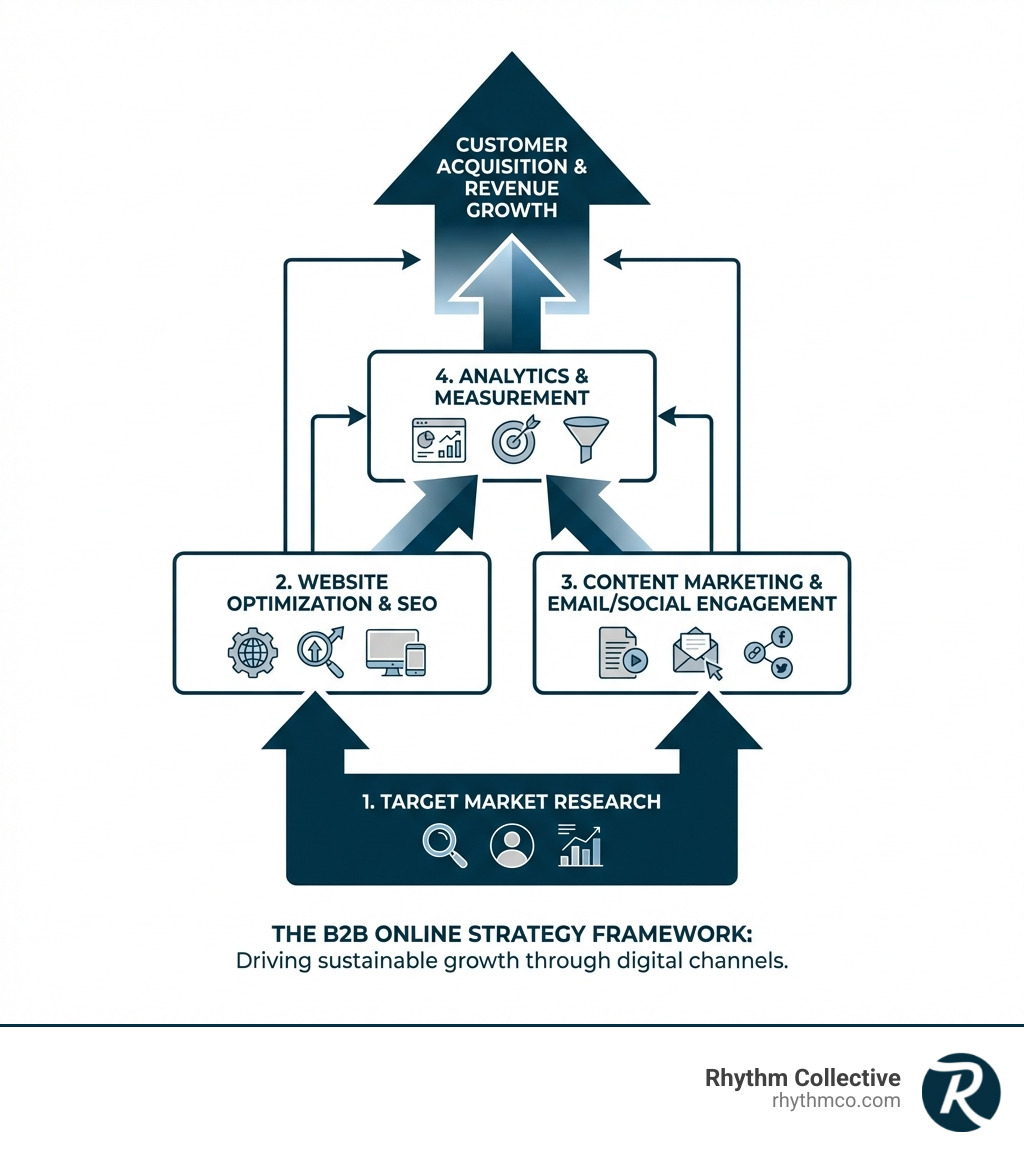
A b2b online strategy is your roadmap for reaching, engaging, and converting business customers through digital channels like your website, search engines, email, social media, and online marketplaces. It encompasses everything from understanding your buyers to optimizing your site, creating valuable content, and measuring results.
Key components of an effective B2B online strategy include:
- Deep audience understanding – Building buyer personas and conducting market research
- High-performance website – Mobile-optimized, fast-loading, and conversion-focused
- Search engine visibility – SEO to capture the 33% of B2B companies who cite it as their top lead generator
- Content marketing – Educational resources that build credibility throughout the buyer journey
- Email and social engagement – Nurturing leads through targeted campaigns
- Analytics and measurement – Tracking ROI and continuously optimizing performance
The business-to-business world has fundamentally changed.
More than 70% of the buyer’s journey now happens digitally before sales teams ever get involved. The B2B eCommerce market has exploded to $19.34 trillion—more than triple the size of direct-to-consumer at $5.5 trillion.
Today’s B2B buyers are different too. With 71% now millennials, they expect the same seamless, personalized experiences they get as consumers. They research independently, compare options online, and often make decisions worth hundreds of thousands of dollars without speaking to a salesperson.
The numbers tell a compelling story. Companies with effective online strategies see an average revenue growth of 25%. Nearly 40% of B2B buyers now spend over $500,000 on a single online purchase, and 68% of B2B firms with eCommerce sites report substantial revenue gains.
But here’s the challenge: Most B2B companies still treat digital as an afterthought. They’ve digitized back-office processes but haven’t innovated around the customer experience. Their websites serve as digital brochures rather than revenue engines. Their sales teams lack the analytics needed to win complex deals.
The gap between digital leaders and everyone else keeps widening. Top performers generate up to five times more revenue growth and eight times more profit growth than their peers.
This guide will show you how to close that gap.
Foundations: What is a B2B Online Strategy and Why is it Crucial?
At its core, a b2b online strategy is the roadmap your business uses to market, sell, and deliver its products or services to other businesses online. It involves using digital channels and technologies to optimize processes, improve customer experiences, and drive growth. Why is this so crucial? Simply put, to stay in the game. Without a clear digital strategy, your venture will struggle. The scale of B2B online transactions is staggering, with buyers increasingly comfortable making substantial purchases online. This shift isn’t just about convenience; it’s about meeting modern expectations.
Unlike B2C (business-to-consumer) eCommerce, which typically involves smaller transactions and shorter decision-making timelines, B2B eCommerce deals with larger order volumes, longer sales cycles, and more complex purchasing processes. Decisions are often driven by logic, ROI, and require multiple stakeholder approvals. This means your online strategy needs to be more sophisticated, offering detailed information, self-service options, and personalized experiences.
B2B eCommerce also encompasses various models, such as:
- Wholesale: Selling products in bulk to retailers or other businesses at a discounted rate.
- B2B2C (Business-to-Business-to-Consumer): Where your business sells to another business, which then sells your product or service to the end consumer.
The demand for streamlined operations is evident as 85% of B2B companies now consider it critical to centralize their commerce into a single platform. This unification allows for better data management, improved customer experiences, and greater operational efficiency. For us, helping businesses in Knoxville, TN, and throughout East Tennessee steer this complex landscape is about ensuring they don’t just survive, but thrive.
Building Your Blueprint: The Core Components of a Winning B2B Online Strategy
Crafting a winning b2b online strategy is akin to building a house – it requires a solid blueprint, careful planning, and the right tools. It’s about a carefully selected set of techniques designed to reach, nurture, and sell your products and services to businesses in your target audience. This blueprint needs to address every stage of the customer journey, from initial awareness to the final purchase and beyond.

A fundamental aspect of this blueprint is understanding the difference between inbound and outbound marketing. Think of it this way: outbound marketing is like fly fishing, actively pursuing customers through methods like email campaigns, cold calls, or trade shows. In contrast, inbound marketing is about attracting customers by publishing valuable content and presenting yourself as a resource, letting them come to you. Leads acquired through inbound marketing tend to be more valuable and often turn into long-term customers, even if the initial investment in content creation can be significant.
Effective strategic planning also involves mapping the customer journey. This means understanding the steps your B2B buyers take, the questions they ask, and the information they need at each stage. Our Marketing Consulting Services are designed to help you create this clear, well-defined plan, ensuring your efforts are targeted and measurable, setting you up for profitable revenue and long-term growth.
Understanding Your Target Market: The Foundation of Your B2B Online Strategy
You can’t build a successful strategy on guesswork. The “build it and they’ll come” mentality simply won’t cut it in today’s competitive B2B landscape. Understanding your target market inside and out is the absolute foundation of your b2b online strategy. This deep understanding ensures that your marketing efforts align precisely with your audience’s needs and preferences.
To truly know your customers, we dig into creating detailed buyer personas. These are semi-fictional representations of your ideal customers, based on real data and educated speculation about demographics, behavior patterns, motivations, and goals. We also leverage firmographic segmentation, which 81% of B2B marketers use to target potential customers based on company size, industry, location, and other characteristics. This level of precision helps us tailor messages that truly resonate.
Market research is critical. Firms that conduct systematic research on their prospects and clients grow three to ten times faster and are up to two times more profitable than peers that don’t pursue research. This research isn’t just about numbers; it involves qualitative insights. We recommend conducting customer interviews to ask current clients if your website still serves their needs. Their feedback is invaluable for repositioning your offerings and refining your messaging. By listening to how they describe their challenges and your solutions, we can craft content that speaks directly to their pain points.
Creating a High-Performance B2B Website
Your website is the central hub of your b2b online strategy and a 24/7 revenue generator. With 80% of people checking a company’s website before engaging, a subpar site means lost leads.
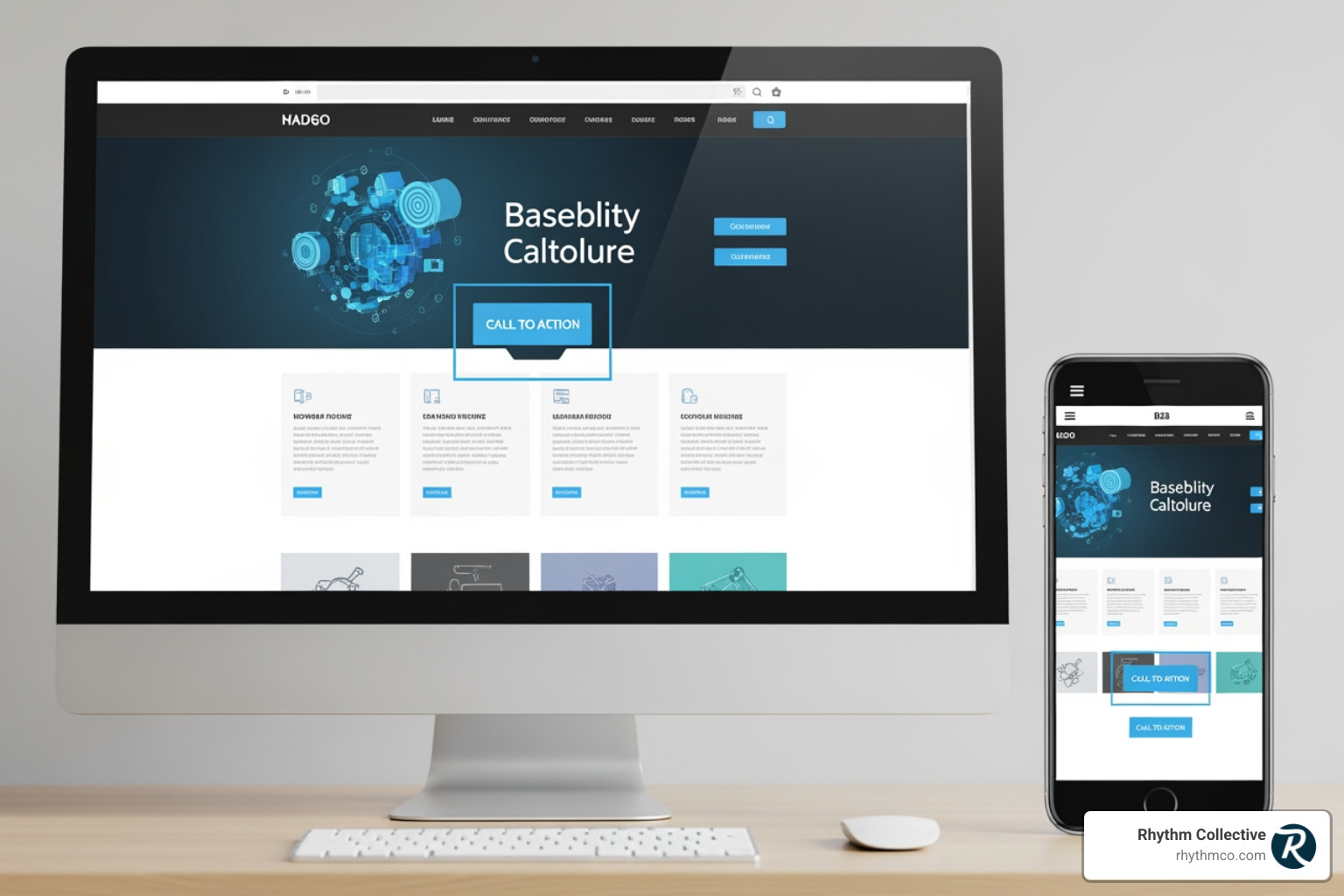
A high-performance site hinges on User Experience (UX). Website user experience determines how users interact with your pages. A poor digital presence can undermine a great company. Key elements include clear navigation, accessibility, and fast loading times, as slow websites lead to lost sales.
Mobile optimization is also non-negotiable. While mobile use is more common in B2C, it still makes up a significant 20-35% of B2B traffic. A clunky, non-responsive mobile site creates a terrible user experience. Your site’s mobile version should be responsively designed, relevant, actionable, and frictionless.
Modern B2B buyers expect self-service options. They want to browse products, place orders, and manage their accounts without constant sales assistance. Providing easy self-serve options—like online catalog browsing, simple reordering, and real-time inventory transparency—can significantly reduce the burden on your sales and support teams, streamlining the purchasing process.
Finally, Conversion Rate Optimization (CRO) is about enhancing your website to drive visitors toward desired actions. This involves optimizing calls-to-action (CTAs), product pages, and checkout processes. By continuously testing and refining these elements, we can maximize the effectiveness of your website. Our Web Design services focus on creating sites that are not only aesthetically pleasing but also highly functional, user-friendly, and optimized for conversions.
Leveraging SEO to Drive Qualified Traffic
In the digital world, if your business isn’t easily found, it’s virtually invisible. That’s why Search Engine Optimization (SEO) is a cornerstone of any effective b2b online strategy. It’s not just about getting traffic; it’s about driving qualified traffic – potential customers actively searching for solutions your business provides. In fact, 33% of B2B companies say SEO is their top lead generator.
B2B SEO is unique. Unlike B2C, where searches might be broad, B2B search queries are typically high-intent and low-volume, reflecting specific industry needs, workflows, or technical requirements. B2B clients search for products and services differently, often involving complex buyer journeys with multiple decision-makers.
Our SEO approach covers several key areas:
- Keyword Research: We identify the precise terms and phrases your target audience uses when searching for solutions. This includes focusing on long-tail, industry-specific keywords that indicate high intent.
- On-page SEO: This involves optimizing elements directly on your website, such as incorporating relevant keywords into your content, meta descriptions, title tags, and headings. This communicates to search engines exactly what your website is about.
- Off-page SEO: This builds your site’s authority and credibility through external signals, primarily high-quality backlinks from reputable industry websites. Digital PR and strategic partnerships are excellent ways to earn these valuable links.
- Technical SEO: This ensures your website’s backend is healthy, focusing on aspects like site architecture, crawlability, indexing, and page speed. Fast loading times and a mobile-friendly experience are crucial for user satisfaction and search engine rankings.
By implementing a robust SEO strategy, we help your business appear at the top of search results, attracting high-intent decision-makers who are already deep into their buying journey. Our Search Engine Marketing and Local Search Visibility services are designed to ensure your business is found by the right people, at the right time, whether they’re across the country or right here in East Tennessee.
Developing a Customer-Centric Content Plan for Your B2B Online Strategy
B2B buyers are highly informed, often completing 70% of their research before contacting sales. Your content must be an educational hub that guides prospects, establishes authority, and builds trust. A customer-centric content plan is therefore paramount to your b2b online strategy.
Engaging and helpful B2B marketing content is what keeps people on your website longer and moves them along their buyer’s journey. Our content strategy focuses on creating valuable resources that address your audience’s pain points, answer their questions, and provide solutions at every stage of the sales funnel—from awareness to decision.
We leverage a variety of content formats to achieve this:
- Blogs and Articles: Regular posts that dig into industry topics, common challenges, and solutions, positioning you as a thought leader. Longer content (2,000+ words) tends to perform better for SEO.
- Whitepapers and Ebooks: In-depth resources that offer comprehensive insights into complex topics, often used for lead generation.
- Case Studies: Real-world examples of how your products or services have successfully solved client problems, providing tangible proof of value.
- Videos: Engaging visual content, including product demonstrations, explainer videos, testimonials, and webinars. According to a LinkedIn survey, 59% of B2B marketing leaders identified video as a highly effective marketing channel. Our Video Production services can help you tell your story powerfully.
The goal is to build credibility and establish thought leadership. By consistently providing valuable information, you become a trusted resource, educating potential clients and addressing their concerns long before a sales conversation begins. This approach not only attracts prospects but also nurtures them, changing initial interest into lasting client relationships.
Engaging Prospects with Email and Social Media Marketing
Once you’ve attracted prospects with your content and website, the next step in your b2b online strategy is to engage and nurture them. Email marketing and social media are powerful tools for this, allowing for personalized communication and community building.
Email marketing remains one of the highest ROI channels in B2B, boasting an impressive return of $44 for every $1 invested. We leverage email for lead nurturing, guiding prospects through the sales funnel with targeted, personalized content. This involves segmenting your email lists based on buyer personas, industry, or stage in the buyer’s journey, ensuring that each communication is relevant and valuable. From welcome sequences to educational newsletters and promotional offers, a well-crafted email strategy keeps your brand top-of-mind. Our Email Newsletter Marketing services focus on creating campaigns that resonate and convert.
Social media’s role in B2B is rapidly expanding. Did you know that 75% of B2B buyers use social media before making a purchase? More than 60% even check out new service providers on social media, making it a more commonly used source of information than formal referrals. While platforms like Facebook and Instagram can build brand awareness, LinkedIn is the go-to platform for B2B marketing, professional networking, and thought leadership.
We help businesses effectively use social media by:
- Sharing valuable content: Distributing your blog posts, whitepapers, and videos to reach a wider audience.
- Engaging with followers: Responding to comments, answering questions, and participating in industry discussions to build community.
- Thought leadership: Positioning key team members as experts in your field.
- Targeted advertising: Using social media’s advanced targeting capabilities to reach specific decision-makers.
Our Social Media Marketing expertise ensures your presence on these platforms is strategic, engaging, and aligned with your overall business objectives, fostering relationships that drive growth.
Advanced Plays & Future-Proofing: AI, ABM, and Emerging Trends
To truly future-proof your b2b online strategy, we must look beyond traditional tactics and accept advanced plays like Account-Based Marketing (ABM), online marketplaces, and the transformative power of Artificial Intelligence (AI).
Account-Based Marketing (ABM) is a highly targeted approach that treats individual high-value accounts as markets in themselves. Instead of casting a wide net, ABM focuses resources on a select group of target accounts, developing personalized campaigns designed to engage key decision-makers within those organizations. This strategy is particularly effective for businesses with longer sales cycles and larger contract values, ensuring marketing efforts are concentrated where they’ll have the biggest impact.
Online Marketplaces for B2B sales offer significant advantages. Platforms like industry-specific marketplaces can improve visibility and brand exposure, allowing businesses to reach a broader audience and tap into industry-specific buyer pools. They can be powerful lead generation tools, placing your products or services directly where buyers are actively searching.
The rise of Artificial Intelligence (AI) is fundamentally reshaping B2B marketing. By late 2025, a projected 95% of B2B organizations will use AI for tasks like content creation and data analysis. AI streamlines operations and improves customer experience by automating tasks, personalizing recommendations, and improving online profiles and listings.
A significant trend to watch is Generative Engine Optimization (GEO). Gartner predicts that by 2026, traditional search engine volume could drop by 25% due to AI chatbots and other virtual agents. This means the future of search will likely combine traditional search engines with generative engines, requiring a new approach to optimization. We need to adapt our strategies to focus on high-intent keywords for AI-driven search, ensuring your business remains findable in this evolving landscape.
Here are some top AI applications for B2B marketers we’re exploring:
- Content Generation & Optimization: AI tools can assist with keyword research, topic clustering, competitive analysis, and generating early drafts of content.
- Data Analysis & Insights: AI can rapidly process vast datasets to uncover patterns, predict customer behavior, and identify optimal marketing strategies.
- Personalization & Automation: AI-powered tools can deliver hyper-personalized content and product recommendations, automate email sequences, and streamline customer interactions.
- Chatbots & Virtual Assistants: Providing instant customer support, guiding buyers through the sales funnel, and qualifying leads on your website.
These advanced strategies and emerging trends are not just buzzwords; they are vital components for a forward-thinking b2b online strategy that drives profitable revenue and ensures long-term growth.
Measuring What Matters: Tracking the ROI of Your B2B Marketing Efforts
A crucial element of any successful b2b online strategy is measuring its impact. Tracking the Return on Investment (ROI) of your B2B marketing efforts allows for data-driven decisions and continuous improvement.
Key Performance Indicators (KPIs) are your compass in this journey. While 70% of marketers face challenges measuring campaign ROI, a clear understanding of these metrics will set your business apart.
Here are some essential B2B metrics and how they help us gauge success:
| Metric | Definition |
|---|---|
| Conversion Rate | The percentage of website visitors who take a desired action, such as filling out a form, downloading content, or making a purchase. |
| Customer Acquisition Cost (CAC) | The total cost of sales and marketing efforts required to acquire a new customer. |
| Customer Lifetime Value (CLV) | The total revenue a business can reasonably expect from a single customer account throughout their relationship. |
| Return on Ad Spend (ROAS) | The revenue generated for every dollar spent on advertising. |
| Pipeline Contribution | The portion of your sales pipeline that originated from or was influenced by your online marketing activities, indicating how leads translate into actual business. |
Tools like Google Analytics are indispensable for measuring and analyzing your site traffic, user behavior, and conversion funnels. For deeper insights into SEO, platforms like Moz and Semrush provide invaluable data on keyword rankings, backlink profiles, and competitive analysis.
We emphasize focusing on metrics that directly correlate with profitable revenue and long-term growth, not just vanity metrics like website clicks. It’s about understanding how your online efforts contribute to your sales pipeline and ultimately, your bottom line. By continuously tracking these KPIs and adapting your strategies, we ensure your marketing investments are always optimized for the best possible outcomes.
Frequently Asked Questions about B2B Online Strategy
How long does it take to see results from a B2B online strategy?
A comprehensive b2b online strategy is a marathon, not a sprint. While some improvements like keyword rankings can appear in a few months, significant results from inbound marketing and SEO typically take 6-12 months. This is due to the longer B2B buying cycles. A phased implementation is often best, but the key is consistency and a long-term perspective for sustainable growth.
What are the most common pitfalls to avoid?
Even the best strategies can stumble if common pitfalls aren’t avoided. Here are some traps we help our clients steer clear of:
- Neglecting Research: Assuming you know your market without thorough research is a recipe for disaster. Firms that don’t conduct systematic research are significantly less profitable than those that do.
- Inconsistent Execution: A brilliant strategy is useless without consistent, disciplined execution. Sporadic efforts lead to fragmented results and wasted budgets.
- Poor User Experience (UX): A clunky website, slow load times, or difficult navigation can ruin a great company’s digital presence. If your website doesn’t offer a seamless experience, prospects will quickly look elsewhere.
- Ignoring Analytics: Failing to measure and iterate means you’re flying blind. Without tracking KPIs and analyzing performance, you can’t identify what’s working, what’s not, or where to optimize.
- Misalignment Between Sales and Marketing: When sales and marketing teams operate in silos, leads can fall through the cracks, and messaging can become inconsistent. Collaboration is key.
- Chasing Vanity Metrics: Focusing on superficial numbers like website clicks without understanding their impact on conversions and revenue can lead to misdirected efforts and a false sense of success.
How do I choose the right technology stack for my B2B strategy?
Choosing the right technology stack is critical for an efficient b2b online strategy. With 85% of B2B companies now prioritizing a single, centralized commerce platform, the goal is seamless integration and real-time data visibility.
When evaluating technology, consider:
- Unified Commerce Capabilities: Your platform should ideally manage both B2B and B2C operations (if applicable) from a single system. This provides a holistic view of your customers and inventory.
- CRM Integration: Seamless connection with your Customer Relationship Management (CRM) system is vital. This ensures that all customer interactions, lead nurturing efforts, and sales data are centralized and accessible.
- ERP Integration: Integration with your Enterprise Resource Planning (ERP) system is crucial for managing inventory, orders, and financial data efficiently. Native integrations can significantly streamline operations.
- Scalability: Choose a platform that can grow with your business, handling increasing traffic, order volumes, and expanding product catalogs without performance issues.
- Total Cost of Ownership (TCO): Look beyond initial setup costs to ongoing maintenance and integration expenses. A unified platform can often offer significant TCO savings.
Mapping out the systems and tools you need, and ensuring they can communicate effectively, is a foundational step. This approach prevents data silos, automates workflows, and provides a comprehensive view of your B2B operations, ultimately enhancing both customer experience and operational efficiency.
Conclusion: From Strategy to Sustainable Growth
The B2B landscape is dynamic, so your b2b online strategy must be a living blueprint that you continuously optimize. By understanding your audience, building a high-performance website, leveraging SEO, creating valuable content, and engaging through multiple channels, your business can thrive. Integrating advanced tactics like AI and ABM will keep you ahead of the curve.
Our mission at Rhythm Collective, based right here in Knoxville, TN, is to help businesses like yours steer this complexity. We don’t just focus on generating leads; we’re dedicated to delivering profitable revenue and long-term growth. We believe that with the right strategy, executed with precision and optimized with data, your business can achieve remarkable success in the digital field.
Are you ready to transform your online presence into a powerful engine for growth? Let our team of experts build a powerful b2b online strategy custom for your business.
Explore our Creative Marketing Agency Services and let’s start building your future today. Contact Us to learn more.