Why Your E-commerce Business Needs a Channel Strategy Now
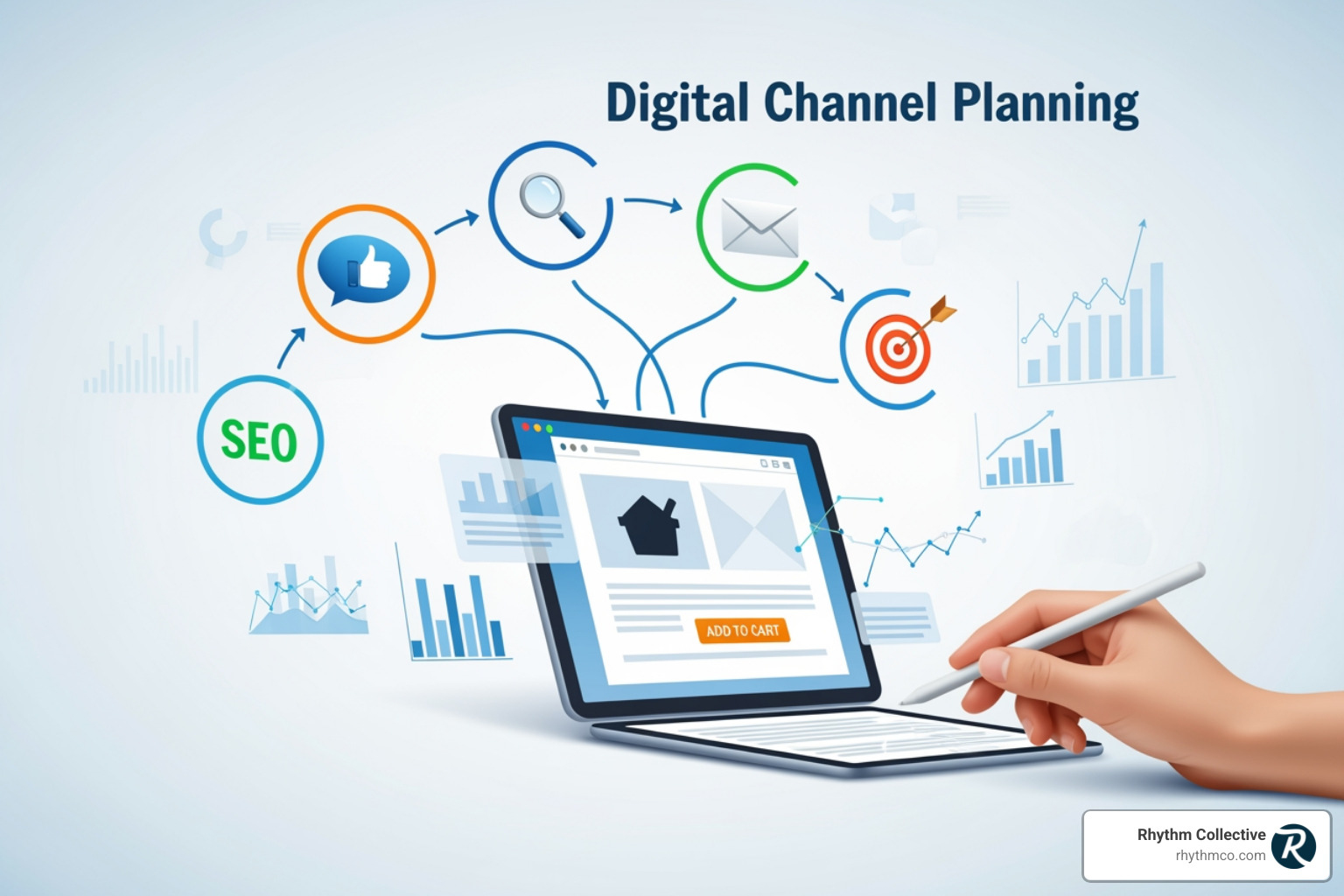
Digital channel planning and e commerce strategy is about mapping out where and how you’ll sell online, then coordinating those channels so customers get a consistent, seamless experience that drives profitable growth.
Quick Answer: What You Need to Know
- What it is: A strategic framework that determines which online sales channels to use (your website, Amazon, social media, etc.) and how to coordinate them effectively
- Why it matters: Companies with strong omnichannel strategies retain 89% of customers vs. just 33% for weak strategies
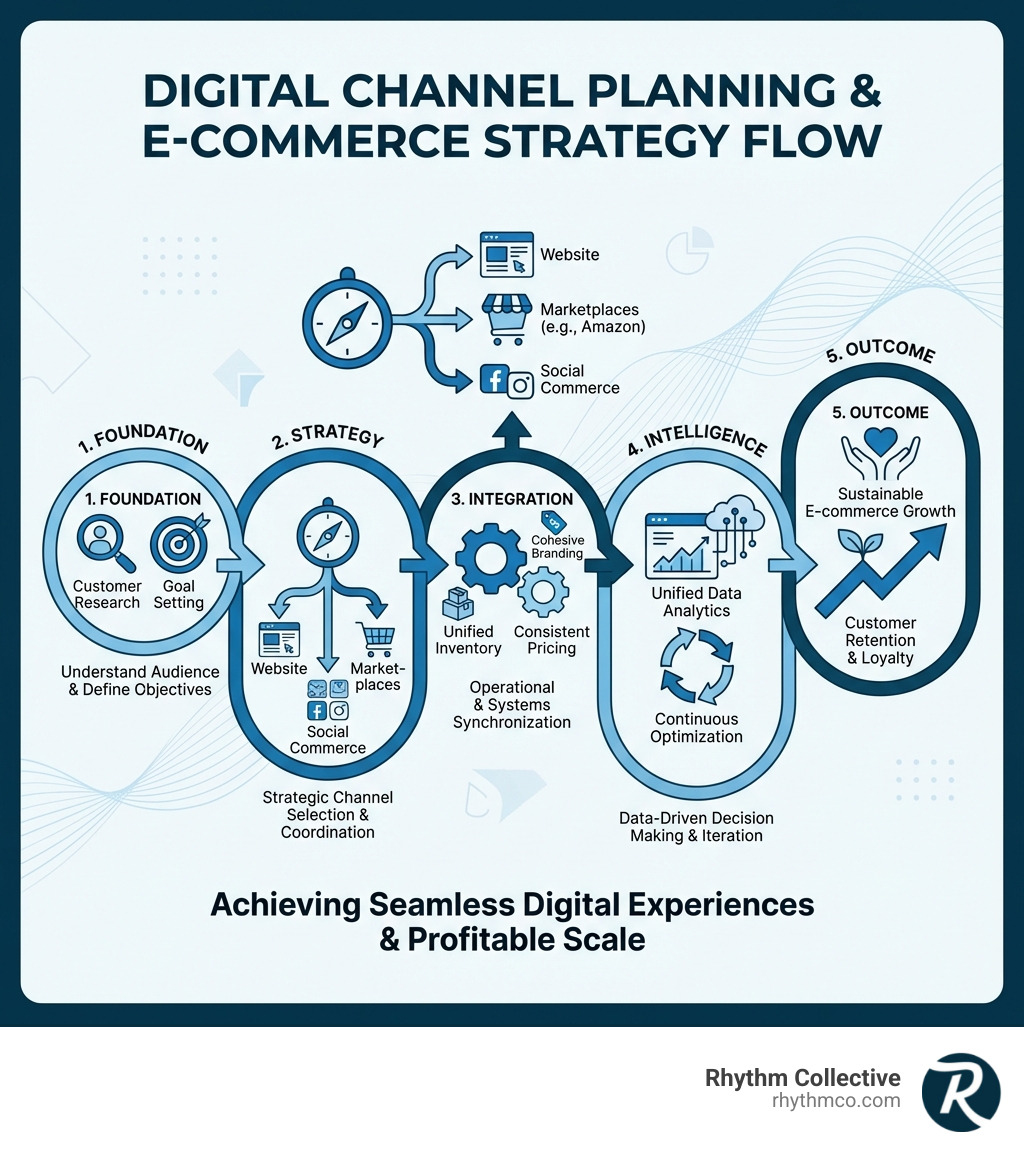
- Key components: Customer journey mapping, channel selection, unified inventory and pricing, consistent branding, and data-driven optimization
- The outcome: Sustainable revenue growth through coordinated channels that work together instead of competing against each other
Here’s the reality: the global e-commerce sector is racing toward US$4.32 trillion by 2025. But growth alone isn’t the goal. Your customers expect seamless digital experiences, not disjointed touchpoints where your Amazon listing contradicts your website and your social media feels like a different brand entirely.
Without a defined channel strategy, you’re essentially running multiple businesses that accidentally have the same name. One channel might offer different pricing than another. Inventory might be out of sync. Your brand message gets diluted.
Digital channel planning is the process of deciding which online platforms make sense for your business, then building the operational backbone to manage them as one coordinated system. It’s not just about being everywhere. It’s about being in the right places, with the right message, at the right time.
Nearly 47% of companies don’t have a planned digital marketing strategy. That’s not just a missed opportunity. It’s leaving money on the table while competitors who do have a strategy capture market share.
The difference between companies that scale profitably and those that struggle comes down to strategic planning, operational integration, and data-driven decision making. This guide walks you through exactly how to build that foundation.
The Foundation: Understanding Your Customer and Marketplace
Before we dive into the nitty-gritty of channel selection and technical integrations, we need to lay a solid foundation. This starts with understanding your customer and the marketplace they inhabit. A well-defined e-commerce strategy that truly understands your audience is the bedrock for sustainable business growth. Customers expect seamless digital experiences, not disjointed touchpoints across multiple channels. Our goal is to guide shoppers naturally from findy to purchase and beyond, fostering lasting customer relationships.
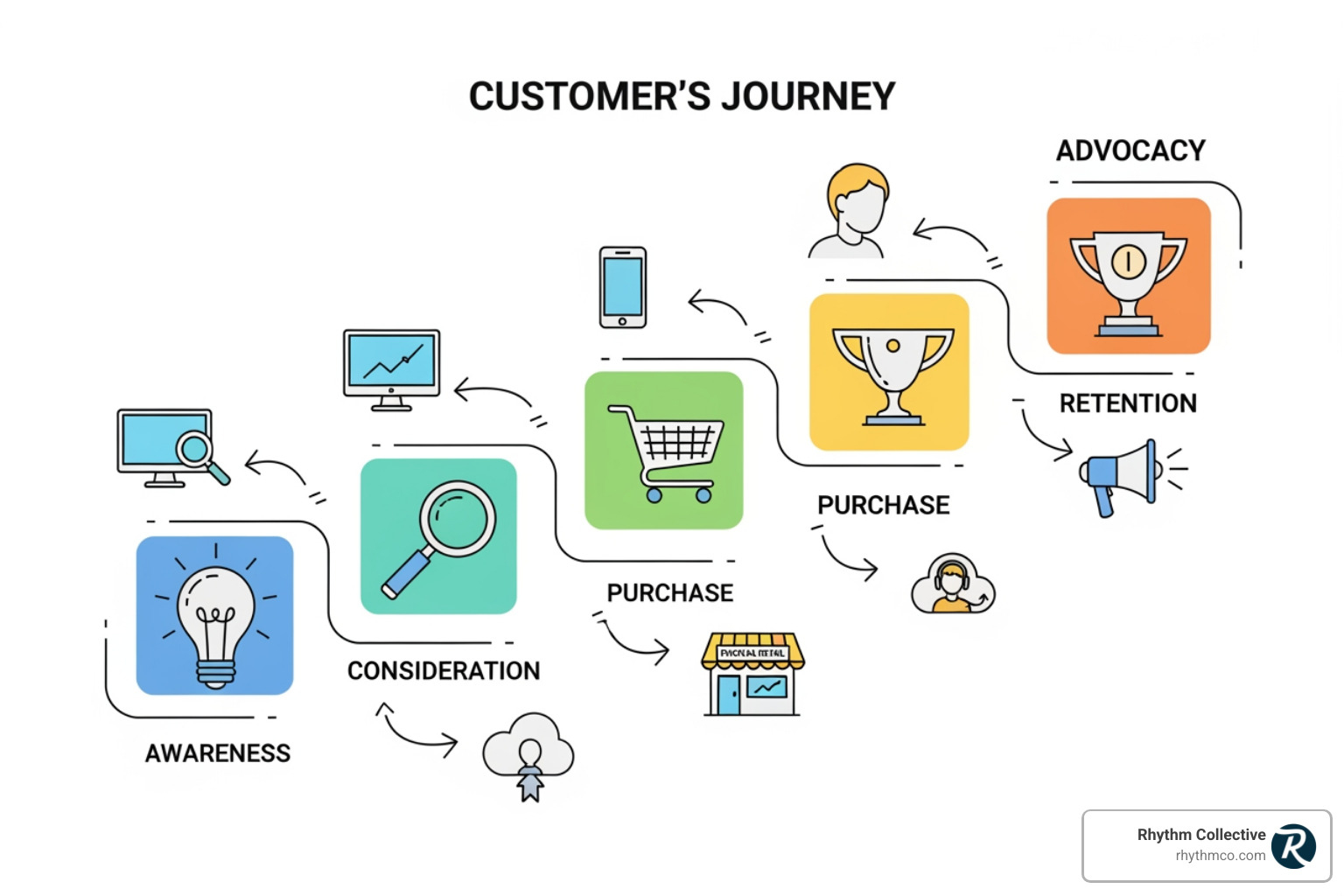
This involves a comprehensive customer journey analysis, creating detailed buyer personas, conducting thorough market research, and performing a deep dive into competitor analysis. By understanding how your customers interact with your brand and what your competitors are doing, we can identify opportunities to reduce friction and lift conversions. For a deeper dive into understanding your market, consider exploring a guide to conducting competitor analysis to uncover hidden opportunities.
Defining Your E-commerce Goals and KPIs
Any effective digital channel planning and e commerce strategy begins with clear, measurable goals. We can’t improve what we don’t measure. That’s why defining SMART (Specific, Measurable, Achievable, Relevant, Time-bound) goals and Key Performance Indicators (KPIs) is non-negotiable. Without clear objectives, your strategy can quickly become unfocused, leading to wasted budget and missed opportunities.
For an e-commerce business, typical KPIs might include:
- Traffic goals: How many visitors are we aiming for on each channel?
- Conversion rates: What percentage of visitors are completing a purchase or desired action?
- Average Order Value (AOV): How much do customers spend per transaction?
- Customer Lifetime Value (CLV): The total revenue we expect from a customer over their relationship with us.
- Customer Acquisition Cost (CAC): How much does it cost to acquire a new customer?
- Return on Ad Spend (ROAS): The revenue generated for every dollar spent on advertising.
These metrics aren’t just numbers; they tell a story about your business’s health and the effectiveness of your digital channels. Setting these targets early allows us to align all our efforts and ensures every tactic contributes to measurable growth. If you need help defining your goals, our marketing consulting services can provide expert guidance.
Mapping the Customer Journey
Understanding the customer journey is paramount. It’s about tracing every touchpoint a customer has with your brand, from initial awareness to post-purchase advocacy. This analysis helps us identify where customers find your products (the “findy” phase), how they evaluate options (consideration phase), where they make a purchase (purchase phase), and how we build loyalty (retention and advocacy phases).
By mapping this journey, we can pinpoint areas of friction that might be causing customers to drop off. Is your website slow? Is the checkout process too complicated? Are customer service responses delayed on certain channels? Addressing these friction points is crucial for improving the overall experience and boosting conversions. A smooth journey leads to satisfied customers and repeat business, strengthening customer engagement and loyalty.
Selecting the Right E-commerce Sales Channels
The temptation to be present on every platform is strong, but effective channel management is less about maximum presence and more about strategic selection. We need to identify where our target audience spends their time and how those channels align with our brand positioning and operational capabilities.
Common e-commerce sales channels include:
- Owned channels: Your direct-to-consumer (D2C) website, which offers maximum control over brand experience and data.
- Marketplaces: Platforms like Amazon, eBay, or Walmart, which offer vast reach but often come with more competition and platform-specific rules. As a low-cost way to expand revenue, many businesses add online sales channels like these to reach new markets.
- Social commerce: Selling directly through social media platforms like Instagram and Facebook, leveraging shoppable posts and influencer marketing.
- B2B distributors: For businesses selling wholesale or to other businesses, specialized distributors might be a key channel.
The choice of channels should be disciplined, not opportunistic. A luxury brand, for example, might deliberately avoid certain mass-market platforms to preserve its exclusive positioning. The goal is to engage your audience on their terms, using their preferred channels and tone of voice. This strategic approach helps answer the question of what is multichannel ecommerce? and how to best use it.
Developing Your Digital Channel Planning and E-commerce Strategy
With a clear understanding of your customer and marketplace, we can now construct a robust digital channel planning and e commerce strategy. This isn’t just a document; it’s a practical roadmap that aligns your online storefront, marketing, operations, and data to drive revenue growth and reduce waste.
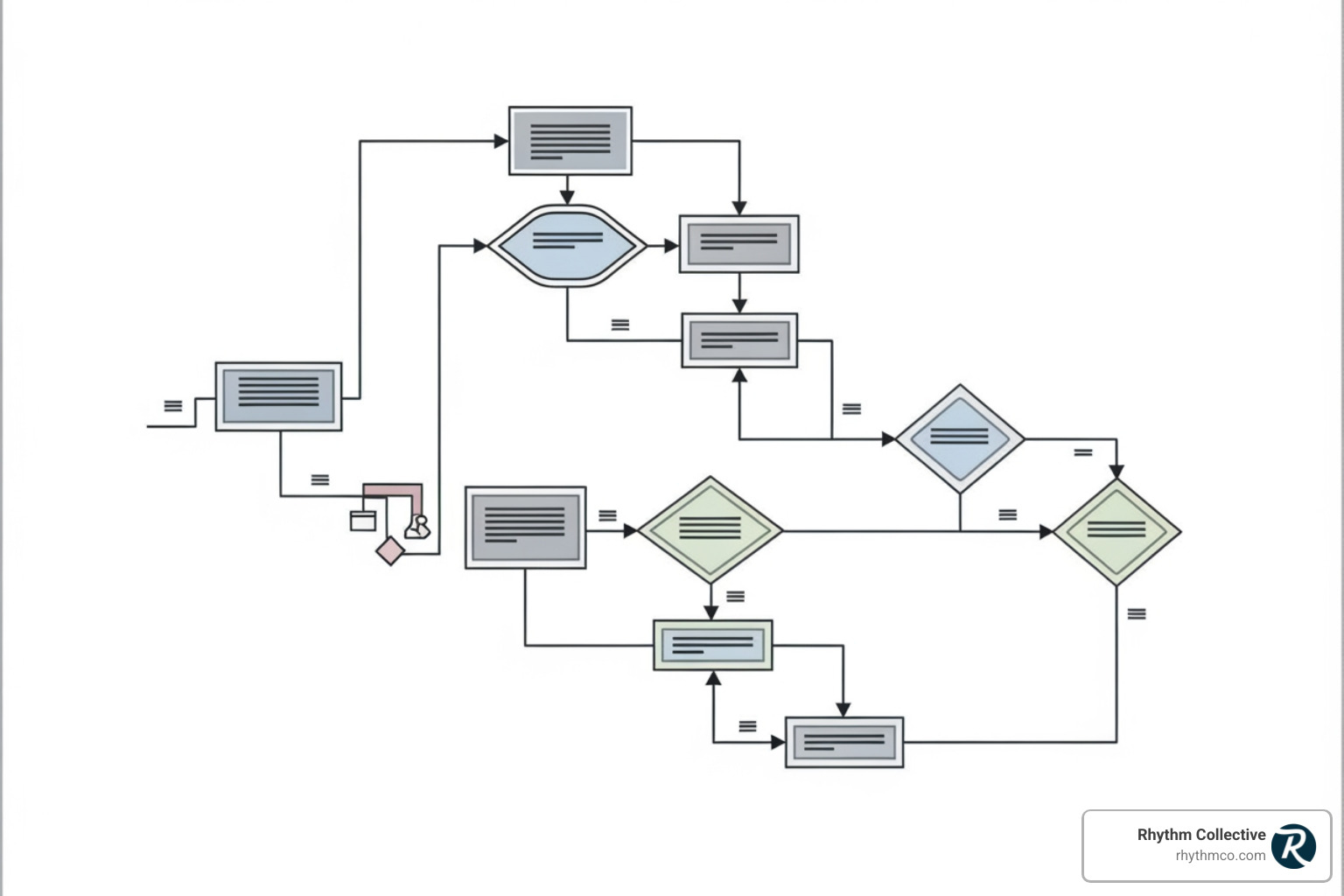
An integrated approach is vital. We often use frameworks like the Smart Insights RACE (Reach, Act, Convert, Engage) framework to structure our digital marketing plan. This helps us define essential activities and measures across the customer lifecycle. We then prioritize strategic initiatives and allocate our budget effectively across channels, recognizing that an integrated digital marketing strategy is essential for acquiring and retaining customers. For more insights on how to structure your plan, refer to how to structure a digital marketing plan.
Key Components of an Effective Digital Channel Planning and E-commerce Strategy
An effective e-commerce channel management strategy hinges on several critical components that ensure coordination and efficiency:
- Centralized Inventory Management: This is crucial to prevent overselling and stockouts, which can quickly erode customer trust. A centralized system integrates in real-time with all your sales channels, ensuring accurate inventory counts across the board.
- Unified Pricing Policy (MAP): Establishing a formalised Minimum Advertised Price (MAP) policy and communicating it clearly to all distribution partners is essential. This minimizes channel conflict and maintains brand value. Customers shouldn’t find your product for significantly different prices on various platforms, as this can lead to feelings of being cheated.
- Brand Consistency: Maintaining consistent product listings, messaging, and visual identity across all channels is paramount for brand integrity and consumer trust.
- Product Information Management (PIM): While not explicitly mentioned in all research, a PIM system helps manage and distribute consistent product data (descriptions, images, specifications) across all your channels from a single source. This is vital for maintaining brand consistency.
- Partner Relationship Management (PRM): For businesses working with distributors or resellers, a PRM platform or a structured communication cadence (e.g., quarterly business reviews) is vital for cultivating strategic alliances rather than just transactional interactions.
These components ensure that your various channels work in harmony, not in competition. Our marketing management services can help you implement these critical systems.
Ensuring Brand Consistency and a Unified Experience
Brand consistency is the cornerstone of a unified customer experience. When a customer interacts with your brand on your website, then on Amazon, and then on social media, they should feel like they’re engaging with the same entity. This builds trust and reinforces your brand identity.
Key elements for ensuring consistency include:
- Brand style guide: A comprehensive document outlining your logo usage, color palettes, typography, and imagery.
- Digital asset management (DAM): A system to store, organize, and distribute all your brand assets (images, videos, product descriptions) to ensure everyone uses the correct, approved versions.
- Consistent messaging: Maintaining a uniform tone of voice and core brand message across all platforms.
- Visual identity: Ensuring that the look and feel of your brand remain consistent, whether it’s an ad, a product page, or a social media post.
As we know from our graphic design expertise, why consistent graphic design is vital is because it directly impacts brand recognition and customer perception.
Managing Inventory and Pricing Across Channels
Effectively managing inventory and pricing across multiple e-commerce channels is crucial to prevent conflict and ensure customer satisfaction. Without a robust system, operational challenges like overselling inventory and missing delivery deadlines can quickly arise.
- Inventory synchronization: Implementing a centralized inventory management system that integrates in real-time with all sales channels is essential. This prevents stockouts on one channel while products sit unsold on another, ensuring you always have accurate stock levels.
- Preventing channel conflict: A customer who buys a product from your website for one price and then sees it significantly cheaper on a marketplace can feel cheated. This is where a unified pricing policy comes in.
- Minimum Advertised Price (MAP) policies: For brands that distribute through partners, a formalised MAP policy clearly communicated to all channels helps maintain price integrity and brand value.
- Dynamic pricing: While requiring careful management, dynamic pricing strategies can allow for adjustments based on demand, competition, and inventory levels, optimizing profitability across channels without causing severe conflict.
By coordinating these aspects, we ensure a fair and consistent experience for customers, regardless of where they choose to shop. For more detailed guidance, refer to Ecommerce Channel Management Best Practices.
From Multichannel to Omnichannel: Execution and Technology
The digital landscape is constantly evolving, and so must our approach to e-commerce. Moving beyond simply having a presence on multiple channels (multichannel) to creating a truly integrated, customer-centric experience (omnichannel) is where execution meets technology. This transition helps us overcome operational challenges and streamline workflows, building a robust technology stack that can adapt and grow.
AI and other emerging technologies are increasingly playing a role in this change, offering new ways to personalize experiences, automate tasks, and gain deeper insights.
Multichannel vs. Omnichannel: Why a Unified Approach Wins
Understanding the difference between multichannel and omnichannel is key to our digital channel planning and e commerce strategy:
- Multichannel e-commerce: Means selling products online across multiple independent platforms. Each sales channel can operate independently, often leading to operational challenges and a disjointed customer experience.
- Omnichannel e-commerce: Integrates all these touchpoints, providing a seamless, unified, and consistent customer experience regardless of how or where they interact with your brand. The customer’s journey is fluid, moving effortlessly between online and offline channels.
Why is omnichannel important for customer retention? The statistics speak for themselves: companies with strong omnichannel customer engagement retain an average of 89% of their customers, compared to just 33% for companies with weak omnichannel strategies. Furthermore, 62% of consumers prefer to buy from brands that offer a seamless omnichannel experience. This unified approach ensures that customer data is integrated, providing customer service teams with a holistic view of a customer’s order history and interactions across all channels. This level of insight allows for personalized service and proactive problem-solving, significantly boosting loyalty. Our website management services are designed to support this seamless integration.
Leveraging Technology and AI to Streamline Operations
To overcome multichannel challenges and streamline e-commerce operations, businesses must strategically leverage technology and software. This isn’t just about having tools; it’s about building an integrated ecosystem that supports your entire digital channel planning and e commerce strategy.
Key technologies include:
- E-commerce platforms: Platforms like Shopify, WooCommerce, or Magento provide the foundational storefront for your direct sales channel.
- Inventory management software: As discussed, a centralized system is vital for real-time synchronization across all sales points.
- CRM systems: Customer Relationship Management (CRM) software helps manage customer interactions and data across various touchpoints, enabling personalized communication and service.
- Marketing automation: Tools for automating email campaigns, social media posts, and other marketing efforts save time and ensure consistent outreach. Our email drip campaign automation services are a prime example.
- AI for personalization: AI-powered tools can analyze customer behavior to offer personalized product recommendations, dynamic merchandising, and custom content, significantly boosting conversion rates.
- AI for product photography: Emerging AI technologies can cut costs in content creation, offering efficient solutions for high-quality product visuals.
These technologies, when integrated effectively, create a powerful operational backbone that enables agility, efficiency, and a truly unified customer experience.
Common Pitfalls to Avoid in Your E-commerce Strategy
Even with the best intentions, implementing an e-commerce channel strategy can be fraught with pitfalls. Recognizing these common mistakes can save us significant time, money, and frustration.
- Ignoring SEO: With over 40% of all e-commerce traffic coming from organic search, neglecting Search Engine Optimization is like opening a store in a hidden alley. Let organic search do the heavy lifting!
- Weak content marketing: Underestimating the power of valuable information to convert customers is a mistake. Content marketing has a compounding effect, driving traffic and sales long after publication, unlike paid ads.
- Poor paid ad execution: Simply pouring money into campaigns without clear targeting, compelling copy, and optimized landing pages will lead to low ROI. Test first, scale later.
- Overcomplicating the user experience: We often see businesses try to offer too many options or make the shopping process overly complex. Reduce friction, not options, to keep customers moving towards purchase.
- Lack of a defined strategy: This is a big one. As mentioned earlier, nearly 47% of companies don’t have a planned digital marketing strategy. Without a clear roadmap, what follows is guesswork, which is a fast way to burn through your budget without tangible results.
- Inaccurate tracking: 70% of marketers report facing moderate to significant challenges in measuring campaign ROI. If you can’t accurately track performance, you can’t optimize. This leads to inefficient spending and missed opportunities.
As the experts at Why So Many Digital Marketing Campaigns Don’t Work highlight, most campaigns fail not because digital marketing doesn’t work, but because the approach is off.
Measure, Optimize, and Dominate: The Role of Data Analytics
In the dynamic world of e-commerce, continuous measurement and optimization are not optional—they are essential for survival and growth. Data analytics plays an indispensable role in optimizing e-commerce channel performance and decision-making. Insights-driven businesses are growing at an average of more than 30% annually, underscoring the power of leveraging data.
This involves setting up robust data governance, conducting A/B testing to refine strategies, and committing to continuous improvement based on real-time insights. Our search engine marketing efforts are continuously refined through data analysis.
Measuring the Success of Your Digital Channel Planning and E-commerce Strategy
To truly understand the impact of our digital channel planning and e commerce strategy, we must rigorously measure its success. This goes beyond vanity metrics and focuses on indicators that directly tie to profitability and growth.
Key metrics for measuring success include:
- Customer Acquisition Cost (CAC): The total cost associated with convincing a consumer to buy a product or service.
- Return on Ad Spend (ROAS): The revenue generated for every dollar spent on advertising.
- Conversion Rate: The percentage of visitors who complete a desired action, like making a purchase.
- Average Order Value (AOV): The average amount spent per customer order.
- Customer Retention Rate: The percentage of customers who remain customers over a given period. Studies show that increasing customer retention by just 5% can boost profits by 25% to 95%.
- Cohort analysis: Analyzing groups of customers based on their acquisition date helps measure retention and Customer Lifetime Value (LTV) by acquisition channel.
- Funnel drop-offs: Identifying where customers abandon their journey helps pinpoint areas for improvement.
- Attribution modeling: Understanding which touchpoints contributed to a conversion helps allocate budget more effectively.
Using Data to Optimize Channel Performance
Data isn’t just for reporting; it’s for action. We use insights from our analytics to continuously optimize channel performance and refine our digital channel planning and e commerce strategy.
- Performance auditing: Regular audits of each channel’s performance help us identify what’s working and what needs adjustment.
- Channel-specific KPIs: Setting and monitoring KPIs custom to each channel (e.g., organic traffic for SEO, CTR for paid ads, open rates for email) allows for granular optimization.
- Budget reallocation: Based on performance data, we can strategically reallocate ad spend and resources to channels yielding the highest ROI, reducing wasted ad spend.
- Personalization strategies: Data allows us to segment audiences and deliver personalized content and offers, increasing relevance and conversion rates.
- Conversion Rate Optimization (CRO): Continuously testing and refining elements on our websites and landing pages (e.g., calls-to-action, product images, checkout flow) helps maximize conversions.
Tools like Google Analytics are invaluable for tracking on-site behavior, attribution, and funnel drop-offs, providing the insights needed for informed decision-making.
Frequently Asked Questions about E-commerce Channel Strategy
What is the difference between multichannel and omnichannel e-commerce?
Multichannel e-commerce refers to selling products across multiple independent platforms or channels, where each channel might operate in a silo. Omnichannel e-commerce, on the other hand, integrates all these channels to provide a seamless, unified, and consistent customer experience, regardless of where or how the customer interacts with the brand. The key difference is integration and a customer-centric view, which is crucial for customer retention.
What are the most critical components of an e-commerce channel strategy?
The most critical components include a comprehensive customer journey analysis, strategic selection of e-commerce sales channels, centralized inventory and unified pricing management across all platforms, maintaining consistent branding and messaging, and leveraging a unified data analytics framework for continuous optimization.
How do you measure the success of an e-commerce channel plan?
Success is measured by tracking a range of specific Key Performance Indicators (KPIs) that align with your business goals. These typically include Customer Acquisition Cost (CAC), Customer Lifetime Value (LTV), conversion rate per channel, Average Order Value (AOV), Return on Ad Spend (ROAS), and overall Return on Investment (ROI). Regular monitoring and analysis of these metrics allow for data-driven adjustments and continuous improvement.
Let’s Build Your Blueprint for E-commerce Success
Developing a comprehensive digital channel planning and e commerce strategy might seem daunting, but it’s the secret sauce for thriving in today’s competitive online marketplace. It’s a practical roadmap that aligns your online storefront, marketing, operations, and data to drive profitable revenue and sustainable growth.
At Rhythm Collective, we understand that an integrated approach is not just a nice-to-have; it’s a necessity. We believe in creating seamless digital experiences that guide shoppers naturally from findy to purchase and beyond, fostering lasting customer relationships. As a Knoxville, TN-based Creative & Marketing Agency, we specialize in web design, video, graphic design, SEO, and digital strategy, all geared towards delivering profitable revenue and long-term growth for our clients. We’ve helped businesses generate over $140 million, proving that with the right strategy, your digital domination is within reach.
Ready to stop guessing and start growing? Let us help you build your blueprint for e-commerce success. Get started with our creative marketing agency services today.