
Why a Digital Marketing and Social Media Strategy is Your Roadmap to Revenue Growth
A digital marketing and social media strategy is your comprehensive plan for using digital channels—especially social platforms—to achieve specific business goals like revenue growth, lead generation, and brand awareness. It’s the difference between simply being on social media and using social media to drive measurable business results. Here’s what you need to build one:
Core Components of an Effective Strategy:
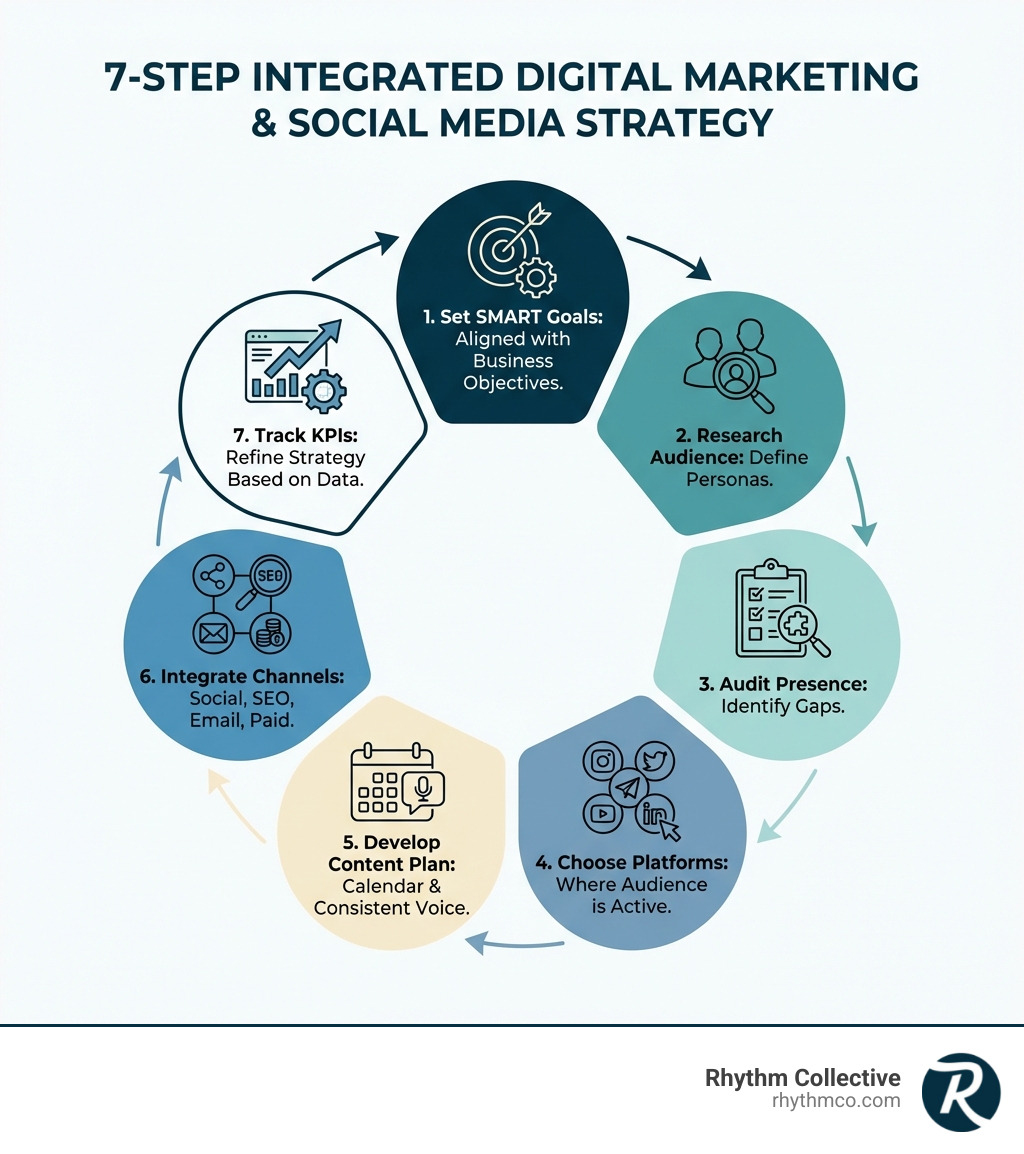
- Clear, measurable goals aligned with business objectives (using the SMART framework). This means moving beyond vague desires like “more engagement” to specific targets like “increase website conversions from social media by 15% in Q3.”
- Deep audience understanding through personas and social listening. You must know who you’re talking to, what they care about, and what problems they need to solve.
- Platform selection based on where your customers actually spend their time. It’s better to dominate one relevant channel than to be mediocre on five irrelevant ones.
- A content plan with themes, a calendar, and a consistent brand voice. This ensures your messaging is strategic, not sporadic, and builds brand equity over time.
- Integration across SEO, email, paid ads, and social media. This creates a seamless customer journey, where a user might find you on social, read your blog post found via SEO, and convert through an email campaign.
- Performance tracking using KPIs that prove ROI, not vanity metrics. Focus on metrics that connect directly to revenue, like cost per acquisition and customer lifetime value.
- A process for regular testing and refinement based on real data. Your strategy should be a living document, not a set-it-and-forget-it plan.
Without this roadmap, you’re essentially sailing without a compass—posting sporadically, chasing trends, and wondering why your marketing budget isn’t delivering the profitable growth you need.
Here’s the reality: 68% of marketers worry about ROI, and many campaigns fail not because digital marketing doesn’t work, but because the foundation is weak. The difference between marketing that generates leads and marketing that drives profitable revenue comes down to strategic planning, consistent execution, and data-driven adaptation.
Social media isn’t just about likes and shares anymore. 25% of American adults now use social media as their primary search channel, and 46% of Gen Z prefer it over traditional search engines. This seismic shift means your strategy must treat social platforms as the powerful business tools they’ve become—places where customers in Knoxville and beyond research, compare, and make buying decisions. Your social profile is often the first impression you make.
The good news? You don’t need a massive budget to compete. You need clarity on your goals, deep knowledge of your audience, and a living document that evolves as you learn what works. This guide will show you exactly how to build that strategy, step by step.
Laying the Foundation: Goals, Audience, and Audits
Before we dive into the nitty-gritty of content creation and platform specifics, we need to establish a solid foundation for your digital marketing and social media strategy. This involves defining what success looks like, understanding who we’re talking to, and taking stock of where we currently stand.

Defining Your Digital Marketing and Social Media Strategy Goals
The first step in any successful digital marketing and social media strategy is setting clear, measurable goals. Without them, it’s impossible to track progress or prove the value of your efforts. Think about your broader business objectives first. Do you need to increase sales, improve brand reputation, or improve customer loyalty? Your marketing goals should directly support these.
We advocate for the SMART framework, which ensures your objectives are well-defined and trackable:
- Specific: Clearly state what you want to accomplish. Who is involved? What are the details?
- Measurable: Define the metrics you will use to determine success. How much? How many?
- Attainable: Be realistic. Is your goal achievable with your available resources and constraints?
- Relevant: Ensure the goal aligns with your overarching business objectives. Does this matter to your bottom line?
- Time-bound: Set a deadline. This creates urgency and helps with planning.
For example, instead of “get more followers,” a SMART goal might be “increase qualified leads from organic search by 30% within six months” or “grow email subscribers by 25% this quarter by promoting our newsletter on LinkedIn and Facebook.”
Common goals for a social media strategy include:
- Brand Awareness: A significant 79% of marketers target brand awareness. This focuses on increasing your brand’s visibility and recognition among your target audience.
- Lead Generation: Driving potential customers to your website or contact forms.
- Conversion Rates: Improving the percentage of visitors who complete a desired action, like making a purchase. In fact, 69% of marketers prioritize key performance indicators (KPIs) like conversion rate or click-throughs for ROI.
- Website Traffic: Directing users from social media and other digital channels to your website.
- Customer Engagement: Fostering interaction and building a community around your brand.
- Customer Satisfaction: Using social channels for support and feedback.
- Market Research: Gaining insights into customer preferences and industry trends.
The key is to focus on the right KPIs (Key Performance Indicators) that directly tie back to your business objectives. Skip vanity metrics like follower count if they don’t translate into tangible business growth. Prioritize metrics like conversion rate or click-throughs, which 69% of marketers prioritize for ROI. As experts, we help you identify these crucial metrics to ensure your efforts lead to profitable revenue and long-term growth, not just fleeting attention.
Understanding Your Target Audience
Who are you trying to reach in Knoxville, TN, or East Tennessee? This might sound obvious, but truly understanding your audience goes far beyond basic demographics. We need to create detailed customer personas that capture their demographics, pain points, motivations, online habits, and content preferences.
To truly know your audience, we recommend a multi-faceted approach:
- Creating Audience Personas: These semi-fictional representations of your ideal customers help us tailor content, messaging, and ad targeting. To build them, we combine data from your website analytics, customer surveys, and interviews with your sales and customer service teams. For instance, a retail brand might create different personas for luxury buyers (who might respond better to exclusive event invitations) versus budget-conscious shoppers (who prefer direct sales ads).
- Social Listening: If you’re not engaged in social media listening, you’re missing out on mountains of actionable insights from real people discussing your brand or industry online. This helps us understand their needs and how they talk about products and services like yours. In fact, 1/3 of brands in 2024 rely on social listening to stay ahead of trends.
- Gathering Real-World Data: Use analytics tools to understand who your followers are, where they live, what languages they speak, and how they engage with your brand. Jugnoo, an Uber-like service for auto-rickshaws, famously used Facebook Analytics to learn that 90% of their users who referred other customers were between 18 and 34 years old, and 65% of that group was using Android. This allowed them to target their ads with precision, resulting in a 40% lower cost per referral. This level of insight is crucial for effectively reaching Reach Local Customers in your area.
By deeply understanding our audience, we can ensure our message resonates, engagement rates climb, and our marketing budget is spent effectively.
Conducting an Internal Audit
Before launching into new strategies, assess your current digital footprint. A comprehensive internal audit helps us understand what’s working, what’s not, and where opportunities lie.
- Social Media Presence Review: Evaluate all existing social media accounts. Which platforms are you active on? Are they consistent in branding and messaging? Are there any inactive or underperforming accounts that need attention, or perhaps even deletion?
- Content Gap Analysis: Look at your existing content. What types of content perform best? Are there topics your audience is interested in that you haven’t covered? What content are your competitors producing that you aren’t? This helps identify “blue ocean” topics where you can become a thought leader.
- Social Media Audit: This is a deeper dive. For each account, ask:
- What is the purpose of this account? Does it align with our overall goals?
- Who is connecting with us here? Does this match our target persona?
- Which sites does our target market use most often?
- How does our presence compare to competitors? Look at their content themes, posting frequency, engagement rates, and the tone of their community interactions. This isn’t about copying them, but about identifying opportunities and benchmarks.
- Are there any impostor accounts we need to report?
- Profile Optimization: Ensure all your social media profiles are fully optimized. This means filling out all fields, using relevant keywords in your bio, and maintaining consistent branding (profile pictures, cover photos). A well-optimized profile improves visibility and makes it easier for potential customers in Knoxville, TN, or East Tennessee to find you. This also ties into your broader Local Search Visibility efforts.
An audit provides the baseline data needed to make informed decisions and build a truly effective digital marketing and social media strategy.
Crafting Your Content and Channel Plan
Now that we understand our goals, audience, and current standing, it’s time to craft the messages and choose the arenas where we’ll deliver them.
Choosing the Right Platforms and Optimizing Your Presence
It’s tempting to try to be everywhere, but a more effective approach is to focus our efforts. It’s better to be consistently active and excellent on one or two platforms than sporadically present on all of them. The choice of platform should always align with where your target audience spends their time and how they prefer to consume content.
Here’s a quick overview of key social media platforms and their typical use cases:
| Platform | User Demographic & Content Type | Business Use Case |
|---|---|---|
| Broad age range, strong presence among 25–54; supports links, text, images, video, events, and groups. Great for local community building and detailed ad targeting. | Ideal for local Knoxville and East Tennessee businesses looking to drive traffic, promote events, run targeted ads, and nurture communities through groups and regular updates. | |
| Popular with 18–44; highly visual platform focused on photos, short videos, Reels, and Stories. Strong for lifestyle, retail, food, and behind-the-scenes content. | Perfect for showcasing your brand’s visual identity, products, portfolio, and culture. Great for shoppable posts, collaborations, and building brand awareness. | |
| Professional audience, B2B decision-makers, and job seekers; supports thought leadership articles, company updates, and professional networking. | Best for B2B brands, professional services, and recruiting. Use it to share insights, case studies, and company news, and to connect with decision-makers in your industry. | |
| TikTok | Strong Gen Z and Millennial presence; short-form vertical video with trends, sounds, and storytelling. | Powerful for reaching younger audiences with creative, authentic content. Great for brand awareness, product demos, quick tips, and local findy. |
| X (formerly Twitter) | News-driven, real-time conversation; users expect fast updates and quick engagement; supports short text posts, images, and links. | Useful for real-time updates, customer support, thought leadership, and participating in industry conversations and trending topics. |
Once you have chosen your core platforms, the next step is optimization:
- Ensure your profile images, cover photos, and bios are consistent with your overall brand.
- Use relevant keywords in your bio and descriptions so local customers in Knoxville, TN and East Tennessee can find you more easily.
- Add links to your website and key landing pages to drive traffic into your broader digital ecosystem.
- Make sure your profiles clearly communicate who you are, what you offer, and who you serve.
If your website is outdated or doesn’t match your social presence, it can create friction in the customer journey. This is where Boost Your Online Presence with Rhythm Collective Website Design becomes essential to turn social media interest into measurable revenue.
Developing a Content Strategy and Calendar
A strong digital marketing and social media strategy is fueled by consistent, purposeful content. Rather than posting at random, we recommend building a content strategy around clear pillars and a calendar.
Key elements of your content strategy include:
- Content pillars: 3–5 core themes that reflect your brand and audience interests (for example: education, behind-the-scenes, testimonials, offers, and community highlights).
- Content mix: Balance educational, entertaining, and promotional content. Many brands find success with the 80/20 rule: about 80% valuable, non-promotional content and 20% direct promotion.
- Formats: Use a variety of formats like short-form video, carousels, single images, Stories, Reels, and longer-form posts or blogs.
- Posting frequency: Choose a realistic cadence you can maintain (for example, 3–5 posts per week per core platform) and focus on consistency over volume.
A content calendar helps you organize all of this so your posting is proactive, not reactive. It should outline:
- What you are posting
- Where you are posting
- When it will go live
- Who is responsible
Use scheduling tools to batch content and maintain a steady presence even during your busiest weeks. This ensures your brand remains visible while you focus on running your business.
Content on social should not exist in a silo. You can amplify performance and drive more profitable revenue by tying your posts to other channels, like your newsletter. For example, a strong monthly or weekly email recap of your best content and offers keeps your audience engaged off social and encourages repeat visits and purchases. If you need help building that engine, explore Email Newsletter Marketing by Rhythm Collective, which connects your social efforts with a high-converting owned channel.