
Why Business Growth Strategies Matter More Than Ever
Business growth strategies are the deliberate, research-backed plans companies use to expand revenue, market share, and profitability. Here’s what works:
Core Growth Strategies:
- Market Penetration – Sell more existing products to current customers
- Market Development – Take existing products to new markets or customer segments
- Product Development – Create new offerings for your current customers
- Diversification – Launch new products in new markets (highest risk, highest reward)
Key Growth Drivers:
- Digital marketing and SEO (companies see 72% of organic traffic from content)
- Strategic partnerships and alliances
- Customer retention and loyalty programs
- Programmatic mergers and acquisitions
- Operational efficiency and cash flow management
Critical Success Factors:
- Only 25% of companies achieve sustainable growth
- Companies that grow sustainably generate 7 percentage points more in shareholder returns
- 80% of growth comes from your core business
- Mastering 4+ growth rules delivers 4+ points of excess returns
Growth is hard. Data shows a typical company grew just 2.8% annually pre-COVID, with only one in eight achieving over 10% growth. Yet, growth drives everything: it creates opportunities, attracts talent, and builds momentum. The difference between thriving and stagnating isn’t luck—it’s a deliberate, well-executed growth strategy.
The challenge is achieving profitable expansion, not just top-line revenue. It demands a resilient mindset and choosing growth as a priority, backed by resources and commitment.
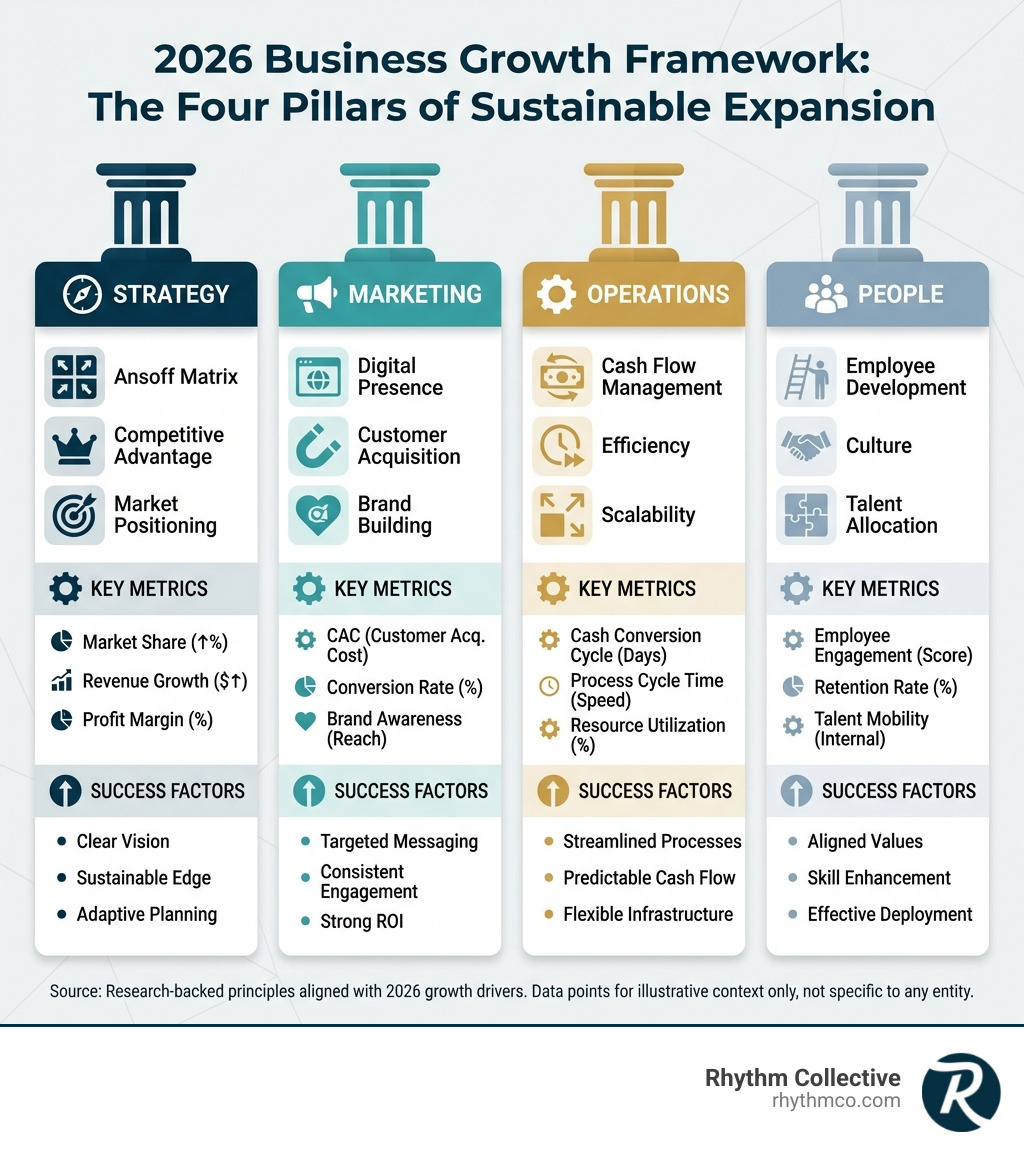
Foundational Business Growth Strategies: The Ansoff Matrix
At Rhythm Collective, we know business growth is complex—it’s about getting smarter and more resilient, not just bigger. Growth drivers stem from understanding your current position and future goals, which requires analyzing your market, products, and operations.
A foundational tool for this is the Ansoff Matrix. Developed by H. Igor Ansoff in his 1957 article titled “Strategies for Diversification,” it provides a framework for strategic options. By categorizing growth paths by products (existing vs. new) and markets (existing vs. new), the matrix helps visualize different business growth strategies and their risks.
When we talk about business growth, it’s crucial to distinguish between organic growth and acquisition growth. Organic growth involves expanding your existing business through internal efforts, such as increasing sales to current customers or developing new products in-house. It’s generally slower and less capital-intensive, relying on your current resources and capabilities. Think of it like nurturing a plant from a seed – it takes time and consistent care, but the roots are deep and strong.
Acquisition growth, on the other hand, involves expanding by purchasing other companies. This can accelerate growth dramatically, offering faster market entry, access to new technologies, or immediate market share. However, it also comes with higher financial and operational risks, including the significant challenge of integrating different organizational cultures. It’s like buying a fully grown tree and transplanting it – faster results, but a delicate process to ensure it thrives in its new environment.
Here’s a quick comparison:
| Feature | Organic Growth | Acquisition Growth |
|---|---|---|
| Pace | Slower, steady | Faster, immediate |
| Risk | Lower, manageable | Higher, complex |
| Resources | Internal, existing capabilities | External, purchased assets and operations |
| Control | High, incremental changes | Variable, integration challenges |
| Capital | Less capital intensive | More capital intensive |
| Cultural Fit | Inherently aligned | Requires significant integration efforts |
Now, let’s explore the four specific business growth strategies outlined by the Ansoff Matrix.
Market Penetration: A Key Business Growth Strategy
Market penetration is all about doing more of what you already do well. This strategy focuses on increasing your market share within your existing markets, using your existing products or services. It’s often the least risky of the four strategies because you’re operating in familiar territory.
How do we achieve this? It involves a multi-faceted approach:
- Customer Retention: This is paramount. As we’ve seen, fulfilling promises to customers isn’t just marketing; it’s operational integrity. By consistently delivering on quality and service, we plug the “holes in the bucket” that lead to churn. Building strong relationships and delivering continuous value means customers stick around, become advocates, and even increase their spending with us. Customer retention isn’t just a feel-good metric; it’s a powerful driver of sustained revenue.
- Competitive Pricing: We need to find that sweet spot – pricing that is attractive to customers while remaining profitable for us. This involves understanding competitor pricing, analyzing our cost structures, and considering the perceived value of our offerings.
- Aggressive Marketing and Sales: This means effectively communicating what makes your company exceptional. Whether it’s through targeted ad campaigns, special promotions, or expanding distribution within your current market, the goal is to attract new customers and encourage existing ones to buy more. For more insights on optimizing these efforts, check out our resources on Marketing Management.
The beauty of market penetration is that it leverages what you already have – your proven products and your existing customer base. It’s about optimizing, refining, and deepening your presence right where you are.
Market Development
When market penetration yields diminishing returns, it’s time for market development: taking existing products to new markets. This could mean:
- New Customer Segments: Targeting a new demographic you haven’t actively pursued.
- Geographic Expansion: Moving into new cities, regions, or even states. For businesses in Knoxville and East Tennessee, this might mean expanding across the state. Identifying viable new markets requires robust data from sources like local chambers of commerce, similar to how Canadian firms use resources like Statistics Canada or Export Development Canada.
- New Distribution Channels: If you primarily sell online, perhaps opening a physical storefront, or vice-versa.
The key here is thorough market research. We need to identify viable new markets that are both attractive and not overly competitive. Testing the waters by having a team present products to actual customers in these new areas can provide invaluable feedback on their willingness to buy. This strategy allows us to diversify our customer base and reduce dependency on a single market, spreading our risk and opening new avenues for growth.
Product Development
If our existing markets are well-served, but we see opportunities to meet evolving customer needs, product development becomes a powerful strategy. Here, we focus on creating new products or services for our existing market. This strategy is about leveraging our deep understanding of our current customers and their preferences.
Product development can take several forms:
- Product Modification: Enhancing existing products with new features, improved performance, or updated designs.
- Different Quality Levels: Offering premium or economy versions of your core product to capture a wider range of customers.
- Related Products or Services: Expanding your product line with offerings that complement your existing ones. Think of a restaurant that starts selling its popular sauces or baked goods as packaged items.
- Entirely New Products: Developing innovative solutions that address previously unmet needs of your current customer base.
Success in product development hinges on investment in research and development (R&D) and, crucially, listening to customer feedback. Our knowledge about our customers is our most valuable asset here. By understanding their pain points and desires, we can develop offerings that truly resonate. This is where creative storytelling through visuals can play a massive role. Our services in The Power of Storytelling Through Videography and How Product Videography Can Boost Your Brand’s Image and Sales can help showcase these new or improved products in compelling ways, driving adoption and excitement among your existing clientele.
Diversification
Diversification is the boldest and often riskiest of the Ansoff Matrix strategies. It involves selling new products to new markets. This means stepping into entirely unfamiliar territory, which naturally carries the highest risk. However, with higher risk can come higher rewards, especially if our existing industry or region is experiencing slow growth.
When considering diversification, we need to carefully analyze our company’s strengths and weaknesses. Can we leverage an existing ‘ownership advantage’ – a unique capability, technology, or brand reputation – in this new market? Or are we starting from scratch?
Diversification can create entirely new revenue streams, reducing reliance on a single product or market. It can involve moving into adjacent industries, which are somewhat related to our core business, or even entirely new, unrelated sectors. For instance, a company specializing in outdoor apparel might diversify into adventure tourism services.
A related concept, often discussed by experts like McKinsey, is the ‘shrink-to-grow’ strategy. This involves periodically pruning less attractive or slow-growing parts of our business portfolio and reinvesting those resources into new, more promising areas, including diversification efforts. It’s about being ruthless with what isn’t working to free up capital and talent for what could work. This strategic pruning allows us to grow healthily from a new, more robust base, rather than clinging to underperforming assets.
Leveraging Digital Marketing and Strategic Alliances for Expansion
In today’s interconnected world, an effective growth strategy isn’t complete without a strong online presence and smart partnerships. These elements are crucial for expanding our reach, building brand loyalty, and ultimately driving sustainable growth.

The importance of online presence cannot be overstated. For businesses in Knoxville and East Tennessee, a robust digital footprint means we’re visible to customers not just locally, but wherever they are searching for our products or services. This visibility is the first step toward engagement and conversion.
Strategic partnerships offer another powerful avenue for expansion. By collaborating with complementary businesses, we can access new customer bases and leverage combined strengths. Imagine a local bakery partnering with a coffee shop – both benefit from increased foot traffic and cross-promotion.
Finally, a customer-centric approach underpins all these efforts. Understanding our customers, retaining their loyalty, and actively seeking their feedback ensures that our growth is not just about numbers, but about delivering real value.
Digital Marketing: Your Online Business Growth Strategy
Digital marketing is no longer an optional extra; it’s a fundamental pillar of any successful business growth strategy. It’s how we connect with our audience, build our brand, and drive sales in the modern era. At Rhythm Collective, we specialize in crafting comprehensive digital marketing strategies that deliver tangible results.
Here’s how various digital marketing channels contribute to growth:
- SEO (Search Engine Optimization): This is about making sure our business appears prominently when potential customers search for products or services we offer. The Zapier report in 2023 highlighted that 72% of their organic website traffic was generated from SEO-focused blogs. This statistic powerfully illustrates the potential of a well-executed SEO strategy. By optimizing our website content, we attract relevant visitors who are actively looking for what we provide.
- Content Marketing: Creating valuable, informative, and engaging content – like blog posts, articles, or videos – not only establishes our expertise but also draws in organic traffic. This aligns perfectly with SEO efforts, providing the substance that search engines and users love.
- Social Media Marketing: Engaging with our audience on platforms like Facebook, Instagram, or LinkedIn allows us to build community, foster brand loyalty, and even drive direct sales. It’s a dynamic two-way street for communication.
- Email Marketing: Building an email list allows us to communicate directly with interested customers, offering promotions, updates, and valuable content. It’s a highly effective channel for nurturing leads and driving repeat business.
- Paid Advertising: Platforms like Google Ads or social media ads allow us to target specific demographics and interests, quickly reaching a broad audience and generating leads.
For businesses looking to truly boost their online presence, strategic digital marketing is non-negotiable. We believe in crafting beautiful, functional websites that serve as the hub for all these efforts. Our services in Boost Your Online Presence With Expert Website Design and Search Engine Marketing are designed to ensure your digital footprint is not just visible, but impactful.
Strategic Partnerships and Alliances
Sometimes, the fastest way to grow isn’t to do everything ourselves, but to team up with others. Strategic partnerships and alliances are powerful business growth strategies that involve collaborating with complementary businesses to achieve mutually beneficial goals. This isn’t about competition; it’s about synergy.
Consider these approaches:
- Co-marketing: Two businesses jointly promote a product or service, sharing the marketing costs and reaching each other’s customer bases. For example, a local fitness studio in Knoxville might partner with a healthy meal prep service.
- Joint Ventures: Businesses might pool resources for a specific project or to enter a new market, sharing both the risks and rewards.
- Cross-promotions: Simply promoting another business’s services to your customers (and vice-versa) can be a low-cost way to expand reach.
The benefits are clear: we can access new customers, leverage complementary strengths (e.g., one company has a strong sales team, the other has cutting-edge technology), and share resources and risks. When choosing partners, it’s crucial to align with businesses that share our values and brand image. Just as consistent graphic design is vital for our own brand, ensuring our partners uphold similar standards helps reinforce our collective message. Learn more about maintaining brand integrity with our insights on Why Consistent Graphic Design Is Vital for Your Marketing Strategy.
The Power of Customer Retention and Feedback
While acquiring new customers is often seen as the hallmark of growth, we know that retaining existing ones is equally, if not more, crucial for sustainable business growth strategies. Think of it this way: it’s much cheaper to keep a customer than to find a new one. Plus, loyal customers often spend more and become powerful advocates for your brand.
Customer retention is a continuous process built on:
- Loyalty Programs: Rewarding repeat business through points, discounts, or exclusive access.
- Exceptional Customer Service: Going above and beyond to ensure customer satisfaction. This means not just solving problems, but anticipating needs and providing a seamless experience.
- Personalized Communication: Making customers feel valued and understood through custom messages. Our Email Newsletter Marketing services can be instrumental in fostering this personalized connection.
But how do we know what our customers truly want? Through robust feedback loops:
- Surveys: Directly asking for their opinions on products, services, and overall experience.
- Social Listening: Monitoring social media conversations to understand sentiments, identify trends, and address concerns.
Customer feedback provides invaluable insights into preferences and pain points, allowing us to continuously improve our offerings and tailor our services. This continuous improvement, driven by customer insights, is a powerful driver of sustainable growth. Happy customers become repeat customers, and repeat customers build a strong, resilient business.
Execution: Managing Operations, People, and Finances for Growth
Having brilliant business growth strategies on paper is one thing; bringing them to life is another. At Rhythm Collective, we understand that execution is where the rubber meets the road. It’s the difference between aspiration and achievement. This involves a holistic approach to managing our daily operations, nurturing our most valuable asset—our people—and prudently managing our finances.

The importance of execution cannot be overstated. Even the most innovative growth ideas will flounder without a clear, actionable plan and the capacity to carry it out. This means focusing on operational efficiency, ensuring that our processes are streamlined and effective. It means diligently managing our cash flow, the lifeblood of any growing business. And it means investing in our employees, empowering them to contribute to and thrive within a scaling organization. These three pillars – operations, people, and finances – are inextricably linked, and mastering their management is crucial for navigating the exciting, yet often challenging, periods of growth.
The Importance of Employee Development in Scaling
Our people are the heart and soul of any successful business. As we scale, investing in employee development becomes not just a perk, but a strategic imperative. When we empower our team members, we’re not just improving individual skills; we’re building a more capable, innovative, and resilient organization.
Here’s why employee development is a critical component of business growth strategies:
- Training and Mentorship: Providing opportunities for continuous learning, whether through formal training programs or mentorship, improves skills and boosts productivity. This means our team is better equipped to handle new challenges and responsibilities that come with growth.
- Fostering Innovation: When employees feel valued and supported in their development, they are more likely to contribute new ideas and accept change. A culture that encourages learning is a culture that fosters innovation, which is essential for staying competitive.
- Positive Work Culture: Investing in our team signals that we care about their growth and well-being. This contributes to a positive work environment, which in turn leads to higher morale, lower turnover, and a more engaged workforce.
- Employee Ownership: Research shows that changes are eight times more likely to succeed when the full organization is activated. Furthermore, companies where more than 20% of employees owned change initiatives saw nearly twice the excess shareholder return than their peers. This highlights the immense power of fostering an ownership mindset, where employees feel a personal stake in the company’s success.
At Rhythm Collective, we believe in building strong teams and fostering an environment where talent can flourish. You can learn more about our philosophy and team on our About Rhythm page. By investing in our people, we’re investing in our future growth.
Managing Cash Flow and Operational Efficiency
Growth can be a double-edged sword. While exciting, it can also strain resources, especially cash flow. This is why effectively managing cash flow and operational efficiency is paramount for any business pursuing ambitious business growth strategies.
- Working Capital Management: As sales increase, so too can the need for working capital to fund inventory, accounts receivable, and other operational expenses. Without careful management, even profitable growth can lead to a cash crunch. We need to ensure that we have sufficient liquid assets to meet our short-term obligations and fund ongoing expansion.
- Cutting Waste and Boosting Profits: Operational efficiency is about doing more with less. By streamlining processes, eliminating redundancies, and leveraging technology, we can reduce waste and boost our profit margins. This not only makes our business more robust but also frees up capital that can be reinvested into further growth initiatives. This focus on efficiency helps us steer the scaling challenges that often accompany rapid expansion.
- Scaling Challenges: Rapid growth often brings new complexities – managing a larger team, expanding infrastructure, and dealing with increased customer demand. Efficient operations ensure we can meet these demands without compromising quality or profitability. The U.S. Small Business Administration offers numerous resources for businesses struggling with these very challenges, emphasizing the importance of sound financial management. For instance, they note that small businesses typically spend 7% to 8% of their total revenue on marketing; understanding how to allocate such budgets efficiently is key to growth.
Managing cash flow and operational efficiency during periods of growth is like ensuring your car has enough fuel and is running smoothly before starting on a long road trip. It prepares us for the journey ahead, allowing us to accelerate when opportunities arise and conserve resources when necessary.
The 10 Rules of Value-Creating Growth
To truly achieve sustainable, value-creating growth, we look to established frameworks and insights from leading experts. McKinsey’s research on the “ten rules of value-creating growth” offers a powerful blueprint for businesses aiming to outperform their peers. These rules are not just theoretical; they are backed by empirical data from thousands of companies, showing which strategies have the most impact on shareholder returns.
Here are the ten rules, providing a comprehensive guide for our business growth strategies:
- Put competitive advantage first: Start with a winning, scalable formula that gives you an edge.
- Make the trend your friend: Prioritize profitable, fast-growing markets and segments.
- Don’t be a laggard: Outgrow your industry peers. Companies mastering this rule were 1.7 times more likely to generate peer-beating returns.
- Turbocharge your core: Focus on maximizing growth within your core industry. This, along with being a local hero, had the second-highest impact (1.6 times more likely to outperform).
- Look beyond the core: Nurture growth in adjacent business areas, leveraging existing capabilities.
- Grow where you know: Focus on expanding in areas where you have an “ownership advantage” (e.g., unique expertise, strong brand).
- Be a local hero: Invest in winning on your home turf (local market). For us in Knoxville, this means deeply understanding and serving our East Tennessee community.
- Go global if you can beat local: Expand internationally only if you have a transferable advantage that allows you to outperform local competitors.
- Acquire programmatically: Combine healthy organic growth with serial, smaller acquisitions aligned with a consistent theme. Programmatic acquirers outperformed peers using other M&A approaches.
- It’s OK to ‘shrink to grow’: Periodically prune slow-growing or underperforming assets and reinvest the proceeds into new, more promising areas. Companies using this strategy generated five percentage points more annual excess shareholder returns than inconsistent growers.
The real power comes from mastering multiple rules. Companies that mastered four or more of these rules generated more than four points of excess shareholder returns, significantly outperforming those who only mastered two or three. This highlights the importance of a holistic, integrated approach to business growth strategies. For a deeper dive into these rules, we recommend exploring insights like “Growth rules: Which matter most?.” It’s not about picking one silver bullet, but rather weaving together a robust mix of strategic initiatives.
Conclusion
The journey of scaling new heights in today’s economy is undoubtedly challenging, but it’s also incredibly rewarding. We’ve explored how a clear understanding of business growth strategies, guided by frameworks like the Ansoff Matrix, can illuminate your path forward. From intensifying your efforts in market penetration and thoughtfully developing new products, to boldly exploring new markets and diversifying your portfolio, each strategy offers unique opportunities and risks.
We’ve also seen how crucial leveraging digital marketing and fostering strategic alliances are in expanding your reach and influence. A strong online presence, powered by SEO, content marketing, and engaging social media, is no longer optional—it’s essential. And nurturing customer retention through exceptional service and feedback loops is the bedrock of sustainable growth.
Finally, we emphasized that brilliant strategies are only as good as their execution. Managing operations efficiently, maintaining healthy cash flow, and, crucially, investing in our people through employee development are non-negotiable for sustained success. The “ten rules of value-creating growth” provide a proven roadmap, reminding us that growth is a deliberate choice, often requiring bold moves and a willingness to prune where necessary.
At Rhythm Collective, we believe that achieving profitable revenue and long-term growth is not just an aspiration but an achievable outcome through strategic planning and flawless execution. We’ve helped our clients generate over $140 million by focusing on these very principles, changing their business growth strategies into tangible results.
Growth is not a passive event; it’s a dynamic process that demands courage, innovation, and a willingness to adapt. It requires a holistic plan that considers every aspect of your business, from your market to your internal culture. If you’re ready to make growth your deliberate choice and build a future of sustained success for your business in Knoxville or East Tennessee, we’re here to help.
Let our Digital Marketing Agency in Knoxville help you grow.