
Your Website Has Visitors — So Why Isn’t It Converting?
If you’re asking “why is my website not converting”, you’re not alone — and the answer is almost never just one thing. Here are the most common reasons, at a glance:
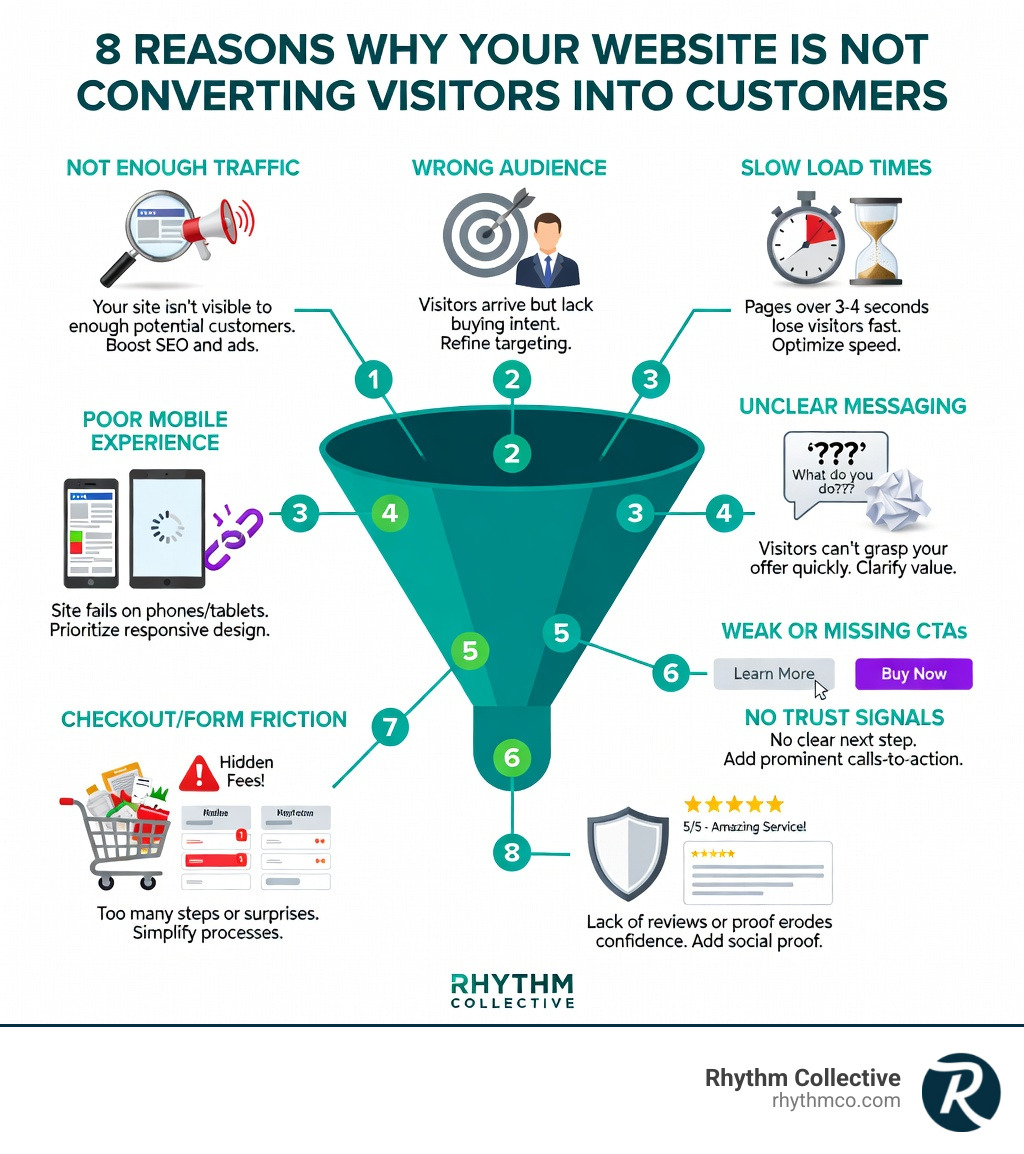
- Not enough traffic — your site isn’t being found by enough of the right people
- Wrong audience — visitors arrive but have no real intent to buy
- Slow load times — pages taking more than 3-4 seconds lose visitors fast
- Unclear messaging — visitors can’t quickly understand what you offer or why it matters
- Weak or missing CTAs — no clear next step for the visitor to take
- No trust signals — no reviews, testimonials, or social proof to build confidence
- Checkout or form friction — too many steps, hidden fees, or required account creation
- Poor mobile experience — site doesn’t work well on phones or tablets
Any one of these can quietly kill your conversion rate. Most struggling websites have several happening at once.
Getting traffic to your website is hard work. Watching that traffic leave without converting is frustrating — especially when you’ve put real time and money into building the thing. The truth is, a website that looks great on the surface can still leak revenue at every stage of the user journey, from the first click all the way through to checkout.
I’m Trevor Jones, founder of Rhythm Collective and a marketing professional with over 13 years of experience helping service-based businesses diagnose exactly why is my website not converting — and fixing it in ways that drive measurable, lasting revenue growth. In this guide, I’ll walk you through how to find the real problem and what to do about it.
Basic why is my website not converting terms:
Introduction
Before we dive into the “how-to” of fixing your site, we need to define what we are actually fighting for. In the digital marketing world, a “conversion” occurs whenever a visitor completes a desired goal, such as filling out a contact form, signing up for a newsletter, or making a purchase.
When a site fails to do this, we often see a high “bounce rate”—a metric that calculates the percentage of visitors who leave your site after viewing only one page. If your analytics dashboard looks like a leaky bucket, it’s usually because you haven’t mastered the 15-second rule. Research shows that the average user stays on a page for less than 15 seconds before deciding whether to stay or scram. If you don’t capture their intent and prove your value in that heartbeat, they are gone.

Diagnosing the Data: Why is my website not converting?
Many business owners in Knoxville and the surrounding East Tennessee area come to us saying, “I need a new website because my current one isn’t making sales.” But after looking at the data, we often find the design isn’t the primary culprit—it’s a discoverability problem.
A website cannot convert visitors it doesn’t have. If your “impressions” (how many times you show up in search results) are low, you have a traffic volume issue. If your impressions are high but your “clicks” are low, you have a relevancy issue. Understanding these SEO fundamentals is the first step in Expert Website Management for Business Growth. By analyzing your click-through rate (CTR), we can determine if people are seeing your link but choosing to ignore it because it doesn’t promise what they need.
Using Google Search Console to see why is my website not converting
Google Search Console (GSC) is the best free tool to diagnose the root of your problems. It shows you the exact search queries people use to find you and your ranking positions. If you rank #1 for a term that has nothing to do with your service, you’ll get traffic that bounces immediately. This is a “user intent” mismatch.
| Scenario | Diagnosis | Action Step |
|---|---|---|
| High Impressions / Low Clicks | Relevancy Problem | Rewrite your Title Tags and Meta Descriptions to be more enticing. |
| Low Impressions / High Clicks | Discoverability Problem | You need better SEO to show up for more search terms. |
| High Clicks / Low Conversions | True Conversion Problem | Your website experience or offer is the bottleneck. |
Identifying traffic mismatch and audience quality
Not all traffic is created equal. You might be getting thousands of hits from social media, but if those visitors are just looking for “cat memes” or “free tips” (top of the funnel content), they aren’t in a buying mindset.
Check your acquisition sources in your analytics. If your referral quality is low—meaning people come from random sites and leave within two seconds—you are targeting the wrong crowd. We provide Website Management Services That Supercharge Your Online Presence to ensure your traffic comes from high-intent sources like organic search and targeted email lists, rather than “viral” fluff that doesn’t pay the bills.
Technical Performance and the “Silent Killers” of Sales
You can have the best copy in the world, but if your site takes forever to load, no one will ever read it. We call these “silent killers” because they turn customers away before they even see your logo.
Statistics are brutal here: after just 4 seconds of waiting, 25% of visitors will jump ship. On mobile, the stakes are even higher. Studies show that 53% of mobile visitors abandon a site if it takes more than 3 seconds to load. If you are a business in Maryville or Sevierville trying to catch a customer on the go, every millisecond counts. Our Stress-Free Website Management Services That Keep You Online and Succeeding focus heavily on technical health to ensure you aren’t losing 7% of your conversions for every one-second delay.
Optimizing for the mobile-first user experience
Mobile devices account for roughly 65% of e-commerce traffic, yet they often lag in conversion rates. Why? Because many sites aren’t truly “responsive.” A responsive design adjusts perfectly to any screen size.
If your buttons are too small to tap with a thumb or your forms require “pinch-to-zoom,” you are failing the mobile-first test. Google actually penalizes poorly designed mobile sites in search rankings, meaning a bad mobile experience hurts your traffic and your conversions. Consistency across devices is no longer optional; it’s a requirement for a Boost Your Online Presence with Expert Website Design.
Reducing cognitive load and visual clutter
Visual clutter increases “cognitive load”—the amount of mental power a visitor needs to process your information. When a site is messy, the brain gets tired and hits the “back” button.
Minimalist design isn’t just an aesthetic choice; it’s a conversion strategy. By using ample white space and a “prototypical” layout (one that follows the standard structure users expect for your industry), you make the experience feel familiar and safe. One real-life case study showed that simply removing visual noise and non-essential elements increased conversions from 6.3% to 27.9%—a staggering 340% increase.
Refining Your Message and Building Instant Trust
Once a visitor lands on your site and the page loads quickly, the next question they ask is: “What’s in it for me?” If your headline is “Welcome to Our Website,” you’ve already lost.
Your Unique Selling Proposition (USP) must be immediately clear. At Rhythm Collective, we focus on How Rhythm Collective Turns Website Designs into Powerful Business Tools by using transformation storytelling. Don’t just list features; tell the customer how their life will be better after using your service.
Fixing why is my website not converting through clear copy
The best copy is written in plain English, not industry jargon. If a 12-year-old can’t understand what you do within five seconds, your copy is too complex. This is known as the Five Second Test.
To fix this, use benefit-driven headlines that speak to the reader’s “stage of awareness.” Are they just learning they have a problem, or are they ready to pick a provider? Tailoring your message to their specific pain points is at the heart of our Web Design services. Stop talking about your “state-of-the-art processes” and start talking about the “stress-free results” your clients crave.
Leveraging social proof and trust signals
Strangers don’t buy from people they don’t trust. To bridge the gap, you need “trust signals.” However, many businesses bury their testimonials on a separate page that no one visits.
The most effective social proof is contextual. This means placing a testimonial about your “fast shipping” right next to the “Add to Cart” button. Use real names and photos whenever possible to increase believability.
Trust-Building Elements Checklist:
- Authentic customer reviews with photos
- Security badges (SSL, payment processors)
- Industry certifications or qualifications
- Case studies showing real-world transformations
- Clear, easy-to-find contact information and “About” details
Removing Friction from the Final Hurdle
Friction is anything that slows a user down on their way to the finish line. If your checkout process is a marathon, don’t be surprised when people drop out at mile two.
Your Calls-to-Action (CTAs) should be action-oriented and use “low friction” words. Instead of “Submit,” which implies work, use “Get My Free Guide” or “Start My Transformation.” Button visibility is also key—if a user has to hunt for the “Buy” button, they’ll probably just close the tab.
Streamlining the checkout and lead capture process
Did you know that 61% of customers abandon their carts due to high shipping costs, and another 35% leave because they were forced to create an account?
To stop the leak:
- Reduce form fields: Only ask for what you absolutely need (3-6 fields is the sweet spot).
- Remove hidden fees: Be transparent about taxes and shipping early in the process.
- Use progress indicators: Show the user how close they are to finishing.
- Offer guest checkout: Don’t force a long-term relationship before the first date.
Nurturing leads with retargeting and segmentation
Most people won’t buy on their first visit. That’s where retargeting and email marketing come in. Experts recommend allocating between 20-30% of your total ad spend for retargeting—showing ads to people who have already visited your site.
When it comes to email, stop sending the same blast to everyone. Marketers who segment their leads (grouping them by interest or behavior) see up to a 760% increase in revenue. Whether it’s an abandoned cart recovery sequence or a personalized follow-up for a specific service, staying top-of-mind is essential for long-term growth.
Frequently Asked Questions about Website Conversions
What is a good average conversion rate?
It varies wildly by industry. For example, SaaS companies average around 5%, while Real Estate sites might see only 1.2%. If you’re in the food and beverage space, 4.6% is the benchmark. Don’t compare your boutique shop in Gatlinburg to Amazon; compare yourself to your industry peers to see if you are truly underperforming.
How do I know if my website design is the problem?
Look at user behavior data. Tools like heatmaps and session recordings (we love Hotjar or Microsoft Clarity) allow you to watch where people get stuck. If everyone clicks on an image that isn’t a link, or they stop scrolling halfway down your homepage, your design is confusing them. A/B testing different layouts is the best way to find a winner.
Why are my PPC ads not converting?
The average PPC conversion rate is 2.35%. If yours is lower, you likely have a “broad targeting” problem. You might be paying for clicks from people who aren’t your ideal customers. Ensure your landing page is 100% relevant to the specific ad the user clicked on. If the ad promises “Affordable SEO in Knoxville” but the landing page is a general “About Us” page, the user will leave immediately.
Conclusion: Turning Your Website into a Growth Engine
At Rhythm Collective, we don’t believe in “pretty” websites that don’t perform. Serving Knoxville, Oak Ridge, Johnson City, and the greater East Tennessee region, we specialize in turning digital presence into profitable revenue.
If you’ve been staring at your analytics wondering “why is my website not converting”, it’s time to stop the guesswork. Whether it’s a technical speed issue, a messaging mismatch, or a high-friction checkout process, these leaks can be fixed. We focus on long-term growth and measurable results, having generated over $140 million for our clients.
Ready to stop the leak? Let’s build a website that works as hard as you do. Reach out to our Digital Marketing Agency in Knoxville today to start your transformation.