Why PPC for Contractors Is One of the Fastest Ways to Fill Your Pipeline
PPC for contractors is a digital advertising model where you pay only when someone clicks your ad — putting your business in front of homeowners actively searching for your services right now.
Here’s what you need to know at a glance:
- What it is: Pay-per-click ads that appear at the top of Google and other search engines when someone searches for services like “roof repair near me” or “emergency HVAC contractor”
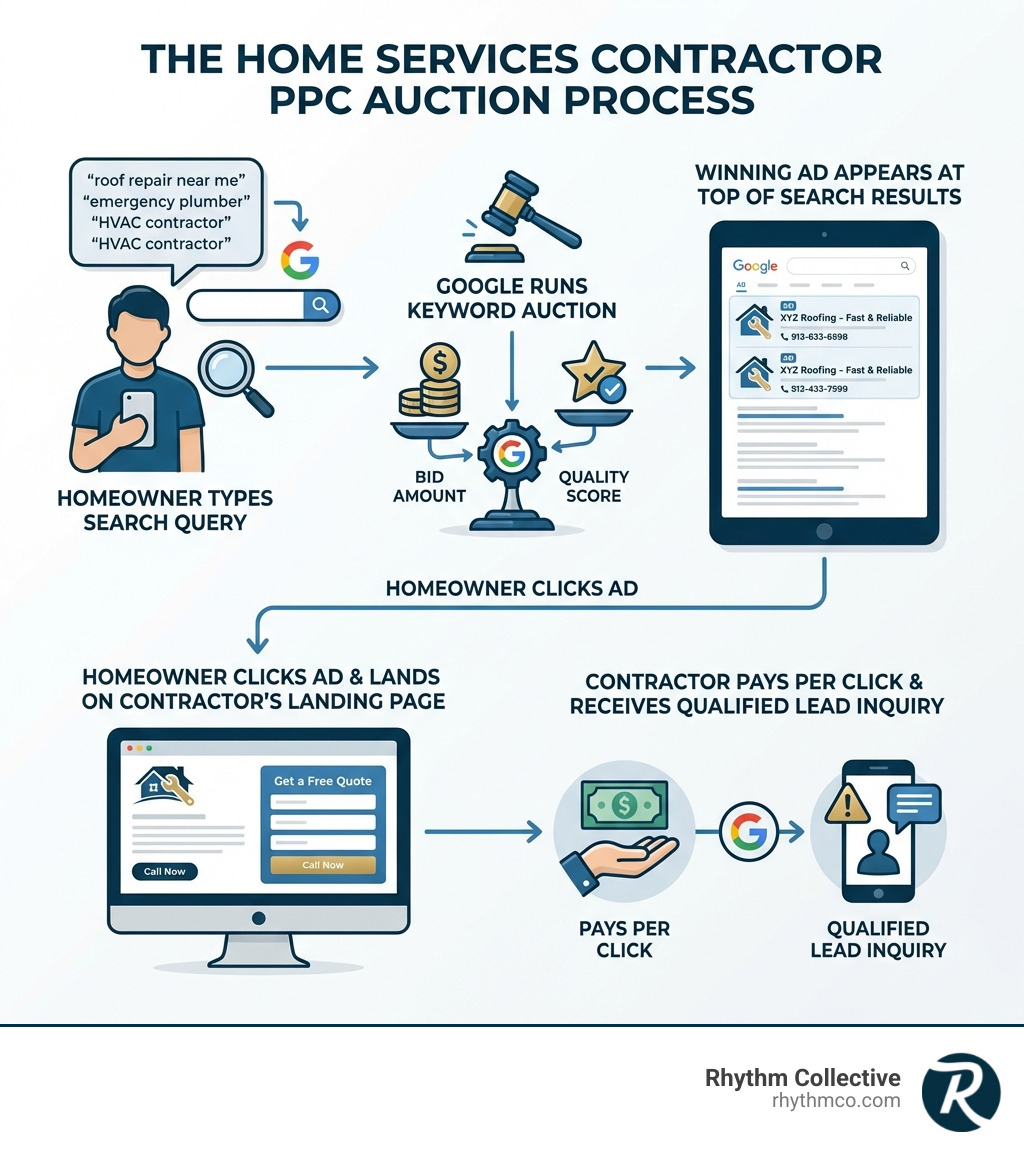
- How it works: You bid on keywords, Google runs an auction, and the winning ads appear above organic results
- Why it matters: PPC campaigns can generate leads within hours of launch — unlike SEO, which can take months
- What it costs: Average cost-per-click for home services ranges from $2.56 to over $75 in competitive metro markets
- What you can expect: Google Ads delivers an average ROI of 200%, with construction companies averaging a 2.2% conversion rate
- Who it’s for: Any contractor who needs a steady, predictable flow of qualified leads — not just referrals
In today’s contracting market, word of mouth and a basic website are no longer enough. Homeowners start their search online, and 96% of them use the internet to find local businesses. If your company isn’t showing up at the top of those results, a competitor is getting that call instead.
The good news? PPC gives you a direct lever to pull. You set a budget, target the right searches in your service area, and start showing up where it counts — immediately.
I’m Trevor Jones, founder of Rhythm Collective and a marketing professional with over 13 years of experience helping service-based businesses build lead generation systems that drive real, measurable revenue. I’ve worked extensively with PPC for contractors, helping businesses across the country turn ad spend into predictable pipelines and profitable growth.
Terms related to PPC for contractors:
The Fundamentals of PPC for Contractors
When we talk about PPC for contractors, we are essentially talking about the ability to “buy” your way to the front of the line. While traditional marketing relies on casting a wide net and hoping someone bites, Search Engine Marketing allows us to place your business directly in front of a homeowner at the exact moment their water heater bursts or their roof starts leaking.
In its simplest form, pay-per-click is an auction. You bid on specific keywords—like “kitchen remodeling Knoxville” or “electrical repair Sevierville”—and search engines like Google display your ad to users typing those phrases. The beauty of this model is that you only pay when a potential client actually clicks on your ad. This makes it a highly efficient way to reach local customers without wasting money on people who aren’t looking for your services.
Why Contractors Choose PPC Over SEO
We often get asked: “Should I do SEO or PPC?” Our answer is usually “Yes.” They work best together, but they serve different roles. Think of SEO like planting a bonsai tree from a seed. It requires years of nurturing, pruning, and patience before it becomes a masterpiece. PPC, on the other hand, is like going to the nursery and buying a fully grown tree. You get the shade (and the leads) today.
For contractors in East Tennessee—from Maryville to Kingsport—PPC offers several distinct advantages:
- Immediate Visibility: SEO can take 4 to 9 months to start delivering consistent leads. With PPC for contractors, your ads can go live and start generating traffic within hours.
- Precision Targeting: We can target specific ZIP codes, income levels, and even behavioral patterns. If you only want high-end bathroom remodels in Gatlinburg, we can make sure your ads only show up there.
- Market Entry: If you’re a new plumbing outfit in Johnson City trying to compete with a company that’s been there for 40 years, PPC is the only way to leapfrog them on the search results page instantly.
How the Google Ads Platform Works for Home Services
While there are many places to run ads, the Google Ads platform is the heavyweight champion for contractors. It operates on a “Quality Score” system. Google doesn’t just give the top spot to the person with the most money (though your bid does matter). They also look at how relevant your ad is to the user and how good your landing page experience is.
If your ad for “roofing repair” sends people to a page about “window cleaning,” Google will penalize you with a lower Quality Score and a higher cost-per-click (CPC). However, if your ad, keywords, and landing page are all perfectly aligned, you can actually pay less than your competitors while maintaining a higher position. It’s about spending smarter, not just spending more.
High-Performance Ad Types and Platforms
Not all ads are created equal. Depending on whether you’re a general contractor looking for $100k renovations or an HVAC tech looking for emergency repair calls, your media buying management strategy will look very different.
Search Ads vs. Local Service Ads
For most contractors, the battle is won or lost on the search results page. There are two primary ways to show up here:
- Standard Search Ads: These are the text-based ads that appear at the very top of the page. They offer the most control over your messaging and allow us to use Search Intent Advertising to target specific problems homeowners are trying to solve.
- Local Service Ads (LSAs): You’ve likely seen these – they feature the “Google Guaranteed” green checkmark and appear even above the search ads. Local Service Ads are a pay-per-lead model rather than pay-per-click. You only pay when a customer actually calls or messages you through the ad. This is incredibly effective for reaching people in your market who need help right now.
Remarketing and Display Strategies
Have you ever visited a website for a new drill, only to have that same drill follow you around the internet for the next week? That’s remarketing.
For contractors, this is a goldmine. Most homeowners don’t hire a deck builder the first time they see an ad; they research, they look at portfolios, and they talk to their spouse. By using data from your website visitors, we can show “reminder” ads to people who have already expressed interest. This keeps your brand top-of-mind and significantly boosts your conversion rates over time. PPC marketing via the Google Display Network can also place visual ads on millions of websites, building brand awareness across the entire East Tennessee region.
Building a Winning Campaign: Keywords, Copy, and Landing Pages
Setting up a campaign is easy; making it profitable is the hard part. A successful “Power Up” for your business requires a three-pronged approach: the right keywords, the right message, and the right destination.
Targeting High-Intent Keywords for Contractor Services
Keyword research is the foundation of everything we do. We differentiate between “research intent” (e.g., “how to fix a leaky faucet”) and “buying intent” (e.g., “emergency plumber Knoxville”). As a contractor, you want to spend your budget on the latter.
We prioritize “long-tail keywords”—specific phrases like “custom home builders in Pigeon Forge”—because they often have lower competition and much higher conversion rates. Equally important is negative keywords. These are terms you don’t want to show up for. For example, if you are a high-end flooring contractor, you should add “cheap,” “DIY,” and “jobs” as negative keywords so you don’t waste money on clicks from people looking for budget linoleum or a career change.
Crafting Compelling Ad Copy and Extensions
Your ad copy needs to do more than just list your services; it needs to solve a problem. We use B2B strategies to highlight your Unique Selling Propositions (USPs). Do you offer 24/7 service? Are you family-owned since 1985? Do you offer a 10-year warranty? These details should be front and center.
If you’re struggling to find the right words, Generative AI can be a powerful tool to help brainstorm headlines that grab attention. We also maximize the use of “Ad Extensions”—those extra bits of info like your phone number, links to specific service pages, and your business location. These make your ad physically larger on the screen and give users more reasons to click.
Best Practices for PPC for Contractors Landing Pages
One of the biggest mistakes we see is contractors sending paid traffic to their homepage. Your homepage is usually too broad. If someone clicks an ad for “roof replacement,” they should land on a page dedicated exclusively to roofing, not a general “About Us” page.
To maximize your ROI, we recommend you create a campaign with the Lead objective and pair it with a landing page that includes:
- A Clear Headline: It should match the ad the user just clicked.
- Trust Signals: Include your “Google Guaranteed” badge, local awards, and security whitepapers to build trust if you handle commercial or sensitive projects.
- Mobile Optimization: Over 60% of home service searches happen on mobile. If your page is slow or hard to read on a phone, you’re throwing money away.
- A Simple Lead Form: Don’t ask for their life story. Name, email, phone, and a brief description of the project is usually enough to get the ball rolling.
Measuring Success and Avoiding Costly Mistakes
You can’t manage what you don’t measure. In our marketing management process, we look far beyond just how many clicks you got.
Key Metrics to Track in PPC for Contractors
To truly understand your overall return on investment, you need to track the right data points:
- Click-Through Rate (CTR): Are people actually interested in your ad? The industry average is about 3.17%.
- Cost Per Lead (CPL): How much does it cost you to get one person to call or fill out a form? For home services, this typically ranges from $50 to $150.
- Conversion Rate: What percentage of people who click actually become a lead? Construction averages around 2.2%, but with a Search Intent Advertising strategy, we aim much higher.
Crucially, you must install a tracking code on your website. This allows us to see exactly which keywords led to a phone call, so we can double down on what’s working and cut what isn’t.
Common Pitfalls and How to Avoid Them
We’ve seen a lot of “DIY” campaigns go south quickly. Here are the most common ways contractors lose money:
- Broad Match Waste: If you bid on the broad keyword “roofing,” Google might show your ad for “roofing jobs” or “free roofing software.” Always use phrase or exact match.
- Poor Location Targeting: If you’re based in Knoxville, you shouldn’t be paying for clicks in Nashville. We use tight location targeting to ensure you only reach people in your market.
- Broken Tracking: If you don’t know where your leads are coming from, you’re just guessing.
- Budget Depletion: Setting a daily budget that is too low can mean your ads stop showing by 10:00 AM, missing out on the afternoon rush of homeowners looking for services after work.
Frequently Asked Questions about Contractor Ads
What is a realistic budget for contractor PPC?
Budgeting for PPC for contractors depends heavily on your trade and location. In smaller markets like Tazewell or Harrogate, your dollars will go further. In major metros, you might see CPCs of $25–$75+. Generally, we recommend a starting budget of at least $1,500 to $3,000 per month for local service areas. This allows for enough data collection to optimize the campaign. It’s not just about spending; it’s about the most out of your budget by focusing on high-intent leads.
How long does it take to see leads from PPC?
One of the best parts of PPC is the speed. You can start driving potential clients to your website the same day your ads go live. However, there is an “optimization period.” It usually takes about 90 days of data collection for the Google algorithm to fully understand which users are most likely to convert for your specific business. During this time, we constantly tweak bids and copy to improve performance.
Should I manage my ads in-house or hire an agency?
While you can manage Google Ads yourself, it is a full-time job. Most contractors are busy running crews and managing job sites—they don’t have time to monitor keyword auctions every hour. According to research, 70% of marketers struggle to measure ROI correctly. Hiring a marketing consulting services partner ensures that your budget is being managed by experts who understand the nuances of the construction industry.
Conclusion
At Rhythm Collective, we don’t just care about clicks or impressions; we care about your bottom line. Based right here in Knoxville, we’ve helped businesses across East Tennessee—from Sevierville to Oak Ridge—generate over $140 million in revenue.
Our goal is to turn PPC for contractors into a predictable engine for profitable revenue and long-term growth. Whether you’re looking to dominate the local map pack or want to scale your operations across the state, we have the digital strategy to get you there.
Ready to stop waiting for the phone to ring and start making it happen? Elevate your business with professional creative marketing services and let’s build something great together.