
Why Your Brand Needs a Winning Digital Marketing Strategy
A digital marketing strategy for a brand is your roadmap for connecting with customers online, driving measurable growth, and building lasting market leadership. Here's what you need to craft a successful one:
Core Components of a Digital Marketing Strategy:
- Clear, measurable goals aligned with business objectives (SMART framework)
- Deep audience understanding through buyer personas and research
- Channel selection based on where your customers spend time
- Content plan that delivers value at each customer journey stage
- Tracking and measurement using KPIs to optimize performance
- Budget allocation across owned, earned, and paid media
Almost half of all companies—47% according to recent research—lack a defined digital marketing strategy, creating a massive competitive gap you can exploit.
Without a strategy, marketing is just a series of disconnected tactics. You might run ads or post on social media, but these efforts don't build on each other, wasting resources and stalling growth.
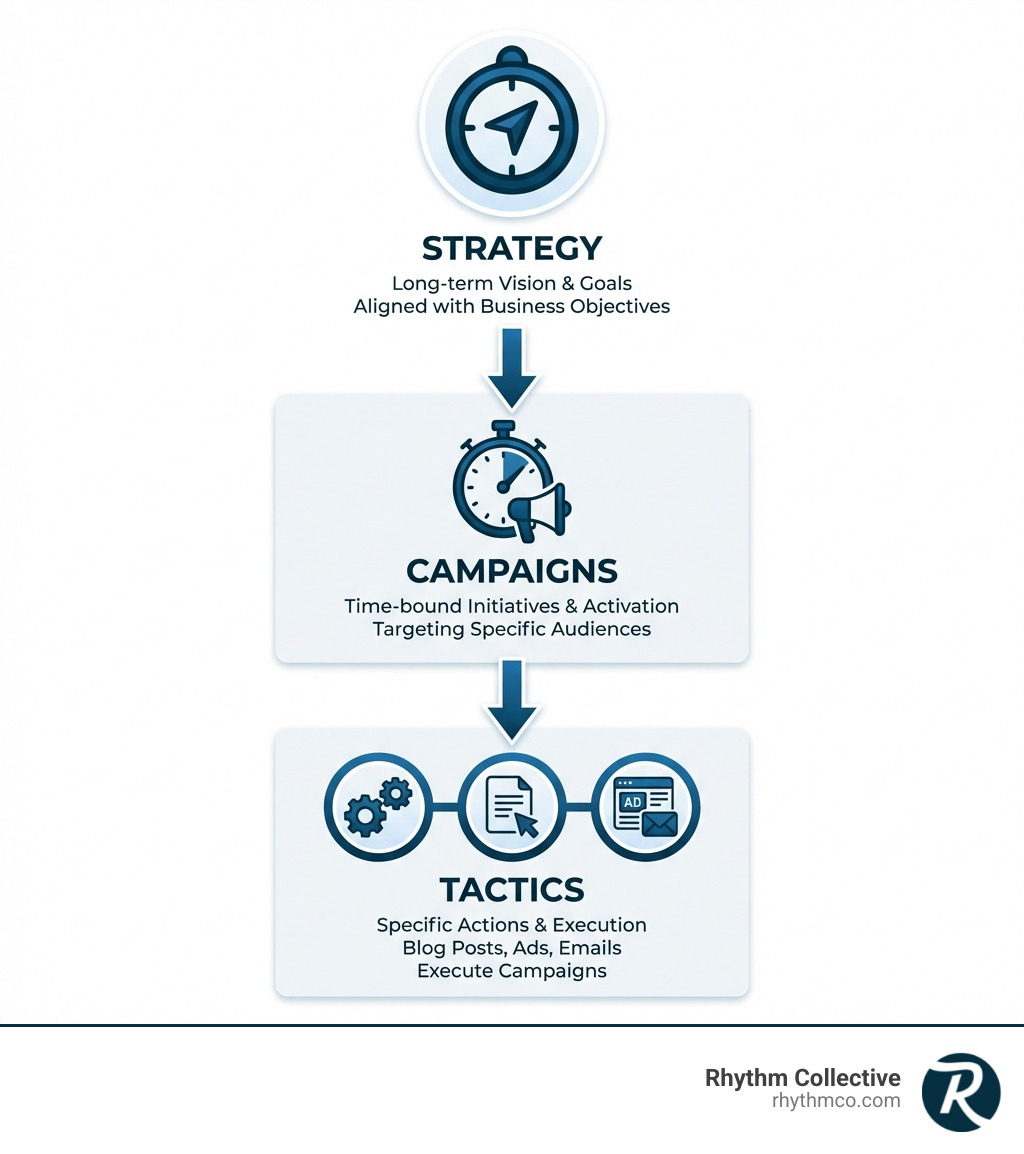
Winning businesses understand a crucial hierarchy: strategy comes first, then campaigns, then tactics. Your strategy sets the long-term vision. Campaigns activate it through focused initiatives. Tactics are the specific actions that execute those campaigns.
For example, if your goal is revenue growth, your strategy might be to capture high-intent buyers via search. Campaigns would target specific audience segments, and tactics would include SEO, paid search ads, and email sequences.
It's not about doing more marketing, but smarter marketing that compounds over time to deliver profitable, long-term success.
Foundations: Understanding Your Digital Marketing Framework
Let's clear up some common confusion. "Strategy," "campaigns," and "tactics" are often used interchangeably, but they are distinct parts of a cohesive digital marketing strategy for a brand.
A strategy is our big-picture, long-term vision. At Rhythm Collective, our strategy focuses on delivering profitable revenue and long-term growth. It's the "why" and "what" we aim to achieve over months or years.
Campaigns are time-bound initiatives that activate our strategy. They have defined objectives and target specific audiences. For example, a brand awareness strategy could be activated by a "thought leadership" campaign.
Tactics are the day-to-day actions executing our campaigns, like publishing a blog post or running a social media ad. Without a guiding strategy, tactics are often ineffective.
A successful digital marketing strategy for a brand also requires understanding the three media types: owned, earned, and paid.
- Owned Media: These are the digital assets we fully control, like our website, blog, social media profiles, and email lists.
- Earned Media: This is the organic attention we get from customer reviews, social media shares, mentions in articles, and word-of-mouth. It builds trust and credibility.
- Paid Media: This involves any digital channel where we pay for visibility, such as search engine ads (PPC), social media ads, or paid influencer collaborations.
A well-crafted digital marketing strategy for a brand harmonizes these media types. For example, a blog post (owned) can be shared by an influencer (earned) and then promoted with ads (paid). Consistent graphic design is vital for your marketing strategy to ensure visual consistency across all channels.
Here's a quick comparison:
| Feature | Owned Media | Earned Media | Paid Media |
|---|---|---|---|
| Control | High (we create and manage) | Low (others generate) | Moderate (we pay for placement, control message) |
| Credibility | Moderate (comes from our brand) | High (third-party validation) | Low to Moderate (perceived as advertising) |
| Cost | Low (initial setup, ongoing content creation) | Free (but requires effort to generate) | High (direct advertising spend) |
| Examples | Website, Blog, Social profiles, Email lists | Reviews, Mentions, Shares, PR | PPC ads, Social ads, Display ads, Influencer campaigns |
What is a Digital Marketing Strategy?
A digital marketing strategy for a brand is an execution plan for reaching and engaging customers online. It's a roadmap outlining the channels, tools, and assets used to achieve business goals like boosting sales, increasing traffic, or building brand awareness. A clear strategy guides every online marketing effort.
It defines the target audience, maps their online journey, selects effective platforms, and ensures messaging resonates. A robust strategy integrates with overall marketing, amplifying offline activities. It ensures your brand appears where customers are with relevant messages, working efficiently toward business objectives.
Why is a Digital Strategy Crucial for Your Brand?
An effective digital marketing strategy for a brand is a necessity because your customers are online. To reach them, you must be where they are.

A well-defined strategy maps the customer journey, identifying key touchpoints for connection. It enables data-driven decisions, avoiding guesswork. By analyzing metrics, we can refine our approach, ensuring every dollar is invested effectively and avoiding the wasted resources common among the 47% of companies without a clear strategy.
Furthermore, a strong digital strategy provides a competitive advantage by helping you understand your market, identify gaps, and position your brand uniquely. It's key to building lasting brand loyalty, especially since brand loyalty is shifting. A thoughtful strategy fosters engagement and value, ensuring customers stick with you. At Rhythm Collective, this is how we help our clients in Knoxville, TN, and East Tennessee thrive.
How to Build a Digital Marketing Strategy for a Brand From Scratch
Building a digital marketing strategy for a brand from scratch might seem daunting, but it's a rewarding process. A solid plan is like a skyscraper's foundation. Here's our 7-step process:

- Define Clear Goals and Objectives: What do we want to achieve?
- Identify and Understand Your Target Audience: Who are we talking to?
- Audit Your Existing Digital Assets and Channels: What do we have to work with?
- Choose Your Core Digital Channels: Where will we reach our audience?
- Plan Your Content Strategy: What messages will we share?
- Allocate Your Budget: How will we fund our efforts?
- Select Your Key Performance Indicators (KPIs): How will we measure success?
For those who prefer a guided hand through this process, consider exploring Marketing Coaching to help you steer these steps effectively.
Step 1: Define Clear Goals and Objectives
This is the most critical step. Without clear goals, you're wandering aimlessly. Your goals must align with your business objectives, like growing revenue or launching a new product.
We use the SMART framework to ensure our goals are:
- Specific: Instead of "get more customers," we aim for "generate 50 qualified leads per month."
- Measurable: We can track progress. "Increase website traffic by 20%."
- Achievable: Our goals should be realistic, even if ambitious. "Grow email subscribers by 25% this quarter."
- Relevant: They must directly contribute to our broader business success. "Boost sales of product X by 15% to support our Q3 revenue target."
- Time-bound: Every goal needs a deadline. "Improve brand engagement by 10% within the next six months."
Setting clear, measurable targets transforms abstract ideas into actionable objectives. This focuses our efforts and ensures every digital activity contributes to profitable, long-term growth.
Step 2: Identify and Understand Your Target Audience
Marketing without audience understanding is like talking to a stranger. You need detailed buyer personas—semi-fictional representations of your ideal customers.
To build these personas, we dive deep into:
- Demographics: Age, gender, location (especially relevant for our Knoxville, TN, and East Tennessee clients!), income, education.
- Psychographics: Personality, values, attitudes, interests, lifestyles.
- Pain Points: What challenges do they face that our brand can solve?
- Motivations: What drives their purchasing decisions? What are their aspirations?
- Online Behavior: Where do they spend their time online? What content do they consume?
We gather this information through surveys, interviews, and by analyzing data from web analytics tools and customer databases.
Here are some key questions we ask to build a comprehensive buyer persona:
- What is their job title and industry?
- What are their biggest professional and personal challenges?
- What goals are they trying to achieve?
- What kind of content do they prefer (blogs, videos, podcasts, etc.)?
- Which social media platforms do they use most frequently?
- How do they search for information or solutions online?
- What influences their purchasing decisions?
This deep understanding allows us to tailor messages, choose the right channels, and create content that resonates.
Step 3: Audit Your Existing Digital Assets and Channels
Before moving forward, you need to audit your existing digital assets and channels to see what you have to work with.
Our audit typically covers:
- Website Audit: Is it modern, mobile-friendly, and optimized for conversions? Is the UX intuitive? A strong website is the backbone; we can help boost your online presence with expert website design.
- SEO Performance: How do you rank in search engines? What are your keywords? Are there technical issues? This is crucial for local businesses in Knoxville, TN, who want to be found by nearby customers.
- Social Media Presence: Which platforms are we active on? What's our engagement like? Are we reaching our target audience effectively?
- Email List Health: How large and engaged is our email list? Are our open and click-through rates healthy?
- Content Gaps: What content do we have, and what are we missing that our audience needs?
- Competitor Analysis: What are our competitors doing well (or not so well) online? What channels are they dominating? Tools like SimilarWeb and SEMrush can provide valuable insights into how competitors acquire visitors.
This audit identifies strengths, weaknesses, and opportunities. It provides a realistic picture of your digital footprint and informs where to focus your efforts for the greatest impact.
Activating Your Strategy: Core Channels and Tactics
With goals, audience insights, and an audit complete, it's time to choose the core channels and tactics to bring your digital marketing strategy for a brand to life.
Your channel mix depends on where your audience spends their time. Marketing can be divided into inbound and outbound approaches.
- Inbound Marketing: This is all about attracting customers by creating valuable content and experiences custom to them. It's like setting out a delicious buffet that draws people in naturally. Search Engine Marketing and content marketing are prime examples.
- Outbound Marketing: This involves actively reaching out to potential customers, often through paid advertising. It's like going door-to-door to invite people to our buffet. Paid ads and some forms of email marketing fall into this category.
A balanced approach using both typically yields the best results. Social Media Marketing is crucial for both.
The Role of Content and SEO in a digital marketing strategy for a brand
Content and SEO are two sides of the same coin in a robust digital marketing strategy for a brand. They work together to attract, engage, and convert your audience.
Content provides value by helping your audience solve problems or answer questions. Buyers often view three to five pieces of content before engaging with sales. Content can take many forms:
- Blogging: Still highly relevant, blogs are excellent for addressing specific questions, establishing expertise, and driving organic traffic.
- Videos: Engaging, memorable, and incredibly persuasive. From tutorials to product showcases, video production allows us to tell our brand's story in a dynamic way.
- E-books and Guides: Longer-form content that positions us as thought leaders.
- Infographics: Visually appealing ways to convey complex information.
SEO is your ticket to online visibility. It's the process of optimizing your site and content to rank higher in search engine results for relevant keywords, bringing more people to your digital doorstep.
Key aspects of SEO include:
- On-Page SEO: Optimizing individual web pages with relevant keywords, clear headings, and high-quality content.
- Technical SEO: Ensuring our website structure is sound, loads quickly, and is easily crawlable by search engines.
- Local SEO: Absolutely critical for businesses in Knoxville, TN, and East Tennessee. This focuses on optimizing our online presence to attract local customers, ensuring we appear prominently in "near me" searches. Our expertise in local search visibility helps our clients get found by the right people at the right time.
Consistently creating valuable, optimized content builds trust, authority, and a sustainable source of organic traffic for long-term growth.
Leveraging Social Media, Email, and Paid Ads
Beyond content and SEO, a comprehensive digital marketing strategy for a brand harnesses social media, email, and paid ads. Each plays a distinct role in engaging your audience.
Social Media Marketing Your audience spends over 145 minutes daily on platforms like Facebook, Instagram, and LinkedIn. Social Media Marketing allows you to:
- Build Community: Foster direct interaction, respond to comments, and encourage user-generated content.
- Increase Brand Awareness: Get our message in front of a wide audience.
- Drive Traffic: Direct followers to our website or specific landing pages.
- Influencer Marketing: The global market for influencer marketing has quadrupled since 2019. Collaborating with local influencers who align with our brand values can be incredibly effective, especially for reaching niche audiences in East Tennessee.
Email Marketing Email remains a powerful tool for nurturing relationships and driving conversions. Our email newsletter marketing helps you:
- Build Relationships: Communicate directly and personally with our audience.
- Automate Communications: With automating your emails, we can send personalized messages at the right time, leading to 30% more opens and 50% more click-throughs.
- Drive Repeat Business: Inform loyal customers about sales, promotions, and new offerings.
Paid Advertising For immediate visibility and precise targeting, use paid ads, including:
- PPC (Pay-Per-Click) Advertising: Running ads on search engines like Google to capture demand from users actively searching for our products or services.
- Social Media Ads: Highly targeted ads on platforms like Facebook and Instagram, leveraging demographic and interest data.
- Retargeting: Showing ads to people who have already interacted with our brand (e.g., visited our website, viewed a product). This is fantastic for bringing back cart abandoners!
- Geofence Advertising: For our local clients, geofence advertising allows us to target mobile users within specific geographic boundaries (like a competitor's store or a local event), delivering highly relevant ads right where they are.
By strategically combining these channels, we create a powerful ecosystem that reaches our audience at every stage of their journey.
Case Studies: Effective Digital Strategies in Action
Here are some examples of how effective digital marketing strategies have driven success:
- The App Ecosystem: An athletic brand built an app ecosystem for training and product releases, even selling digital goods in virtual worlds. This strategy meets customers with personalized experiences across digital touchpoints. Takeaway: Innovation and personalization create deep brand engagement.
- The Creative Campaign Wrap-Up: A music streaming service turns user data into personalized, shareable year-end summaries. This data-driven approach becomes a viral marketing phenomenon. Takeaway: Make data engaging and shareable.
- The User-Generated Content (UGC) Hype: A tech giant's viral campaign encouraged users to share photos taken with its new smartphone. This generated massive buzz and provided authentic content at a low cost. Takeaway: Harness the power of community and user-generated content.
- Influencer-Driven Growth: A fitness brand partnered with diverse influencers, offering discount codes. This leveraged influencer trust to drive brand awareness and direct sales. Takeaway: Strategic influencer collaborations build credibility and reach new audiences.
These examples show that an effective digital marketing strategy for a brand requires integrated, thoughtful approaches that resonate with the audience and align with business objectives.
Measuring Success and Embracing Future Trends
If you can't measure it, you can't improve it. Measuring success is integral to any digital marketing strategy for a brand. It's how we ensure we're delivering profitable growth, not just vanity metrics.
This involves rigorous data analysis, iteration, and A/B testing. We use tools to track performance and make data-driven decisions to optimize campaigns. Our Marketing Management services provide the expertise to keep everything on track.
Using KPIs to Measure Your Digital Marketing Success
Key Performance Indicators (KPIs) are the vital signs of your digital marketing health. They are measurable values demonstrating how effectively you are achieving business objectives. Choosing the right KPIs is crucial to guide optimization.
Some common and highly effective KPIs include:
- Website Traffic: Not just the number of visitors, but also their source, behavior on the site, and whether they are new or returning.
- Conversion Rate: The percentage of visitors who complete a desired action, such as making a purchase, filling out a form, or signing up for a newsletter.
- Cost Per Lead (CPL): How much it costs us to acquire one lead. Keeping this low is key to profitability.
- Customer Lifetime Value (CLV): The total revenue a customer is expected to generate over their relationship with our brand.
- Engagement Rate: For social media, this includes likes, shares, comments, and clicks, indicating how well our content resonates with the audience.
Set clear benchmarks for each KPI and monitor progress. If a KPI underperforms, test new tactics, refine messaging, or adjust your channel strategy. This iterative process ensures constant improvement.
The Future: AI, Personalization, and 2025 Trends for a digital marketing strategy for a brand
The digital landscape is always evolving. A future-forward digital marketing strategy for a brand must anticipate these shifts. Looking towards 2025, several trends are shaping customer connections.
- The Impact of AI: AI is a game-changer, impacting strategy by helping analyze data, predict behavior, and automate tasks. AI enables a shift from reactive to predictive marketing.
- Personalization at Scale: Consumers expect custom experiences. Brands excelling at personalization see 40% more revenue. AI and first-party data enable highly relevant messages and offers, fostering loyalty.
- The Rise of Social Commerce: Social media is becoming a direct shopping channel, with US sales expected to exceed $141 billion by 2028. This means integrating shopping experiences into your social presence, as 55% of US Gen Z have made a purchase via social media.
- M-Commerce Dominance: Mobile commerce will drive two-thirds of online sales growth by 2028, with 94% on smartphones. This makes mobile-first design and advertising essential.
- Voice Search Optimization: With the proliferation of voice assistants, optimizing content for natural language queries is becoming increasingly important.
- Emerging Technologies (AR/VR): Millennials and Gen Z are two to three times more likely to use AR/VR to learn about products. Virtual try-ons and immersive experiences are becoming powerful tools to improve the customer journey.
The retail landscape evolves with changing consumer demographics and technology. With US retail sales projected at $7.41 trillion in 2024, staying ahead means integrating these trends into your digital marketing strategy for a brand.
Frequently Asked Questions about Digital Marketing Strategy
How often should I update my digital marketing strategy?
A digital marketing strategy for a brand is not a static document. We recommend an annual review, with quarterly check-ins for high-growth businesses. This allows you to adapt to market changes and performance data. The key is to be responsive, making informed adjustments based on insights.
What’s a realistic budget for a small business’s digital marketing strategy?
There's no one-size-fits-all answer. A realistic budget for a digital marketing strategy for a brand depends on your industry, goals, and growth pace. Many businesses allocate 5-15% of revenue to marketing, or use a goal-based approach to determine costs.
For small businesses in East Tennessee, typical monthly budget breakdowns might look like:
- SEO & Local SEO: $750–$2,500/month
- Paid Ads (management + spend): $1,000–$5,000/month
- Content creation: $500–$1,500/month
- Website updates or redesign: One-time $3,000–$10,000+
Start with a focused budget on 2-3 core areas and scale with results. The goal is to invest wisely, ensuring every dollar contributes to profitable growth.
What is the difference between a digital marketing strategy and a digital marketing plan?
This is a common point of confusion. Think of it this way:
- A digital marketing strategy for a brand is the "why" and the "what." It's our high-level roadmap, outlining our overarching goals, target audience, and the core approaches we'll take.
- A digital marketing plan is the "how" and the "when." It details the specific actions, timelines, resources, and budgets required to execute the strategy.
For example, a strategy to "increase brand awareness among Gen Z" would have a plan detailing specific TikTok campaigns, a video production schedule, and KPIs. One can't succeed without the other!
Find Your Rhythm and Build a Winning Digital Strategy
Crafting an effective digital marketing strategy for a brand is a journey. We have covered the foundations, from strategy vs. tactics to the role of different media types. We have also walked through building a strategy from scratch, emphasizing SMART goals, audience understanding, and digital audits.
Content and SEO are long-term growth engines, while social media, email, and paid ads engage and convert. Measuring success with KPIs and embracing future trends like AI ensures you stay ahead.
Your digital marketing strategy for a brand is a living document. Consistency and data-driven adaptation are key to open uping its full potential.
At Rhythm Collective, we specialize in helping businesses in Knoxville, TN, and across East Tennessee find their rhythm and build winning digital strategies that deliver profitable revenue and long-term growth. If you are ready to transform your online presence and achieve measurable success, we are here to help. Contact us today to learn more about our creative marketing agency services and how we can help your brand thrive.