Why Local SEO is Your Key to Reaching Nearby Customers
What is local SEO? It’s the process of optimizing your online presence to attract more customers from local searches—people who are physically near your business or actively searching for services in your specific area.
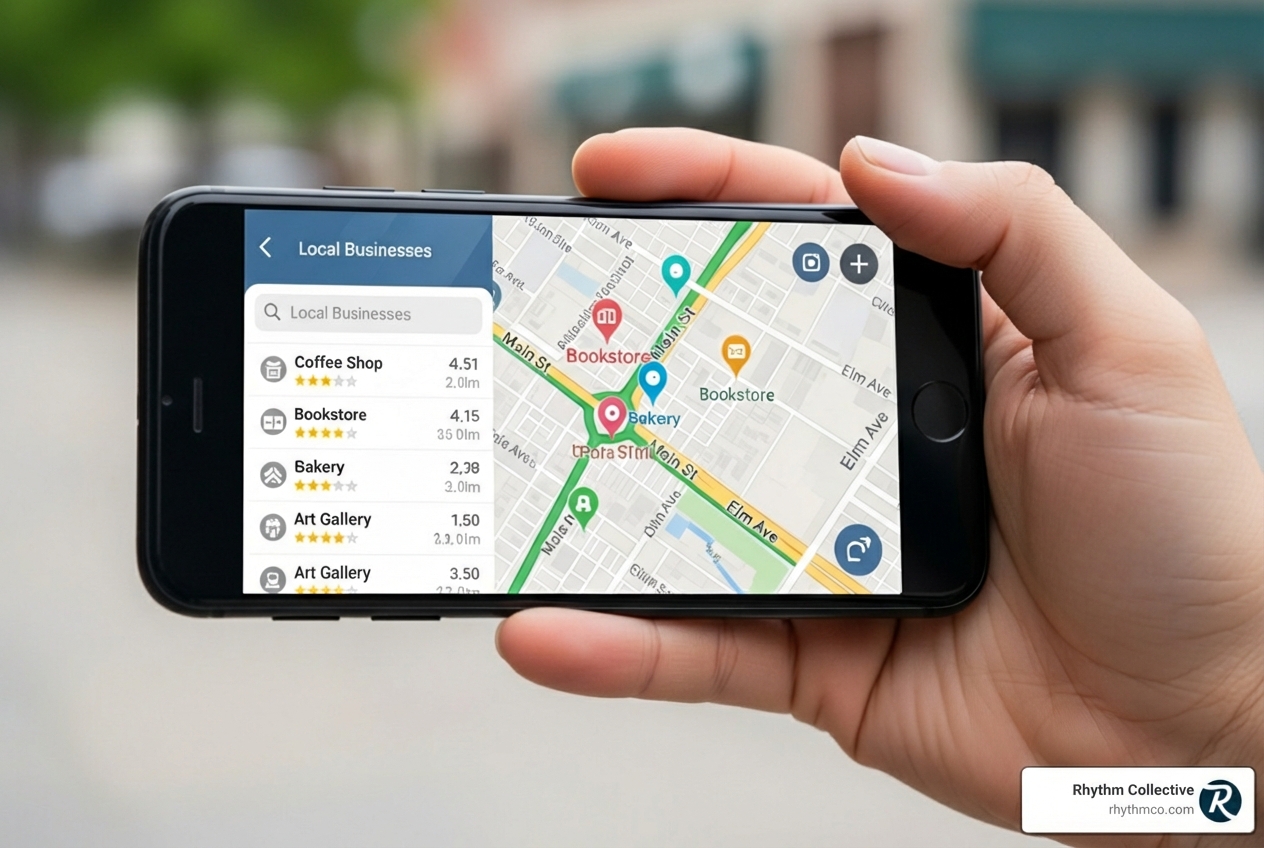
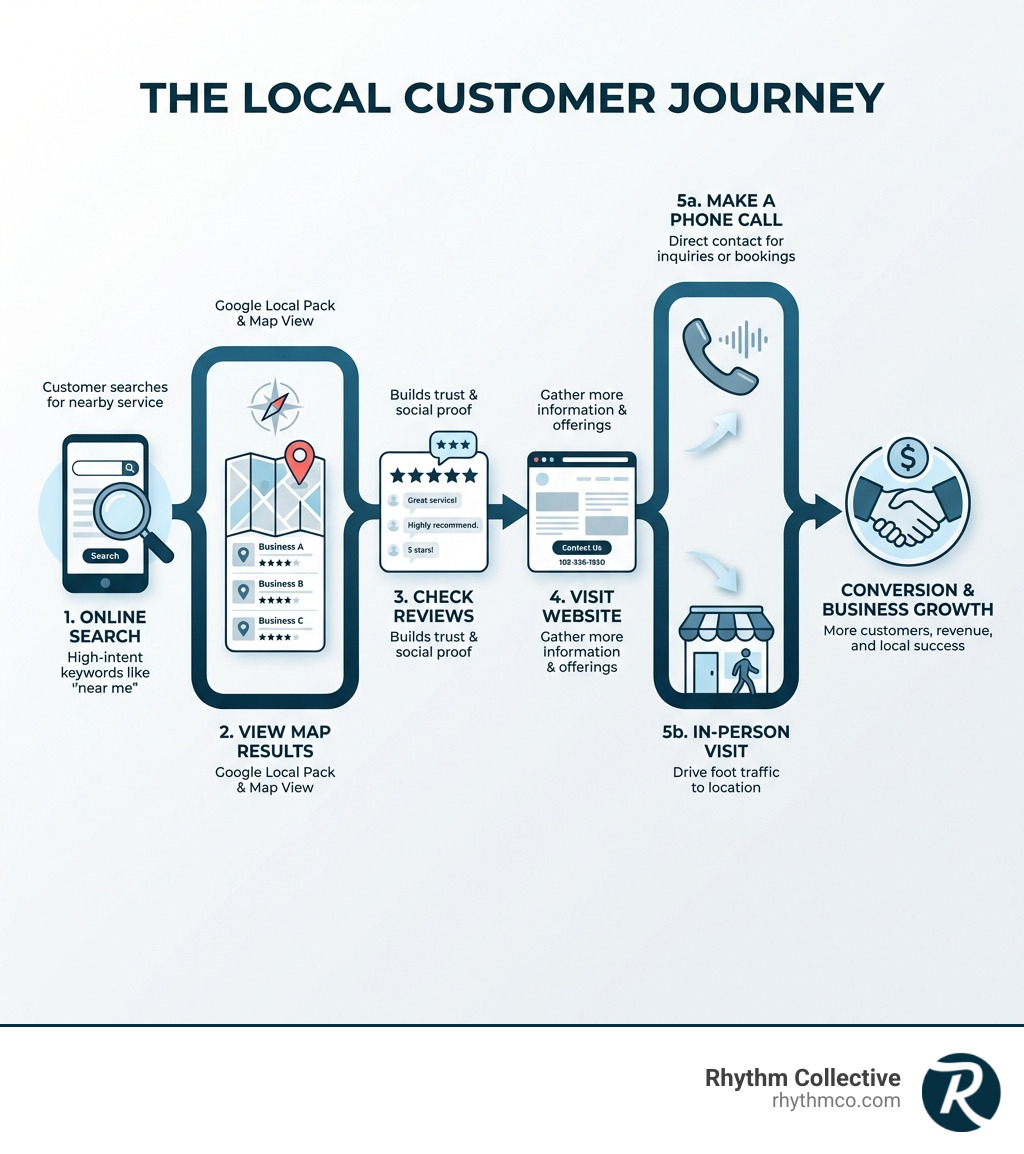
When someone pulls out their phone and searches for “coffee shop near me” or “plumber in Knoxville,” they’re ready to take action. That’s the power of local search. These aren’t casual browsers—they’re high-intent customers who want to find you right now.
Here’s what local SEO does for your business:
- Increases your visibility in Google’s Local Pack (the map with three business listings)
- Drives foot traffic to your physical location
- Generates qualified leads for service-area businesses
- Builds trust through reviews and local prominence
- Captures mobile searchers at the moment they need you most
The numbers tell a compelling story. 46% of all Google searches have local intent. Even better, 76% of people who search for something nearby visit a business within a day. If your business isn’t showing up in these searches, you’re invisible to customers who are ready to buy.
Local SEO works differently than traditional SEO. Instead of competing nationally, you’re focusing on proximity and relevance to nearby searchers. Google uses different signals—like your distance from the searcher, your review ratings, and how consistent your business information is across the web—to decide which local businesses to show.
Whether you run a restaurant, law firm, dental practice, or HVAC company, local search is how your next customers will find you. The businesses that master it don’t just get more visibility—they fill their calendars and grow their revenue.
What is Local SEO and Why Does It Matter?
At its heart, local SEO is all about making your business visible to people in your immediate geographic area. Think of it as your digital storefront in the heart of East Tennessee. While traditional SEO aims for broad national or global visibility, local SEO narrows its focus to a specific region, city, or even neighborhood. It’s the strategy we use to ensure that when potential customers in Knoxville, Maryville, or Oak Ridge search for what you offer, your business is right there at the top of their results.
Why does this matter so much? Because when someone searches locally, they’re often looking to make a purchase or visit a business soon. They’re not just browsing; they’re ready to act. This translates to more foot traffic, more phone calls, and ultimately, more sales for your business. Google delivers billions of local search results every month, making prominent placement crucial for customer findy.
Let’s look at a quick comparison to highlight the difference:
| Feature | Local SEO | Traditional SEO |
|---|---|---|
| Geographic Focus | Specific cities, regions (e.g., Knoxville, TN) | National or global audience |
| Target Audience | People physically nearby or searching for local services | Broad, geographically diverse audience |
| Key Ranking Signals | Google Business Profile, NAP consistency, reviews, proximity, local citations | Website authority, backlinks, content quality, keywords, technical SEO |
| Goal | Drive local foot traffic, phone calls, in-store visits | Increase website traffic, brand awareness, online sales |
| Primary Platforms | Google Maps, Local Pack, local directories | Google Search (organic results) |
The main thing that makes local SEO different is the consideration of distance from the user. Google’s local algorithm prioritizes businesses that are physically close to the searcher, alongside their relevance and prominence. This means that even if you have a fantastic website, without a solid local SEO strategy, you might be missing out on a huge segment of your most valuable customers right in your backyard.
The Different Types of Local Search Results
When a local search query is performed, Google often displays results in a few distinct ways. Understanding these can help us tailor our strategy to appear in all the right places.
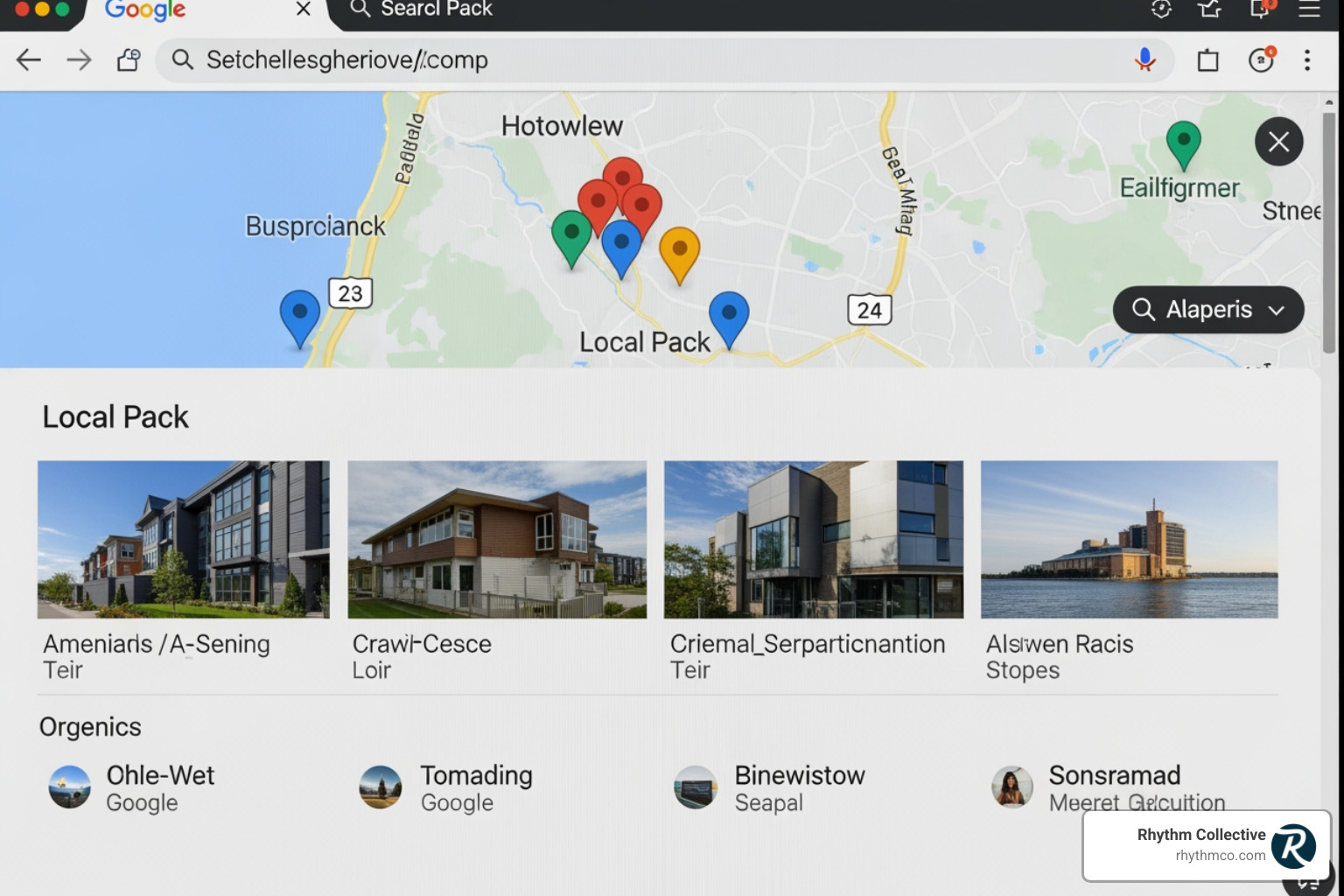
- The Local Pack (or Map Pack): This is arguably the most coveted spot. It’s the block of 3-4 business listings, complete with a map, that appears at the very top of the search results for local queries (like “plumbers Knoxville”). These listings pull directly from Google Business Profile (GBP) data and typically get a large share of clicks, especially on mobile. Our goal is to get your business into this “3-pack”.
- Google Maps Listings: Beyond the Local Pack, a click on “More businesses” or a direct search within Google Maps will show a more comprehensive list of local businesses. Ranking well here is crucial, as many users go straight to Maps for directions or contact information. The information on Google’s map is taken from your Google Business Profile.
- Local Organic Results: Below the Local Pack and any paid ads, you’ll find the traditional “blue link” organic search results. For local queries, these often include local business websites, directories, or articles relevant to the area. While not as visually prominent as the Local Pack, ranking high here still drives significant traffic and conversions.
These three areas work together, with GBP often being the central hub feeding information to all of them. A strong local SEO strategy ensures your business is optimized to appear across all these local search result types, maximizing your visibility to potential customers in East Tennessee.
The Importance for Your Business Model
Regardless of your business structure, local SEO offers immense value, especially for businesses operating in areas like Knoxville, Maryville, or Lenoir City.
- Brick-and-mortar businesses: If you have a physical storefront where customers visit you (e.g., a restaurant, retail store, salon), local SEO is non-negotiable. It helps people find your exact location, operating hours, and even check your menu or product availability before they arrive. It directly translates online searches into in-person visits.
- Service-area businesses (SABs): Even if you don’t have a physical storefront but serve customers at their location (e.g., plumbers, electricians, landscapers in Alcoa or Oak Ridge), local SEO is vital. While you might hide your address on your Google Business Profile, optimizing for local search ensures you appear for queries like “HVAC repair Maryville” or “landscaping services Sevierville”. It’s how you generate targeted leads that are within your service radius.
- Hybrid models: Businesses with both a physical location and a service area (e.g., a moving company with an office) benefit from a blended approach, leveraging the best of both worlds.
Local search helps us Reach Local Customers effectively. It’s about generating highly qualified leads who are actively seeking your products or services in your specific geographic area. Without it, you’re essentially invisible to a large, eager audience.
The Pillars of Local Search: How Google Ranks Local Businesses
Google’s local algorithm is a sophisticated system designed to deliver the most relevant local businesses to users. It considers numerous factors, but these can largely be grouped into three fundamental “pillars” that influence your local search rankings: Relevance, Proximity, and Prominence. Think of these as the three legs of a stool—if one is weak, the whole thing might topple.

Understanding these pillars is key to mastering how Google’s local algorithm works and optimizing your presence effectively.
Pillar 1: Relevance
Relevance is all about how well your business matches what someone is searching for. If a user types “pizza delivery Knoxville,” Google wants to show them businesses that are, well, pizza delivery places in Knoxville.
To establish relevance, we need to:
- Accurately categorize your business: On your Google Business Profile, choosing the most precise categories for your services (e.g., “Italian Restaurant” instead of just “Restaurant”) tells Google exactly what you do.
- Optimize your on-page content: Your website should clearly state what you offer and where you offer it. If you’re a “dentist in Maryville,” make sure your website’s content reflects that.
- Include keywords: Use keywords people are already searching for, naturally within your GBP description, services, and website content.
The more clearly and consistently you communicate what your business does and where it’s located, the more relevant Google will deem you for related local searches.
Pillar 2: Proximity (Distance)
This pillar is perhaps the most straightforward: how close is your business to the person performing the search? Google uses the searcher’s physical location (often determined by their device’s geolocation data) to prioritize businesses that are nearby. This is the “near me” factor in action.
For example, if someone in downtown Knoxville searches for “coffee shop,” Google will prioritize coffee shops within a short distance, rather than one across town, even if that one has slightly better reviews. While we can’t change your physical location, we can ensure your address is accurately listed across all platforms to help Google correctly identify your proximity to potential customers. For service-area businesses, this means clearly defining your service areas.
Pillar 3: Prominence (Reputation)
Prominence refers to how well-known and respected your business is. Think of it as your business’s reputation, both online and offline. Google wants to show users businesses that are reputable and trusted.
Factors contributing to prominence include:
- Online Reviews: A high volume of positive reviews, along with active responses from the business owner, significantly boosts prominence. We’ll dive deeper into this soon, but suffice it to say, reviews are gold.
- Backlinks from local sources: When other reputable local websites (e.g., local news sites, community organizations, local business directories) link to your website, it signals to Google that your business is important and trusted within the community.
- Citations: Mentions of your business’s Name, Address, and Phone number (NAP) across the web, even without a direct link, contribute to prominence.
- Brand Mentions: When your business is talked about online, even informally, it adds to your prominence.
- E-E-A-T (Experience, Expertise, Authoritativeness, Trust): Google’s quality guidelines emphasize these factors. Demonstrating that your business has real-world experience, expertise in its field, is an authoritative source, and is trustworthy, contributes to its overall prominence.
The stronger your business’s reputation and online presence, the more prominent it will appear in local search results.
Your Local SEO Playbook: Key Components for Success
Now that we understand the “why” and “how” behind local SEO, let’s dive into the “what”. An effective local SEO strategy involves several core tasks that, when executed consistently, build a strong local foundation for your business.
Optimize Your Google Business Profile (GBP)
Your Google Business Profile is the absolute cornerstone of local SEO. If you don’t have one, claim it now. If you do, it’s time to make it shine. The information on Google’s map is taken from your Google Business Profile, so it is important to claim your profile and ensure it is as complete as possible.
Here’s how to optimize it:
- Claim and Verify: This is step one. Google needs to confirm you’re the legitimate owner of the business.
- NAP (Name, Address, Phone) Accuracy: Ensure your business name, address (for physical locations), and phone number are identical to what’s on your website and other online listings. Inconsistencies can confuse Google and hurt your rankings.
- Choose Correct Categories: Select the most specific primary category and relevant secondary categories for your business. This helps Google understand exactly what you offer.
- High-Quality Photos and Videos: Upload appealing photos of your storefront, interior, products, and team. Businesses that provide up-to-date photos get significantly more itinerary requests.
- Google Posts for Updates: Use Google Posts to share news, offers, events, and product updates. This keeps your profile active and engaging.
- Answering the Q&A Section: Monitor and respond to questions asked by users. This demonstrates engagement and provides valuable information.
- Complete All Sections: Fill out every available field, including business hours, services, products, website link, and a compelling description. The more complete your profile, the better.
Build Consistent Local Citations
Local citations are online mentions of your business’s Name, Address, and Phone Number (NAP), often found on business directories, social media platforms, and other websites. Think of them as digital breadcrumbs that Google uses to verify your business information and build trust.
- What are citations: A citation is any online mention of your business’s NAP. It doesn’t even need a link back to your website to be valuable.
- NAP consistency is critical: This cannot be stressed enough. Discrepancies in your business name (“Rhythm Collective” vs. “RhythmCo”), address (“123 Main St.” vs. “123 Main Street”), or phone number across different platforms can confuse search engines and hurt your local rankings. According to research, 62% of consumers would avoid using a business if they found incorrect information online.
- Structured vs. unstructured citations: Structured citations are formal listings on dedicated directories like Yelp, Yellow Pages, or Facebook. Unstructured citations are mentions on blogs, local news sites, or other web pages. We aim for both.
- Major data aggregators: These companies (like Infogroup, Factual) collect and distribute business information to a vast network of online directories. Ensuring your data is accurate with them is crucial.
- Auditing and cleaning up listings: We regularly audit your existing citations to identify and fix any inconsistencies or outdated information. This “digital cleanup” is vital for improving your search engine trust.
Master Online Reviews
Online reviews are a powerful force in local SEO. They act as social proof, influencing both potential customers and search engine algorithms.
- Impact on rankings and customer decisions: A high volume of positive reviews, coupled with strong star ratings, signals to Google that your business is reputable and popular. It also heavily influences consumer trust; 99% of U.S.-based consumers read reviews, and 92% now consider business owner responses to reviews to be part of providing high-quality, modern customer service.
- Encouraging customer reviews: Make it easy for satisfied customers to leave reviews. We can prompt them after a positive experience, send follow-up emails with direct links, or even use QR codes in your physical location.
- Responding to all reviews (positive and negative): This is crucial. Responding to positive reviews shows appreciation and reinforces loyalty. Responding professionally and constructively to negative reviews demonstrates excellent customer service and a commitment to improvement. Google has confirmed that replies help strengthen your local presence. You can find more details in Google’s guidelines on reviews.
- Using feedback to improve: Reviews aren’t just for show; they’re a goldmine of market intelligence. Analyzing feedback can help you identify areas for improvement in your products, services, or customer experience.
Optimize Your Website for Local Queries
While your Google Business Profile is paramount, your website remains your digital home base and a critical component of your local SEO strategy.
- Mobile-first optimization: Most local searches happen on smartphones. Your website must load quickly and function seamlessly on mobile devices. If it doesn’t, potential customers (and Google) will quickly move on. You can Check mobile-friendliness with Chrome Lighthouse to see how your site performs.
- Creating location-specific pages: If you serve multiple locations in East Tennessee (e.g., Knoxville, Alcoa, Sevierville), dedicated pages for each area are invaluable. These pages should offer unique, valuable content custom to that specific community, detailing services available in Alcoa or highlighting local projects in Sevierville.
- Using local keywords: Naturally incorporate localized keywords (e.g., “web design Knoxville”, “digital marketing Maryville”, “SEO services Lenoir City”) into your website’s title tags, meta descriptions, headers, and body content. Avoid keyword stuffing; aim for natural, helpful language.
- Implementing LocalBusiness schema: Structured data (schema markup) helps search engines understand specific information about your business, such as your address, hours, and review ratings. Implementing LocalBusiness schema can improve your appearance in search results. Learn more at schema.org. Integrating structured data into your website requires deeper technical knowledge, but it is well worth it.
Putting It All Together: Tracking and Measuring Your Strategy
Implementing a local SEO strategy isn’t a “set it and forget it” task. It requires ongoing effort, monitoring, and adaptation. We need to continuously track our progress and measure the results to ensure our efforts are generating a positive return on investment.
Local Keyword Research and Content
Effective local SEO starts with understanding what your potential customers in East Tennessee are actually searching for.
- Finding what local customers search for: We conduct thorough local keyword research. This involves looking beyond generic terms and identifying location-specific queries (e.g., “video production Knoxville,” “graphic design Maryville,” “SEO agency Oak Ridge”).
- Using tools like Google Keyword Planner: Tools like Google Keyword Planner can help us find new business-related keywords and check their search volume for specific locations. We also look at “People Also Ask” sections and Google Autocomplete suggestions for ideas.
- Creating helpful, localized content: Once we know the keywords, we create content that addresses those local needs. This could be blog posts about local events, guides to unique aspects of living in Knoxville, or detailed service pages specific to certain neighborhoods. The more involved you are in the communities you serve, the more reason you will be giving local people to talk about and link to your business.
Tracking and Measuring Performance
Measuring the impact of our local SEO efforts is crucial to understanding what’s working and where to adjust our strategy.
- Monitoring your Local Search Visibility: We keep a close eye on your business’s appearance in the Local Pack and local organic results.
- Using Google Search Console: This free tool helps us monitor your website’s organic performance, identify technical issues, and see which local queries are driving traffic.
- Analyzing Google Business Profile Insights: Your GBP dashboard provides invaluable data on how customers are finding your business (direct searches, findy searches), how many views your profile photos are getting, and customer actions (website clicks, calls, direction requests).
- Tracking keyword rankings in specific locations: We use specialized tools to track your business’s ranking for key local keywords, not just generally, but specifically in and around Knoxville, Maryville, or other target areas. This granular data helps us understand our dominance (or lack thereof) across specific neighborhoods.
Frequently Asked Questions about Local SEO
What is local SEO and how does it differ from traditional SEO?
What is local SEO is a targeted approach to search engine optimization that focuses on increasing visibility for businesses that serve a specific geographic area. It differs from traditional SEO primarily in its geographic focus and the unique ranking signals it prioritizes. Traditional SEO aims for broad, national, or global reach by optimizing for general keywords and website authority. Local SEO, on the other hand, targets users in a specific service area (like Knoxville or Alcoa) by leveraging signals such as proximity to the searcher, Google Business Profile optimization, consistent NAP information, and online reviews. The goal is not just website traffic, but driving foot traffic, phone calls, and local leads.
Can I do local SEO without a website?
Technically, yes, you can appear in local search results without a dedicated website. A fully optimized Google Business Profile can rank in the Local Pack and Google Maps listings on its own, especially for businesses with strong reviews and high prominence. However, relying solely on GBP is like trying to win a race with one hand tied behind your back. A website is crucial for:
- Building Authority: Your website is your owned media, where you control the narrative and build long-term authority.
- Providing Detailed Information: You can offer far more detailed information about your services, products, and unique selling propositions than GBP allows.
- Controlling Your Brand Message: Your website is where your brand’s personality and values truly shine.
- Capturing Leads: Websites offer more sophisticated lead capture mechanisms (contact forms, chat widgets).
- Future-Proofing: While GBP is powerful, having a robust website ensures your online presence isn’t solely dependent on one platform.
So, while possible, we highly recommend having a comprehensive, mobile-friendly website to maximize your local SEO potential.
How do AI and new search features impact local SEO?
The rise of AI and new search features like AI Overviews (formerly Search Generative Experience, or SGE) and advanced voice search are already changing the local SEO landscape. These features rely heavily on understanding context and providing direct answers, which has significant implications:
- AI Overviews (SGE): These AI-generated summaries often appear at the top of search results. For local queries, they can pull information directly from your Google Business Profile descriptions, services, and reviews. This makes having a comprehensive, keyword-rich, and well-reviewed GBP more critical than ever.
- Voice Search: As more people use voice assistants (Siri, Alexa, Google Assistant) to find local businesses (“Hey Google, find a pizza place near me”), the need for natural language optimization grows. Voice searches are often more conversational and location-specific.
- Growing Importance of Structured Data: Implementing structured data (like LocalBusiness schema) on your website helps search engines and AI understand your business’s key attributes (hours, address, services, reviews) more accurately, making it easier for them to feature your information in rich results or AI summaries. Google Search Central on structured data provides excellent guidance.
- Emphasis on Comprehensive GBP Information: AI systems synthesize information from many sources. The more complete, accurate, and consistent your GBP and website information, the more likely AI features will correctly represent your business.
AI amplifies the importance of the core local SEO principles: accuracy, relevance, and prominence. It rewards businesses that provide clear, trustworthy information across all their digital touchpoints.
Conclusion
What is local SEO? It’s not just a buzzword; it’s a vital strategy for any business looking to connect with customers in its community. For businesses in Knoxville, Maryville, Oak Ridge, and across East Tennessee, mastering local SEO is the difference between being found and being forgotten.
We’ve explored the foundations:
- A carefully optimized Google Business Profile is your digital front door.
- Consistent NAP information across the web builds trust with search engines and customers alike.
- A stream of positive customer reviews, actively managed, fuels your prominence and reputation.
- A mobile-friendly, localized website acts as your authoritative hub.
These elements, working in harmony, are your keys to success in the local search arena. At Rhythm Collective, we understand that you’re not just looking for leads; you’re looking for profitable revenue and long-term growth. Our expertise in web design, SEO, and digital strategy is custom to deliver just that.
To truly dominate your local market and turn nearby searchers into loyal customers, partner with an expert Digital Marketing Agency in Knoxville that understands the unique pulse of East Tennessee. Let us help you get found locally, grow globally, and thrive.