
Prices and platform details current as of November 2026.
What Is the Difference Between Episodic Growth and a Systematic Growth Engine?
Businesses achieve sustained revenue growth by combining structured revenue management frameworks, automated digital platforms, and account expansion strategies that prioritize customer retention. Implementing these repeatable commercial systems turns unpredictable sales surges into reliable cash flow. While episodic growth relies on isolated promotions or temporary demand, a systematic growth engine coordinates pricing, delivery, and customer data into a single continuous process.
Short-term revenue surges often mask internal operational problems. When sales jump without scalable delivery processes, profit margins tend to compress due to overtime expenses, expediting fees, and customer service bottlenecks. According to Harvard Business Review research on corporate growth systems, companies that achieve consistent annual growth earn an average market valuation of 4.2 times revenue. Companies with episodic growth average 2.8 times revenue, while lower performers average 1.7 times revenue.
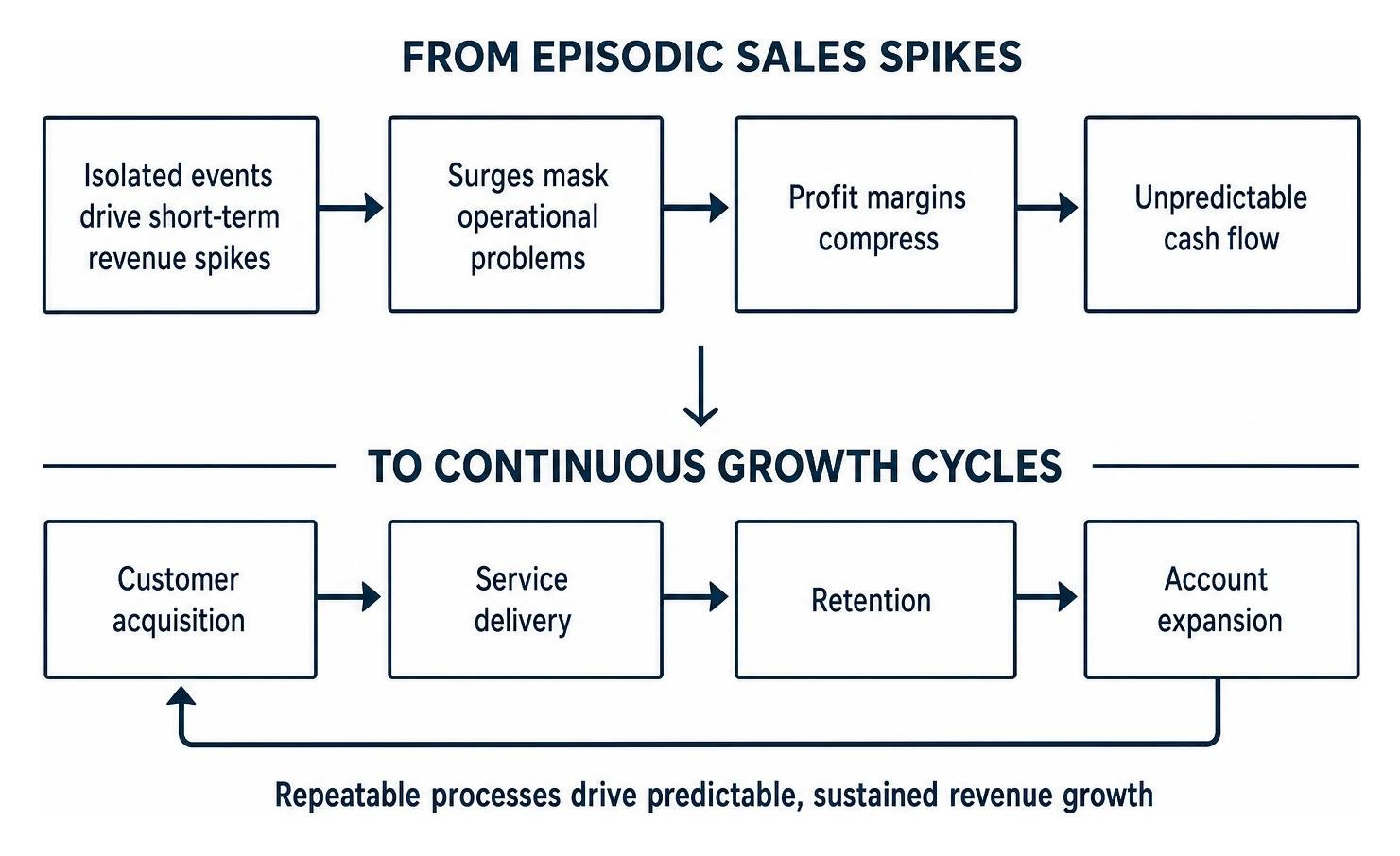
Transitioning to a repeatable growth system requires moving away from reactive sales tactics. A continuous growth engine connects customer acquisition, service delivery, retention, and account expansion into a single workflow. This alignment creates predictable cash flow and protects operational stability during volume increases.
How Do You Build a Repeatable Revenue Growth Management Framework?
Revenue Growth Management (RGM) is a structured approach that coordinates pricing, promotions, product assortment, and demand forecasting. Originally developed in consumer goods industries, RGM now applies directly to business-to-business (B2B) and regional service companies. It helps business owners evaluate which service packages generate the highest margins and which client segments retain longest.
According to McKinsey research on continuous growth outperformance, embedding structured RGM capabilities yields a 4 to 7 percentage point improvement in gross margins. Companies using these frameworks are 2.4 times more likely to sustain financial value over time compared to businesses running ad hoc growth initiatives.
Applying profitable revenue expansion tools helps establish financial predictability. A standard implementation begins with a 3 to 6 month pilot in one service division or market, followed by an organization-wide rollout over 6 to 12 months.
Defining Clear Customer Outcomes
Sustainable revenue starts by defining specific customer outcomes rather than marketing a list of generic features. For example, a hypothetical commercial HVAC contractor in Knoxville might package preventative maintenance around guaranteed system uptime rather than selling disconnected technician visits.
Aligning top-line pricing with clear customer milestones encourages long-term retention. Collecting real-time feedback through field service records or digital check-ins shows where customers experience friction. These insights guide service updates and prevent customer cancellations before they occur.
Aligning Operating Models and Breaking Departmental Silos
Departmental silos create friction that stalls sales and frustrates clients. When marketing, sales, and operations track conflicting goals, communication breaks down and handoffs fail.
Building shared performance goals across all commercial teams resolves these discrepancies. Standardized sales playbooks ensure team members handle lead intake, service agreements, and project kickoffs consistently without relying on founder intervention.
Which Strategies Generate More Revenue from Existing Customers Versus New Acquisition?
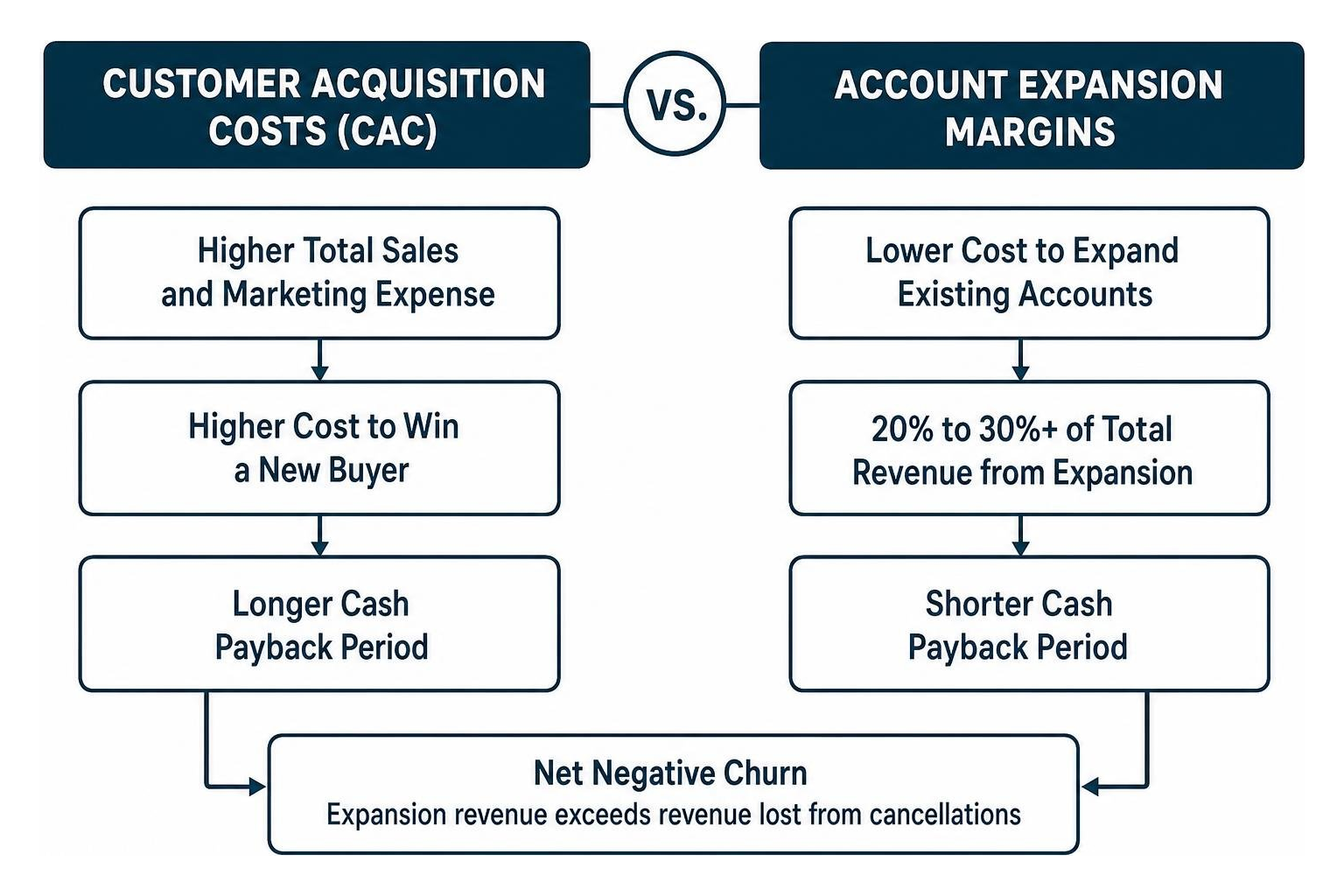
Customer acquisition cost (CAC), which measures the total sales and marketing expense required to win a single new buyer, is consistently higher than the cost of expanding existing accounts. Research on revenue optimization principles from Stripe shows that high-performing recurring businesses generate 20% to 30% or more of their total revenue from account expansion.
Expanding revenue from existing clients shortens the cash payback period and stabilizes monthly cash flow. Businesses achieve Net Negative Churn when the revenue gained from existing client upgrades exceeds the revenue lost from cancellations. Aligning marketing and account management with profit-driven marketing strategies directs resources toward high-margin retention rather than purely top-of-funnel volume.
Maximizing Account Expansion and Net Negative Churn
Structuring clear service tiers allows businesses to offer logical cross-sell and upsell options as a client grows. Field technicians and account managers can use customer relationship management (CRM) tracking to identify when an account needs additional capacity or specialized maintenance.
Customer retention programs must address both voluntary churn (active cancellations) and involuntary churn (payment processing failures). Setting up automated billing retries and scheduled account check-ins reduces account drop-off across all service lines.
Aligning Pricing Architecture with Perceived Customer Value
Pricing directly influences gross profit margins and perceived service quality. According to Harvard Business School research on business growth strategies, sustainable growth occurs when a company widens the gap between a customer's willingness to pay and the actual cost to deliver the service.
Value-based pricing sets service rates based on the measurable business value delivered rather than simple cost-plus hourly markups. Grouping complementary offerings into clear service tiers lets clients select advanced service levels without creating discounting habits that erode margins.
What Digital Tools and Automation Platforms Drive Scalable Expansion?

Technology platforms magnify existing operational workflows. If an underlying intake or fulfillment process is disorganized, adding new software subscriptions accelerates confusion rather than revenue.
Scalable growth requires four primary software categories: CRM platforms, Enterprise Resource Planning (ERP) systems, marketing automation, and automated billing software. Coordinating these platforms using effective online business growth strategies creates clear lead visibility from first contact through final payment.
| Growth Tool Category | Core Operational Function | Implementation Timeline | Required Internal Resources | Expected Revenue Impact |
|---|---|---|---|---|
| CRM Systems | Centralizes client history, sales pipelines, and communication records | 1 to 3 months | Sales leadership, data admin | Improves lead conversion rates and pipeline visibility |
| Marketing Automation | Triggers email nurture sequences, review requests, and appointment texts | 2 to 6 weeks | Marketing team, content lead | Reduces lead response times and recovers abandoned inquiries |
| ERP Systems | Unifies inventory, job costing, field labor, and operational accounting | 6 to 12 months | Operations directors, finance team | Identifies margin leaks and optimizes service delivery costs |
| Automated Billing & RGM | Handles recurring invoicing, subscription payments, and contract audits | 1 to 3 months | Billing coordinator, accounting staff | Shortens billing cycles and eliminates unbilled service work |
Centralizing CRM and Marketing Automation
A centralized CRM creates a single source of customer data across sales, dispatch, and customer support. When client notes and purchase histories stay in one database, team members avoid asking customers to repeat basic information.
Automating routine customer touchpoints reduces internal labor hours. Systems can immediately send confirmation texts, route inbound requests to available staff, and deliver post-service review links. Setting strict Service Level Agreements (SLAs), such as contacting every inbound web lead within 15 minutes, improves conversion rates.
Deploying AI Analytics and Financial Automation
Modern artificial intelligence tools assist small and mid-sized teams by handling routine administrative tasks. AI assistants can draft initial service proposals, categorize incoming customer tickets, and highlight accounts showing renewal risks.
Automated billing platforms reduce month-end reconciliation delays. According to Salesforce research on small business growth, 80% of business buyers view the overall customer experience as equal in importance to product and service quality. Automated invoicing ensures accurate, prompt billing that protects customer trust and reduces accounting overhead.
Which Key Performance Indicators Measure Growth Sustainability and Transferable Value?
Tracking top-line revenue alone does not show whether a business is building long-term financial stability. Rapid revenue increases can hide declining gross margins, high client turnover, and operational inefficiencies.
Sustainable value creation relies on tracking earnings quality and earnings before interest, taxes, depreciation, and amortization (EBITDA). Combining operational performance tracking with results-driven performance and SEO tracking connects marketing expenses directly to verified sales outcomes.
Tracking Unit Economics and Earnings Quality
Unit economics reveal whether servicing an individual customer generates positive cash flow after accounting for marketing, labor, and overhead costs. Monitoring key ratios ensures sales growth remains profitable:
- LTV-to-CAC Ratio: Compares Customer Lifetime Value (LTV) against Customer Acquisition Cost (CAC), with a 3:1 ratio benchmark noted by the U.S. Small Business Administration representing a standard guide for healthy commercial growth.
- Expansion MRR: Tracks the monthly recurring revenue gained specifically from add-ons, upgrades, and cross-sells across existing clients.
- Net Revenue Retention: Measures the percentage of recurring revenue retained from existing customers over a specific period, including expansion and churn.
- Gross Margin by Service Line: Evaluates direct labor and material costs for each offering to identify which services yield the highest return.
Reducing customer concentration protects business valuation. As outlined in financial risk guidelines from the U.S. Small Business Administration, if a single client represents more than 15% of total annual sales, losing that account creates severe cash flow vulnerability during economic downturns.
Developing Scenario Planning and Leadership Bench Depth
Scenario planning prepares organizations for unexpected economic shifts, labor shortages, or material price increases. Establishing clear operational trigger points (such as adjusting inventory purchasing when material costs rise by 10%) prevents reactive decision-making.
Building leadership bench strength requires two-deep coverage for every critical operational seat. When managers document daily workflows into clear standard operating procedures, businesses maintain service quality without relying entirely on single key individuals.
What Are the Most Common Questions About Sustained Revenue Growth?
What is the fastest way to stabilize revenue during a growth plateau?
Review current customer churn rates and survey recent cancellations to identify service delivery gaps. Audit service packages to add high-margin preventative maintenance or support options for existing accounts before increasing acquisition ad spend.
Why do CRM and marketing automation implementations fail to produce revenue growth?
Software implementations fail when businesses purchase tools without first defining their sales pipeline stages and team responsibilities. If staff members enter incomplete data into unorganized systems, automated reports produce inaccurate pipeline metrics.
How can a business assess revenue from existing accounts?
Track monthly account renewals, service add-ons, and contract tier upgrades separately from net-new customer sales. Comparing expansion revenue against total lost revenue from downgrades and cancellations shows whether existing accounts are expanding over time.
How Can You Build a Unified Revenue Strategy for Your Business?
Sustainable growth requires aligning creative messaging, targeted advertising campaigns, and clear data attribution into one coordinated plan. Have a question about marketing your business? Talk with a growth specialist at Rhythm Collective in Knoxville.