

Common Google Ads Mistakes to Check First
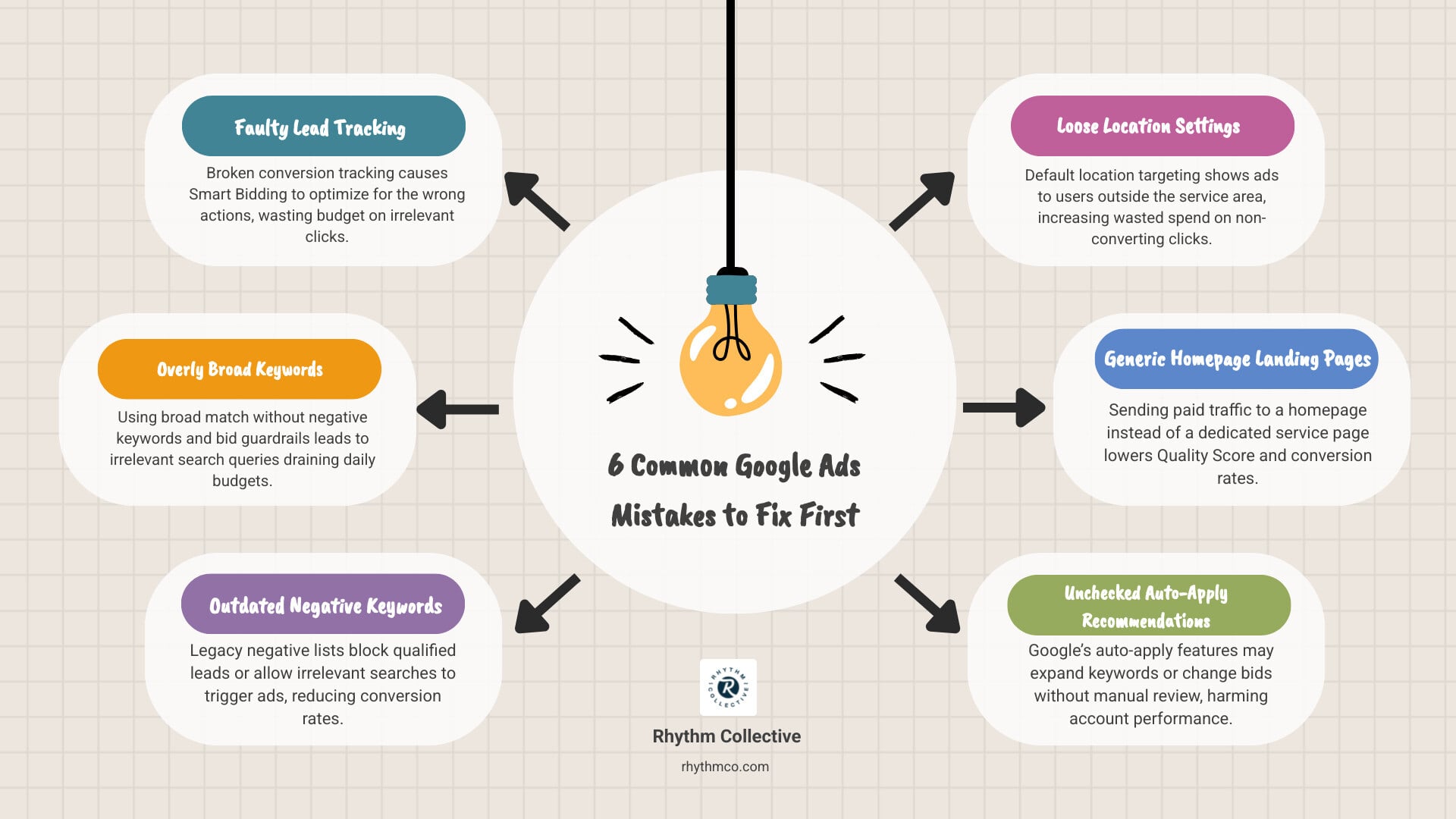
Common Google Ads mistakes involve inaccurate conversion tracking, unrestrained keyword match types, unreviewed negative keywords, broad location parameters, and directing traffic to general homepages. For service businesses in Knoxville, Chattanooga, and the Tri-Cities, reviewing account settings verifies where ads display, how searches match queries, how forms and calls record, and how destination pages align with specific ad copy.
Review the account checklist below.
Prices and platform details current as of Google Ads Help documentation.
What Are the Most Common Google Ads Mistakes in Account Setup?
Google Ads functions on an ad auction system where advertisers pay per click (CPC), determined by maximum bids, ad quality, and competition, as documented by Google Ads Help. Account configuration involves campaign network options, geographic parameters, match types, and conversion tracking definitions.
Account Configuration Checklist
- Location options: The default setting includes people in, or who show interest in, targeted locations. The alternative setting restricts ad delivery to people physically in or regularly in the selected geographic area.
- Keyword match types: Broad match serves ads on searches related to keywords. Phrase and exact match restrict ad triggers to queries containing specific phrases or identical search meanings.
- Network distribution: Campaigns default to Search Network, Google Display Network, and Search Partners. Settings allow isolating the Google Search Network separately.
- Automated recommendations: Accounts include options to auto-apply suggested changes to bidding, keywords, and creative assets without prior manual review.
- Landing page destinations: Campaign links route to root domain homepages or dedicated service pages.
Evaluating structural setup details aligns campaign structure with traffic requirements. Account architectures can be evaluated alongside resources such as the PPC management guide for Knoxville.
How Do Inconsistent Conversion Tracking Setup Errors Affect Bidding?
Conversion tracking records specific user actions, such as phone calls, form completions, or appointment bookings. Automated bidding strategies use recorded conversion data to calculate real-time auction bids.
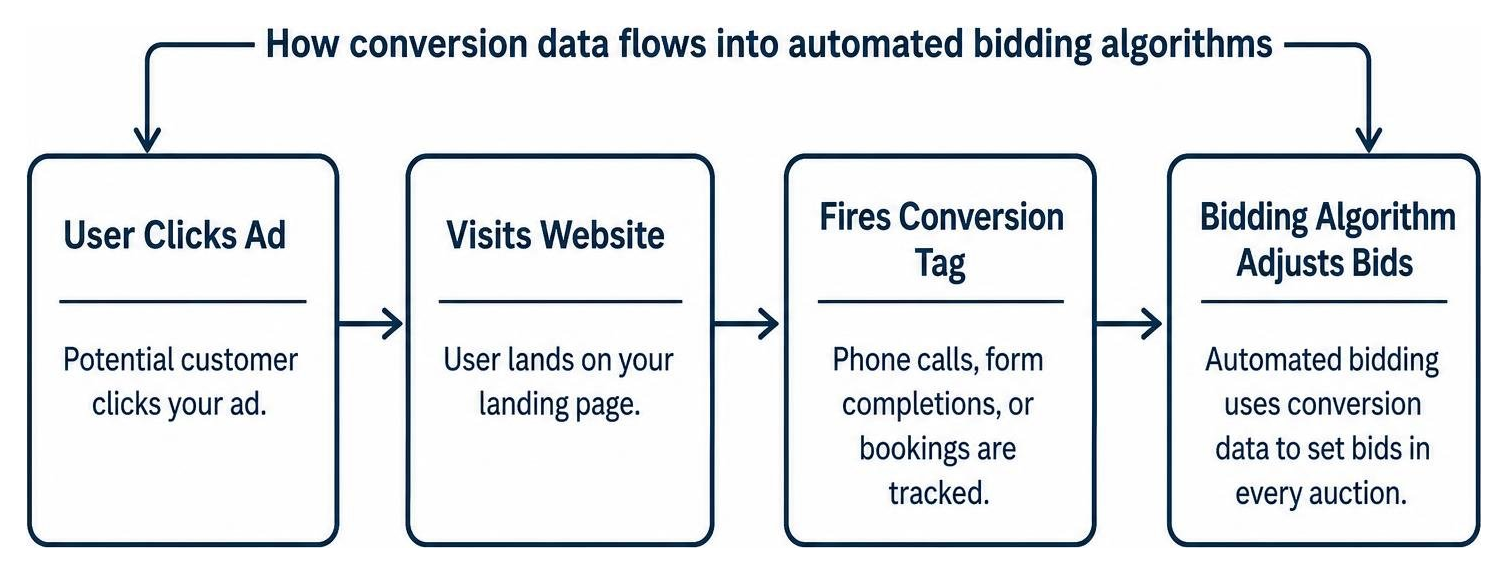
When duplicate conversion actions record simultaneously as primary goals, the platform registers multiple conversions for a single user action. This alters data points used by automated bid strategies. Conversion tracking settings and attribution rules are documented by industry analysis in Top 10 Google Ads mistakes to avoid in 2026.
Why Is Broad Match Without Guardrails Documented Among Google Ads Mistakes?
Broad match is a keyword setting that displays ads on searches related to a keyword, including synonyms, related searches, and topical variations according to Google Ads Help. Running broad match without target bid parameters allows automated systems to match queries across broad semantic themes.
Broad match keywords operate alongside target bidding strategies, such as Target Cost Per Acquisition (Target CPA) or Target Return on Ad Spend (Target ROAS). Maximize Conversions without a target cap allocates daily campaign budgets toward search queries across all available match variations.
How Do Targeting and Keyword Errors Waste Ad Budget?
Targeting settings determine the geographic boundaries and search queries where campaign funds are allocated. Reviewing Knoxville PPC budget guidelines provides context on aligning search traffic volume with monthly advertising budgets.

Targeting and Keyword Checklist
- Location settings audit: Verifying whether campaigns use "Presence or interest" or "Presence: People in or regularly in your targeted locations."
- Negative keyword list audit: Checking shared negative keyword lists for outdated terms that block active service queries.
- Search term report review: Identifying non-commercial or irrelevant search queries triggering ad spend.
How Do Location Settings Affect Ad Delivery Outside East Tennessee?
Google Ads provides geographic targeting options that include users who search for topics related to a location, even if they reside elsewhere. Under the default "Presence or interest" setting, a user outside the target service area who searches for regional keywords can trigger ad impressions.
Selecting "Presence: People in or regularly in your targeted locations" limits ad impressions to individuals physically within designated areas across Knoxville, Chattanooga, or the Tri-Cities.
How Do Negative Keyword Lists Impact Search Traffic?
Negative keywords prevent designated search queries from triggering ads. Advertisers utilize negative keyword lists to filter terms associated with employment searches, educational materials, or do-it-yourself instructions.
Negative keyword lists can also include terms that conflict with active services. Auditing search terms reports identifies negative keyword conflicts, as detailed in 12 Costly Google Ads Mistakes and How to Avoid Them - Swydo.
Why Does Ad and Landing Page Alignment Lower Conversion Rates?
Advertisers pay for each click on search ads, after which the destination page receives the visitor. Page speed, navigation structure, and headline relevance determine whether visitors complete conversion actions. Data regarding conversion rate optimization methods outlines how user flow affects lead capture rates.
Landing Page and Asset Checklist
- Destination URL alignment: Verifying that ad headlines direct users to specific service pages rather than general homepages.
- Ad asset deployment: Confirming the activation of call assets, sitelinks, callout assets, and location assets.
- Message matching: Ensuring page headers, text, and calls to action correspond directly to the specific search query.
How Does Directing Traffic to a Homepage Differ From Dedicated Landing Pages?
A homepage presents general organizational information, navigation menus, brand history, and multi-service directories. A dedicated landing page contains content, service details, and contact options specific to the individual service advertised in the search ad.
Directing ad clicks to a homepage requires visitors to locate relevant service pages manually through website menus. A dedicated landing page displays the advertised service details immediately upon landing.
How Do Ad Assets Function in Search Results?
Ad assets append supplementary details to search ads, including direct phone numbers, specific page links, business locations, and callout phrases.
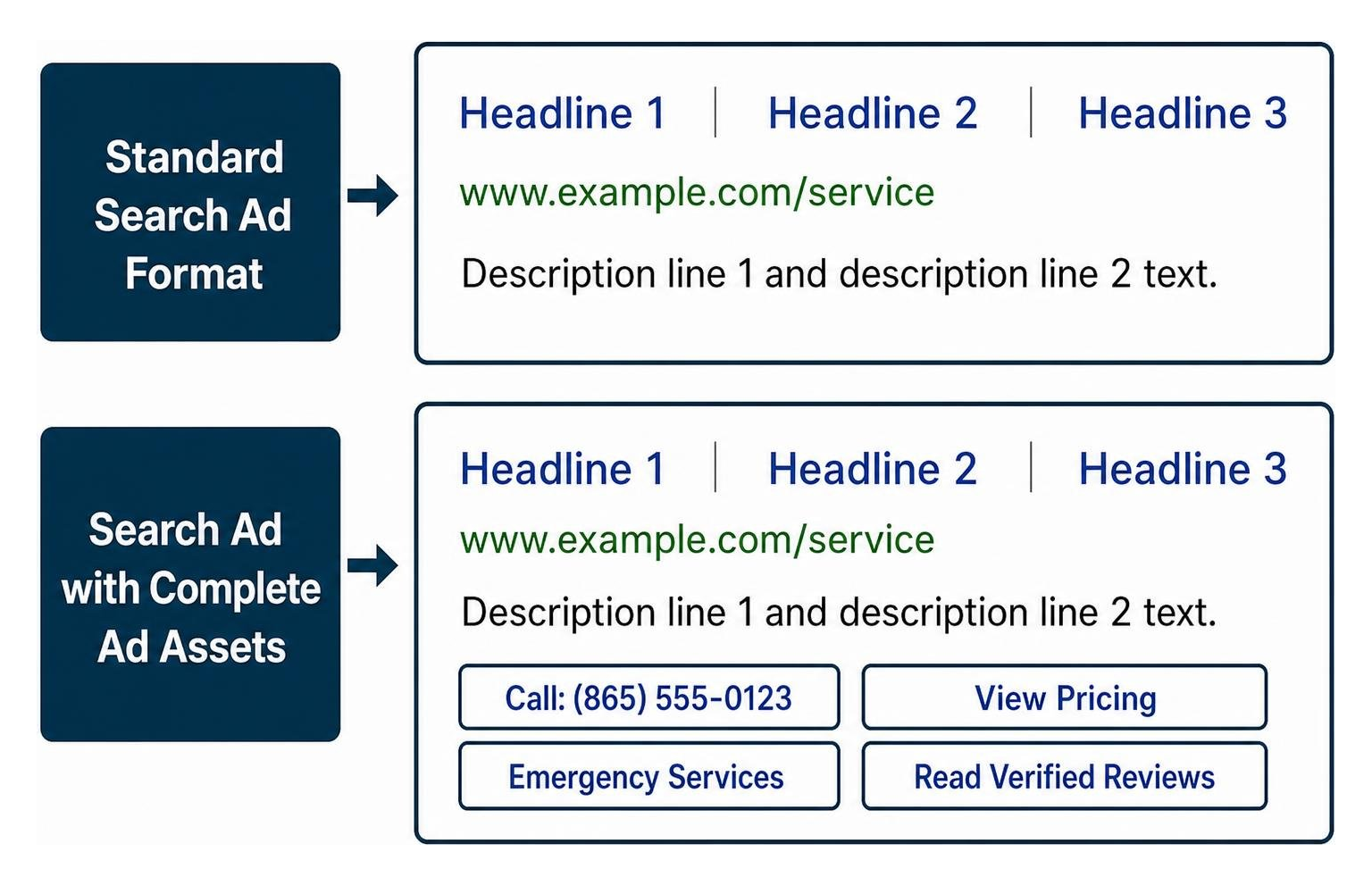
Ad assets increase ad size on search results pages without additional fees per impression, according to Google Ads Help. Available assets include clickable phone numbers for mobile users, site navigation links, and service highlights.
How Can You Audit Your Account for Google Ads Automation Errors?
Google Ads incorporates machine learning algorithms for real-time bid calculations, creative asset combinations, and search query matching. Evaluating account automation involves reviewing bidding constraints, auto-apply settings, and asset metrics. Exploring options with PPC management services in Knoxville provides a framework for reviewing account automation features.
Automation Checklist
- Auto-apply settings: Checking the auto-apply history log to review automated updates to keywords, match types, and bidding models.
- Smart bidding parameters: Confirming whether Target CPA, Target ROAS, or budget caps are configured on automated strategies.
- Ad Strength evaluation: Assessing asset quantity metrics alongside actual conversion metrics and cost per lead.
How Do Auto-Apply Settings Operate?
Google Ads features an automated recommendation section with settings that can apply suggested platform changes automatically. According to Google Ads Help, enabled auto-apply features implement suggestions across keyword expansion, bidding strategy adjustments, and ad asset generation without requiring manual confirmation.
The "Auto-apply" history tab provides a log of automated platform adjustments applied across campaign structures.
How Is Ad Strength Defined in Google Ads?
Ad Strength is an asset metric in Google Ads that rates Responsive Search Ads from "Poor" to "Excellent" based on the quantity and diversity of headlines and descriptions provided.
According to Google Ads Help, Ad Strength measures the completeness of creative assets and does not factor into Google Ads Quality Score calculations or auction ad rank determinations.
Frequently Asked Questions About Google Ads Setup Errors
Does Ad Strength affect Quality Score?
No, Ad Strength does not influence Quality Score or auction ad rank. According to Google Ads Help, Quality Score evaluates expected click-through rate, ad relevance, and landing page experience, while Ad Strength measures asset variety within Responsive Search Ads.
How are conversion tracking audits scheduled?
Advertisers conduct conversion tracking audits periodically, as well as after website redesigns, script changes, or CRM updates. Audits verify that conversion tags record actions accurately and that lead forms and call tracking numbers route data into analytics tools.
Why do Google Ads show to searchers outside target service areas?
Ads appear outside targeted areas when campaigns operate with the default "Presence or interest" location setting. Selecting "Presence: People in or regularly in your targeted locations" limits impressions to users physically located within the specified geographic area.
Get an Objective Review of Your Paid Search Setup
Already running Google Ads? Rhythm Collective offers a free Google Ads audit for East Tennessee businesses. Thinking about Google Ads? Request a free keyword estimate to see local search demand and click costs for your services.