
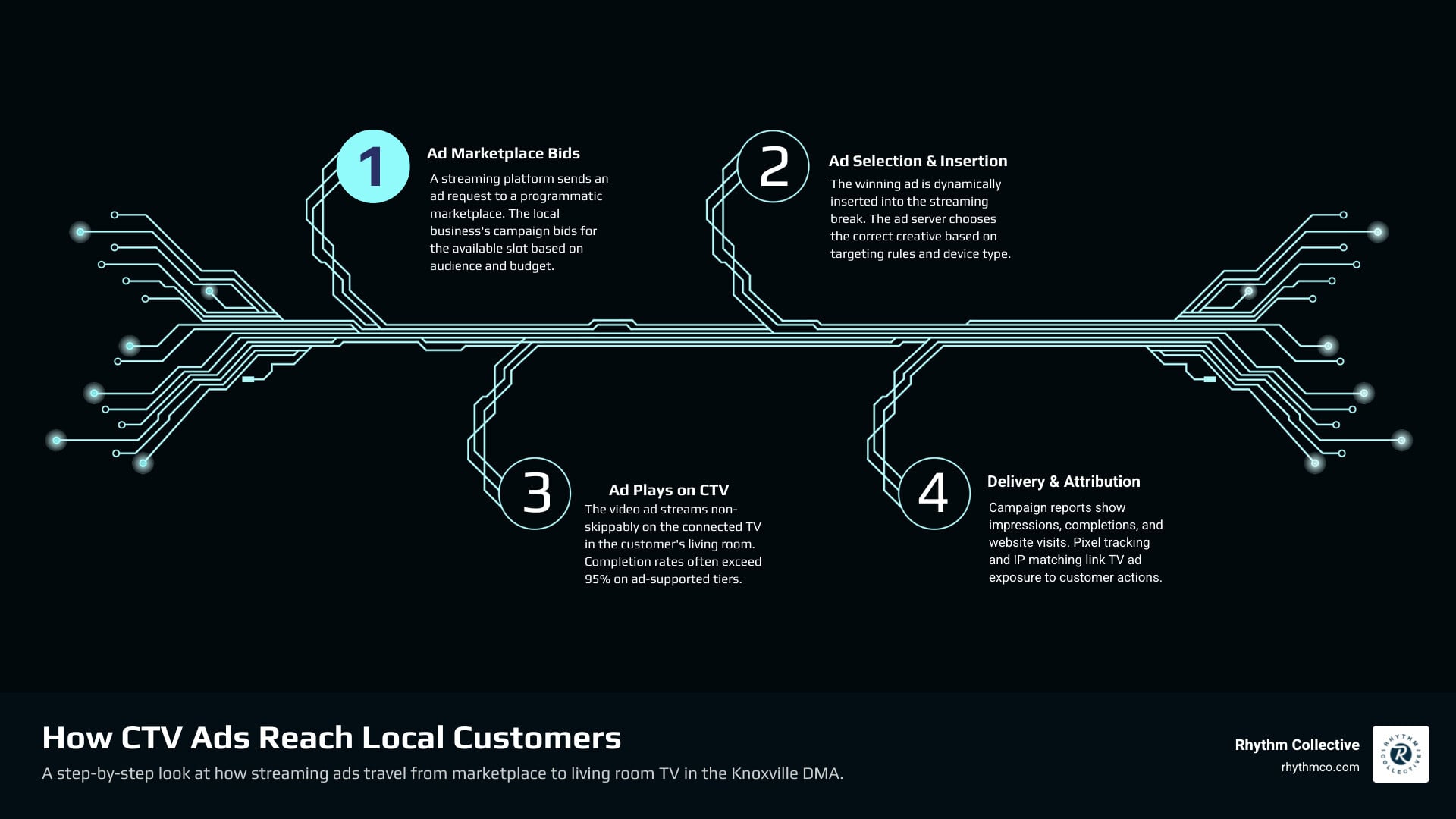
How CTV Advertising Reaches Local Customers
CTV advertising places video ads in streaming shows watched on internet-connected TVs. A Knoxville service business can choose where its ads run, define an audience, and buy ad space through a streaming platform or automated marketplace. The ads appear during streaming breaks, while campaign reports show ad delivery and track possible customer actions.
The buying, targeting, and tracking steps fit together as follows.
Prices and platform details current as of November 2026.
What Is CTV Advertising and How Does It Differ from Traditional TV?
Connected TV (CTV) advertising delivers digital video commercials to internet-connected television sets. Traditional linear television broadcasts signals over the air, through coaxial cable, or via satellite to broad Designated Market Areas (DMAs), such as the Knoxville DMA. In contrast, CTV relies on digital ad marketplaces to serve commercials to individual households streaming content.
According to research from eMarketer, cord-cutter households are projected to make up 72% of U.S. homes, up from 53% in 2022. Traditional linear TV ad spending will decline to $64.94 billion, while combined linear and CTV advertising will surpass $100 billion. The overview from Amazon Ads explains how streaming environments combine digital audience targeting with full-screen living room viewing.
| Feature | Linear Broadcast TV | Over-The-Top (OTT) Video | Connected TV (CTV) |
|---|---|---|---|
| Primary Device | Traditional TV sets | Mobile, desktop, tablets, TVs | Television screens only |
| Delivery Method | Cable, satellite, broadcast | Public internet streams | Public internet streams |
| Targeting Level | Broad DMA ratings panels | Device, IP, digital profiles | Household IP, addressable data |
| Buying Method | Upfronts, manual scatter | Programmatic, self-serve | Programmatic, private auctions |
| Typical Ad Format | 15s / 30s commercial breaks | In-stream, out-stream, banner | Full-screen, non-skippable video |
Distinguishing CTV Devices from OTT Content Delivery
Over-The-Top (OTT) describes the delivery mechanism for video content streamed across the internet without a traditional cable subscription. Connected TV refers strictly to the physical device displaying that stream.
All CTV viewing falls under the umbrella of OTT delivery, but OTT content also plays on mobile phones and laptops. CTV devices include smart TVs, gaming consoles, and streaming media players such as Roku or Amazon Fire TV. For local advertisers, CTV focuses digital ad delivery entirely on living room screens.
Core Mechanics of CTV Advertising and Programmatic Delivery
Programmatic ad delivery uses automated real-time bidding to place commercials inside streaming breaks. When a viewer watches ad-supported streaming content, the platform issues an automated bid request to an ad server.
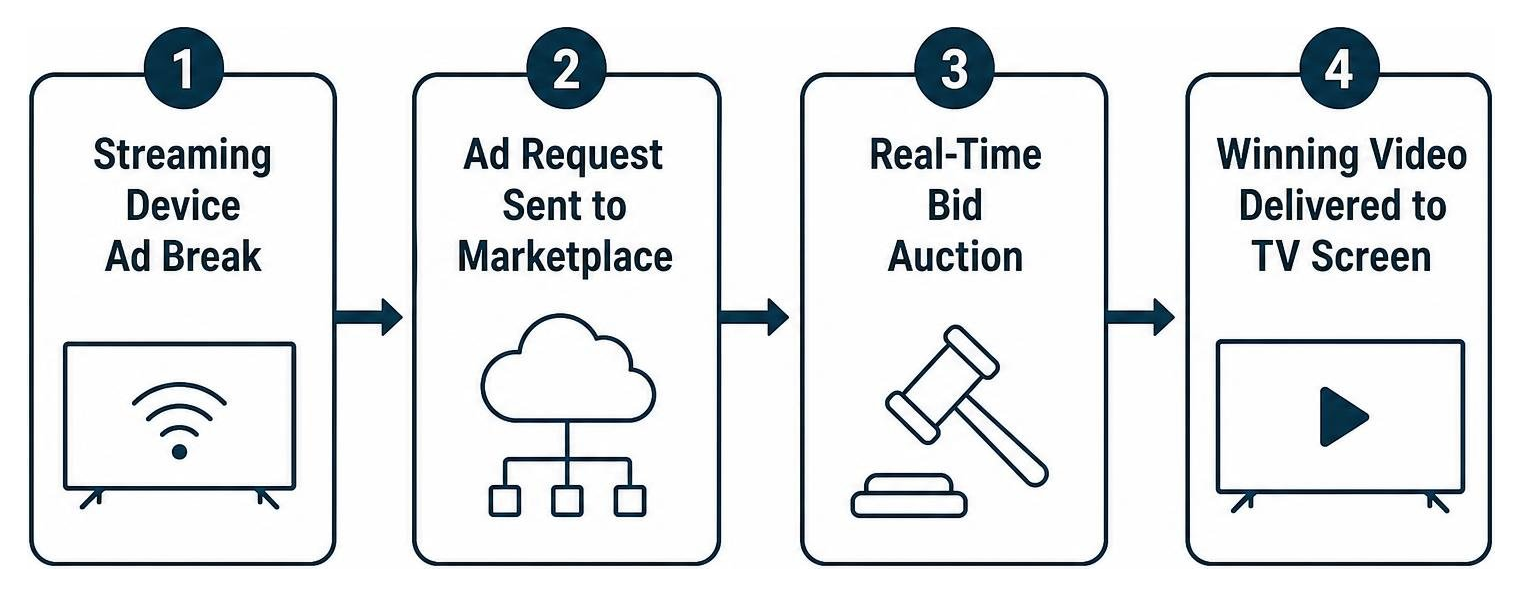
Through dynamic ad insertion (DAI), two households in Knoxville watching the same streaming show can receive different commercials based on household traits. Exploring options for streaming TV allows businesses to manage frequency and buy inventory programmatically.
How Do Local Service Businesses Target Audiences on Streaming Platforms?
Local service businesses can establish geographic boundaries on streaming platforms using IP addresses and physical location clusters. Instead of purchasing an entire regional DMA, an advertiser can focus ad delivery on specific communities.
Targeting and Attribution Capabilities in CTV Advertising
Modern CTV platforms match viewer IP addresses with first-party customer relationship management (CRM) records and third-party demographic databases. Advertisers can segment viewers by household income, homeownership status, or property type. Coordinating campaigns through media buying management helps businesses connect streaming impressions to web visits and customer inquiries.
Hyper-Local Radius and Zip-Code Level Parameters
Streaming platforms allow advertisers to set zip-code boundaries and radius buffers around specific service hubs. A hypothetical plumbing company in Maryville can target zip codes across Blount County while excluding adjacent rural zones. Similarly, service contractors in Oak Ridge, Lenoir City, or Sevierville can isolate specific residential neighborhoods across Knox County and Anderson County.
What Ad Formats and Creative Specifications Exist for Streaming Ads?
CTV ad inventory consists primarily of standard in-stream video, interactive formats, and pause placements. Most streaming platforms require standard high-definition video files with 16:9 aspect ratios and normalized stereo audio.
Standard In-Stream and Non-Skippable Video Specs
Standard CTV spots run for 15 or 30 seconds within pre-roll and mid-roll breaks. Because these placements are unskippable, video completion rates (VCR) often exceed 95%, with Paramount+ reporting an average completion rate of 96% as cited by eMarketer. Professional video production ensures commercial assets meet platform audio normalization and bitrate requirements.
Interactive Elements and Emerging Formats
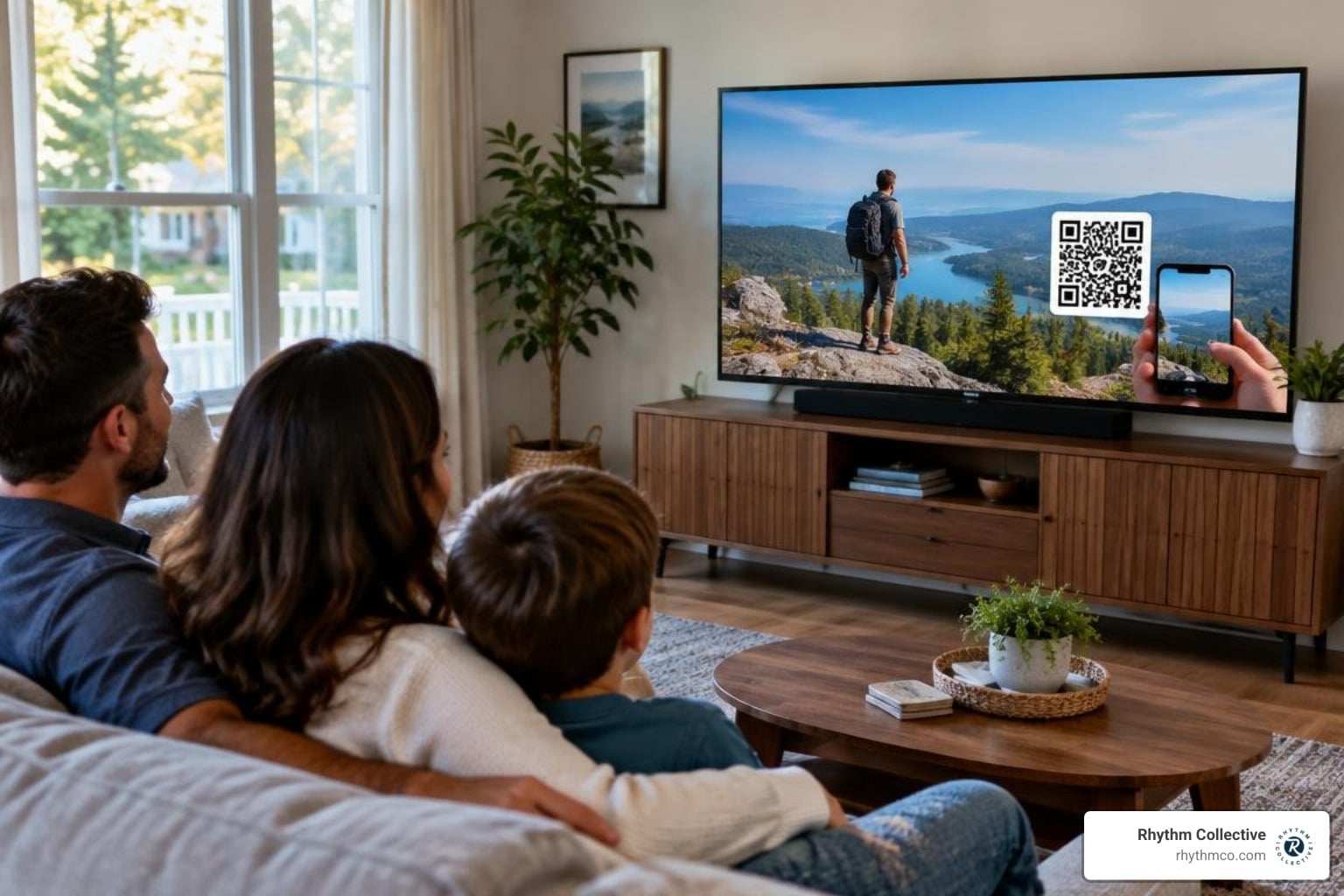
Interactive formats include on-screen QR codes, pause screens, and branded screensavers. Research cited by eMarketer indicates that interactive CTV ads achieve an engagement rate of 1.94%, alongside a 36% lift in unaided recall and a 13% increase in foot traffic. Pause ads display static or animated brand messaging when a viewer halts playback, delivering a 34% lift in brand recall.
What Does Streaming TV Advertising Cost and How Is Performance Measured?
CTV advertising is priced on a cost per thousand impressions (CPM) model. Advertisers pay a set rate for every 1,000 video ad impressions delivered to viewer screens.
| Metric / Model | Definition | Application |
|---|---|---|
| Cost Per Thousand (CPM) | Cost to deliver 1,000 ad impressions | Standard pricing for programmatic inventory |
| Video Completion Rate (VCR) | Percentage of ads watched from start to finish | Evaluates viewer retention and message delivery |
| Cost Per Completed View (CPCV) | Ad spend divided by fully completed video views | Measures efficiency of unskippable creative |
| Digital Pixel Attribution | Tracking website visits from exposed IP addresses | Measures direct response actions and form leads |
| Footfall Attribution | Matching exposed household IPs to physical mobile visits | Evaluates retail and physical showroom traffic |
CPM Pricing Benchmarks and Budget Allocation
Pricing on programmatic platforms varies based on audience targeting, season, and inventory tier. Typical CTV CPMs range widely across self-serve and premium publishers. Evaluating options through comprehensive advertising programs allows businesses to align ad spend with revenue expectations. Setting daily pacing limits ensures steady exposure across the billing cycle, as outlined in your Knoxville media buying playbook.
Attribution Methods from Pixel Tracking to Footfall Verification
Attribution tools connect CTV ad views to subsequent customer actions without relying on third-party web cookies. When an ad airs, the platform logs the household IP address.
When a viewer in that household subsequently visits the company website from a laptop or phone, a tracking pixel matches the IP address. For brick-and-mortar storefronts, footfall attribution matches mobile location data to exposed household networks.
How Does Streaming Video Integrate into a Broader Local Marketing Plan?
CTV serves as an upper- and mid-funnel awareness medium that reinforces lower-funnel direct-response channels. Combining television reach with targeted digital channels maintains brand presence across multiple devices.
Connecting Living Room Video to Paid Search and Social Campaigns
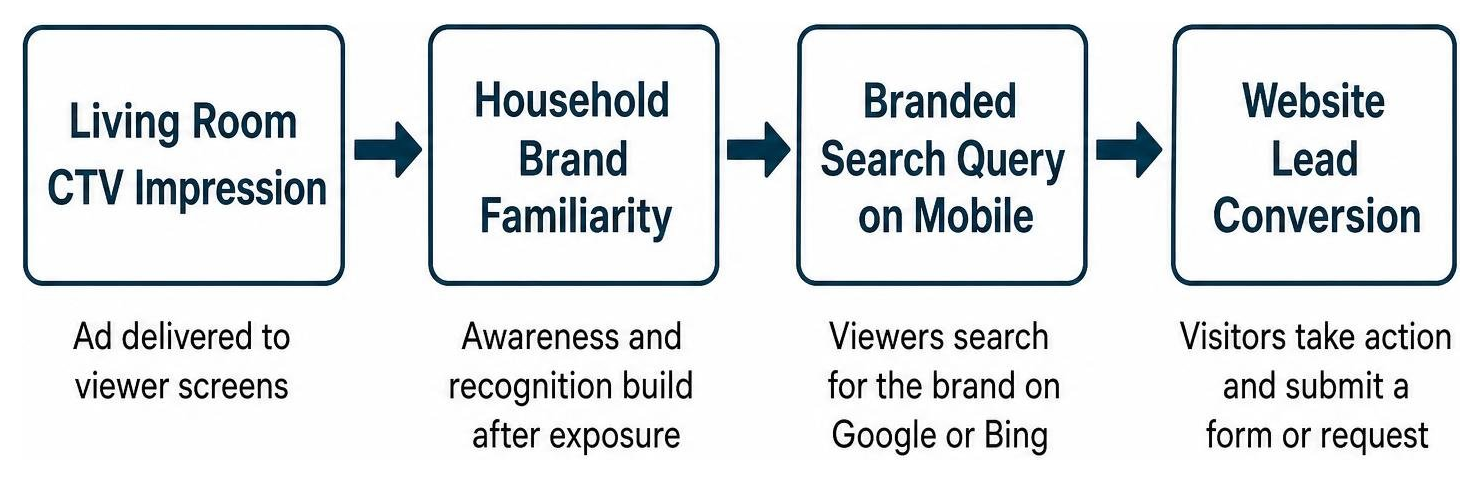
When households view a local CTV commercial, brand search volume typically rises on Google and Bing. Coordinating streaming TV with a specialized PPC agency in Knoxville captures consumers searching for services after seeing a television spot. Sequential retargeting can also serve display banners or social ads to devices linked to the same household network.
Measuring Marketing Mix and Full-Funnel Touchpoints
Multi-touch attribution models evaluate how CTV impressions contribute to overall pipeline velocity. While paid search captures active demand, streaming video introduces services to consumers before a repair need arises. Aligning channels through structured planning, such as crafting a digital advertising plan, ensures each stage of the funnel receives appropriate attribution.
Frequently Asked Questions About Streaming TV Ads
What is the difference between OTT and CTV?
OTT describes the method of streaming video content over the internet rather than through legacy cable or satellite wires. CTV refers specifically to the internet-connected television screen or connected streaming stick used to display that content in a living room.
How much budget is needed to test streaming TV ads locally?
Testing parameters vary by platform, with self-serve marketplaces accommodating flexible daily spend limits. Maintaining a consistent test schedule across multiple weeks allows tracking pixels to gather reliable attribution data.
Can streaming ads track physical visits to a local business?
Yes, footfall attribution partners match the IP addresses of households exposed to a CTV ad with anonymized mobile device location signals. This process measures whether an exposed household physically visited a local commercial storefront or showroom.
How do non-skippable streaming ads achieve high completion rates?
Ad-supported streaming platforms deliver commercials during predefined mid-roll breaks without skip buttons. Because viewers are engaged in full-screen viewing, video completion rates regularly remain strong across major publishers.
Plan Your Local Streaming Campaign
Have a question about marketing your business? Talk with a growth specialist at Rhythm Collective in Knoxville.